
All property owners in California—whether commercial stores, apartment complexes, or private residents—are bound by Civil Code § 1714, which mandates a “Duty of Care” to maintain a safe environment. To win a premises liability claim, we must prove the owner had “Notice” of the hazard (a wet floor, a broken gate, or inadequate lighting) and failed to act. We use subpoenaed maintenance logs and surveillance footage to establish this timeline and lock in their liability before the evidence is erased.

Slip and Fall Injury Lawyer: what matters immediately in San Diego under California Law
Under the legal framework of California Law (specifically Civ. Code § 1714), the most important rule is simple: treat a slip-and-fall like an evidence case, not just a pain story. Premises claims are won on proof of the hazard’s duration—a standard we enforce using the Morse Injury Law advantage. If the property owner denies responsibility, we are prepared to prove their negligence in specific San Diego legal venues. To ensure you capture that proof before it’s mopped up, review our client resources guide immediately.
How a real San Diego slip-and-fall becomes a case worth filing
I’ve reviewed enough “clean” incident reports to know how they’re written: the goal is to make your fall look spontaneous and unavoidable. In practice, most serious falls come from predictable conditions—wet floors, poor lighting, uneven transitions, loose mats, neglected stair nosings—where the defense tries to hide the timeline.
In one anonymized San Diego matter, a client fell at a commercial entrance where condensation created a recurring slick zone. We built the file like it was going to San Diego Superior Court from day one, because once litigation is real, the defense has to pick a story and live with it. California Law governs duty and damages, but procedure and documentation decide whether a jury ever hears your facts.
- Problem: the property side claims “no notice” and blames footwear or distraction.
- Escalation: video retention windows and cleaning logs become the battleground.
- Legal strategy: prove the condition, notice, and causation with objective records and consistent medical timelines.
- Resolution: once duty and notice are supported, settlement value becomes risk-based instead of “take it or leave it.”

The insurer-side playbook is to reduce your case to a “trip and fall” with no root cause. That’s why I lock the basics early: where exactly it happened, what the condition was, what the lighting looked like, what the floor surface was, and what the store or property manager knew.
Slip-and-fall cases are not about drama. They’re about the timeline: how long the hazard existed and whether reasonable inspection and maintenance would have caught it.
Why California Law and San Diego Superior Court venue change the leverage
In San Diego Superior Court, you don’t “negotiate” a premises case into existence. You prove it. That proof is anchored in California Law—duty under Civ. Code section 1714, damages under Civ. Code section 3333, and filing deadlines under C.C.P. section 335.1.
- Claims handling: without documentation, the carrier values your case like a soft complaint.
- Leverage: once discovery is on the table, the defense has to explain inspections, cleaning, and prior incidents.
- Litigation outcomes: the stronger your notice proof and medical causation, the less room there is for “comparative fault” games.
The “Immediate 5” questions real San Diego slip-and-fall victims ask
What do I need to prove in a San Diego slip-and-fall under California Law?
You generally need to prove a dangerous condition, that the property owner owed a duty of care, and that the breach caused your injuries. Civ. Code section 1714 is the backbone, and the defense will attack notice, comparative fault, and medical causation unless the evidence is locked early.
How long do stores and properties keep surveillance video in San Diego cases?
There is no universal retention rule that protects you, and many systems overwrite quickly. The practical rule is to request preservation immediately, because once the video is gone, you are left proving the condition through photos, witness statements, logs, and medical timeline consistency.
What if I slipped on a public sidewalk or at a city facility in San Diego?
Then you may be in public-entity territory, and the deadline posture can change fast. California Government Code section 911.2 governs the claim presentation timeline, and California Government Code section 945.4 can bar a lawsuit if the claim process isn’t completed before filing.
How does the defense argue “it’s your fault” in a slip-and-fall?
They usually push distraction, footwear, lighting you “should have seen,” and that the condition was open and obvious. That argument gets weaker when you can show the hazard was recurring, poorly marked, inadequately inspected, or created by the property’s own operations.
How are damages valued in a San Diego slip-and-fall injury claim?
Damages are still measured under Civ. Code section 3333, which means the value follows objective proof: imaging, treatment, work impact, and functional limitations. The defense will try to label falls as “minor,” and your medical record either supports a serious injury mechanism or it doesn’t.
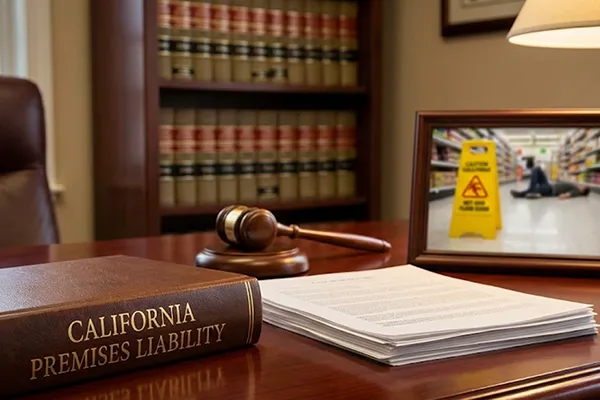
Premises cases become expensive for the defense when the facts are pinned to documents: cleaning logs, inspection routines, incident history, and a medical progression that matches the mechanism of the fall. That’s when “deny and blame” turns into evaluation.
How magnitude is evaluated in San Diego slip-and-fall cases
Evidence Evaluation in San Diego Cases
- Incident reports vs medical records: reports are often defense-shaped; medical records establish causation, timing, and objective findings.
- Scene photos vs maintenance documentation: photos show the hazard; inspection/cleaning logs show notice and whether reasonable care was used.
- Treatment timeline consistency: delays create causation attacks; consistent care tightens damages and credibility.
- Tie to real San Diego claims handling: carriers downplay falls unless you prove the condition and the timeline.
Settlement vs Litigation Reality
Before filing, the defense can play “lack of proof” and force you to negotiate in the dark. Once the case is filed in San Diego Superior Court, discovery forces the property side to account for inspections, cleaning, prior incidents, and who was responsible for the area.
- Discovery obligations: logs, policies, vendor contracts, and incident histories become relevant.
- Leverage: the more objective your notice proof, the less a carrier can hide behind speculation.
- Risk: inconsistent medical treatment invites “preexisting” and “unrelated” defenses.
San Diego-Specific Claim Wrinkles
- Coastal moisture and polished surfaces: fog, humidity, and tracked-in moisture amplify slip hazards in La Jolla, Mission Beach, and high-traffic coastal corridors, especially on smooth tile and sealed concrete.
- Short-term rentals and shared common areas: lobby and stairwell falls can involve owners, HOAs, management companies, and maintenance vendors, which complicates who had inspection responsibility.
- Common Southern California defense patterns: “no notice,” “open and obvious,” and “you were distracted” are standard until you prove condition, notice, and causation with hard evidence.
Lived Experiences
Mary
The store acted like it was my fault before I even left the building. Once my attorney pushed for the logs and preserved what evidence we could, the tone changed from blame to negotiation based on facts.
Nathan
I didn’t realize how fast video disappears. My attorney treated the case like it was headed to San Diego Superior Court and focused on documentation, not arguments, which made the claim feel real instead of dismissible.
California Statutory Framework & Legal Authority
These are the exact statutes cited on this page, linked to the official LegInfo source, with a plain-English explanation of what each governs and why it matters in a San Diego personal injury claim.
|
Attorney Advertising, Legal Disclosure & Authorship
ATTORNEY ADVERTISING.
This content is provided for general informational and educational purposes only and does not constitute legal advice.
Under the California Rules of Professional Conduct and applicable State Bar of California advertising regulations,
this material may be considered attorney advertising.
Viewing or reading this content does not create an attorney-client relationship.
Laws and procedures governing personal injury claims vary by jurisdiction and may change over time.
You should consult a qualified California personal injury attorney regarding your specific situation before taking any legal action.
Responsible Attorney:
Richard Morse, California Attorney (Bar No. 289241).
Morse Injury Law is a practice name and location used by Richard Peter Morse III, a California-licensed attorney.
About the Author & Legal Review Process
This article was prepared by the legal editorial team supporting Richard Peter Morse III,
with the goal of explaining California personal injury law and claims procedures in clear, accurate, and practical terms for injured individuals in San Diego and surrounding communities.
Legal Review:
This content was reviewed and approved by Richard Morse, a California-licensed attorney (Bar No. 289241),
who concentrates his practice on personal injury litigation and insurance claim disputes.
With more than 13 years of experience representing injury victims throughout California,
Mr. Morse focuses on serious personal injury matters including motor vehicle collisions, uninsured and underinsured motorist claims,
premises liability, catastrophic injury, and wrongful death.
His practice emphasizes claims evaluation, insurance carrier accountability, and litigation in California courts when fair resolution cannot be achieved.
|