
In a San Diego T-bone case, I treat the first 7–10 days like a preservation window: identify the controlling rules (red signal under Veh. Code § 21453, left-turn yield under Veh. Code § 21801, unsafe movement under Veh. Code § 22107), then prove sequence with the three items insurers can’t “interpret away”: impact geometry, independent witness identity, and a consistent medical timeline that ties symptoms to the collision.

T-bone & intersection crashes in San Diego: what do you have to do first under California Law to protect the claim?
Securing the integrity of an intersection claim requires aggressive, early-stage investigation to lock down proof before the narrative shifts into a subjective timing argument. Under the specific Legal Framework governing California personal injury, these cases are often valued and settled based on the strength of objective data.
Success depends on your ability to substantiate signal phase sequences, precise approach paths, and the exact point of impact through forensic evidence. At Venues across the state, the window to collect this information is narrow; once the defense story hardens and witnesses disappear, the opportunity for a maximum recovery diminishes. Utilizing the right Resources ensures that critical evidence is preserved immediately. This proactive approach defines Our Edge, turning technical data into an undeniable foundation for your claim.
What I see in real San Diego intersection cases, and how the defense tries to price them
The first week after a side-impact collision is when the case gets silently assigned a number. I know the insurer playbook because I have been trained by people who used to defend these claims: they want uncertainty, and they want it early. So they lean into “late yellow,” “unavoidable,” and comparative fault narratives, then use that uncertainty to justify a discount.
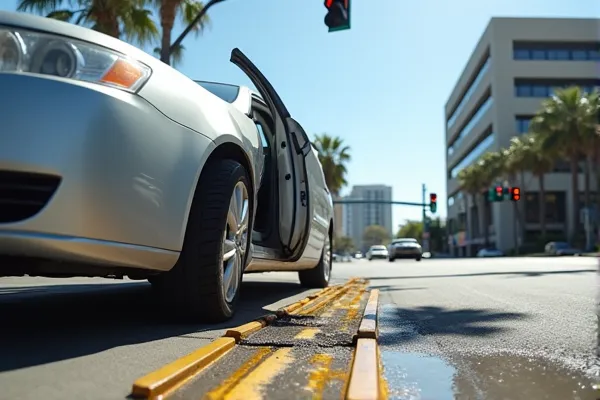
A realistic San Diego scenario: a driver turns left across traffic near Mission Valley, a straight-through vehicle enters on a changing light, and the T-bone happens in the middle of the box. Within days, the insurer argues shared blame, attacks speed, and tries to frame the impact as “angle contact,” not a true broadside, because broadside injuries tend to be more serious. If the facts support it, we build the file like it is going to San Diego Superior Court, because intersection cases only settle at fair value when the defense believes their story will be tested against objective proof and consistent medical records.
- Liability anchor: right-of-way and signal compliance under Veh. Code § 21453 and Veh. Code § 21801.
- Conduct anchor: unsafe movement and speed-for-conditions under Veh. Code § 22107 and Veh. Code § 22350.
- Negligence backbone: responsibility under Civ. Code § 1714.
Why California Law and San Diego Superior Court venue change leverage in intersection collisions
Intersection crashes are defended as timing disputes, and timing disputes are priced on proof. Under California Law, negligence is still anchored to Civ. Code § 1714, but right-of-way rules define what “reasonable care” looks like in a controlled intersection.
Venue matters because it forces the defense to commit, preserve, and explain. When we file in San Diego Superior Court venues, the case stops being an adjuster narrative and starts being a record-based dispute grounded in a provable sequence. The filing deadline is procedure, not negotiation, under CCP § 335.1.
The “Immediate 5”: questions San Diego victims ask after a T-bone or intersection crash
1) If the other driver ran a red light in San Diego, what rule actually governs fault?
The core rule is signal compliance under Veh. Code § 21453. If you cannot prove timing with physical evidence, insurers will try to convert a red-light violation into “late yellow” uncertainty.
2) In a San Diego left-turn T-bone, how does California Law treat the turning driver?
A driver turning left has a duty to yield to oncoming traffic close enough to be a hazard under Veh. Code § 21801. The legal starting point is that the turning movement carries the yield obligation.
3) What if the crash happened at a stop sign or uncontrolled intersection in San Diego?
Stop-controlled right-of-way is governed by Veh. Code § 21802, and uncontrolled intersections by Veh. Code § 21800.
4) If the insurer claims I changed lanes or moved unsafely right before the impact, what statute do they use?
Unsafe turning or lane movement is commonly framed under Veh. Code § 22107.
5) How long do I have to file an intersection crash case in San Diego, and why does waiting hurt these cases?
In many California personal injury cases, the limitations period is set by CCP § 335.1. Waiting is dangerous because intersection cases depend on perishable proof.
Magnitude expansion: what actually moves a San Diego intersection case
A) Evidence Evaluation in San Diego Cases
Police reports help identify parties, but intersection cases rise or fall on objective proof. I compare the report against scene photos, vehicle damage, medical records, and a clean timeline.
- Police reports vs medical records: records prove injury progression and consistency.
- Scene photos vs repair documentation: repairs show impact energy and direction.
- Treatment timeline consistency: gaps get exploited as “unrelated” arguments.
Kimberly
“They kept repeating that the light was yellow… Once the impact point and timeline were laid out clearly, the story changed.”
California Statutory Framework & Legal Authority
|
Attorney Advertising, Legal Disclosure & Authorship
ATTORNEY ADVERTISING.
This content is provided for general informational and educational purposes only and does not constitute legal advice.
Under the California Rules of Professional Conduct and applicable State Bar of California advertising regulations,
this material may be considered attorney advertising.
Viewing or reading this content does not create an attorney-client relationship.
Laws and procedures governing personal injury claims vary by jurisdiction and may change over time.
You should consult a qualified California personal injury attorney regarding your specific situation before taking any legal action.
Responsible Attorney:
Richard Morse, California Attorney (Bar No. 289241).
Morse Injury Law is a practice name and location used by Richard Peter Morse III, a California-licensed attorney.
About the Author & Legal Review Process
This article was prepared by the legal editorial team supporting Richard Peter Morse III,
with the goal of explaining California personal injury law and claims procedures in clear, accurate, and practical terms for injured individuals in San Diego and surrounding communities.
Legal Review:
This content was reviewed and approved by Richard Morse, a California-licensed attorney (Bar No. 289241),
who concentrates his practice on personal injury litigation and insurance claim disputes.
With more than 13 years of experience representing injury victims throughout California,
Mr. Morse focuses on serious personal injury matters including motor vehicle collisions, uninsured and underinsured motorist claims,
premises liability, catastrophic injury, and wrongful death.
His practice emphasizes claims evaluation, insurance carrier accountability, and litigation in California courts when fair resolution cannot be achieved.
|