
Left-turn collisions are governed by California Vehicle Code § 21801, which mandates that drivers yield to any vehicle close enough to constitute an “Immediate Hazard.” The standard insurance defense is to claim the rider was speeding or “invisible.” We defeat this by using Event Data Recorders (EDR) and sightline reconstruction to prove the driver looked but failed to see you.

Motorcycle Left-turn accidents Lawyer: what you must do first under California Law
Under California Law, the single most important rule is this: secure independent proof of who had the right-of-way before the insurer turns your case into “rider fault.” Get the report number, intersection photos, vehicle positions, and medical documentation immediately—left-turn cases are won on geometry and timing.
What left-turn motorcycle cases really look like in San Diego
The most dangerous lie in a left-turn motorcycle crash is “I didn’t see you.” It’s not a defense under the legal framework of California Vehicle Code 21801-it’s the mechanism of the crash. But insurers treat it like a permission slip to blame the rider: attacking speed, lane position, visibility, or claiming “they came out of nowhere.” We dismantle this bias using the Morse Injury Law advantage, proving that the driver simply failed to look.
California Law governs the right-of-way duties, but the fight is about proof and how it will look in San Diego Superior Court. In these cases, I build the file like we’re going to trial, because that’s what forces honest valuation when the defense starts angling for comparative fault.
- Problem: the driver admits the turn but claims you were “going too fast.”
- Escalation: the carrier leans on a vague report and tries to cap the claim before specialists and PT are even finished.
- Legal strategy: reconstruct the turn with physical evidence, witness statements, and timing—then lock damages with consistent care.
- Resolution: when the geometry is clear, the defense stops debating liability and starts pricing risk.
I’ve watched insurance defense teams build left-turn narratives for years: “limited visibility,” “sun glare,” “the bike appeared suddenly,” and “minor impact.” That story works only when the rider’s file is messy and the scene proof is missing.
In a good case, we lock down line-of-sight, turn path, impact point, and the timing that shows the driver took the turn when it wasn’t safe. That’s not rhetoric. It’s the kind of proof that holds in deposition and makes a San Diego Superior Court jury lean forward.
Why California Law and San Diego Superior Court venue materially change outcomes
California Law sets right-of-way duties and comparative fault principles, but venue determines pressure and transparency. In San Diego Superior Court, once the case is filed, the driver’s story gets tested under oath and the defense can’t hide behind “what might have happened” forever.
- Claims handling: pre-suit, insurers can float speculation; post-filing, discovery forces details.
- Leverage: a documented intersection analysis reduces the insurer’s ability to push rider-blame discounts.
- Litigation outcomes: credibility wins, and credibility is built by physical evidence and consistent care.
The “Immediate 5” questions San Diego riders ask after a left-turn crash
What California rule makes a left-turn driver responsible when they turn across a motorcycle?
California Vehicle Code section 21801 requires a driver turning left to yield the right-of-way to oncoming traffic close enough to constitute a hazard. In practice, that duty is the backbone of most left-turn motorcycle cases, because the crash usually happens precisely when the driver misjudges distance and speed.
What if the driver says they “didn’t see me” or claims sun glare?
“Didn’t see you” is not a legal shield when the driver had a duty to yield under California Vehicle Code section 21801. The defense uses visibility arguments to push comparative fault, so the response is proof: sight lines, turn angle, lighting conditions, and whether the driver’s story matches physical evidence and witness accounts.
Can the insurer reduce my claim by saying I was speeding or lane-splitting?
Comparative fault arguments can reduce damages in California, but they do not erase the left-turn duty to yield when oncoming traffic is a hazard. If lane-splitting is alleged, California Vehicle Code section 21658.1 recognizes lane-splitting and frames how it is treated, and the real question becomes whether the rider’s conduct was reasonable under the circumstances.
How long do I have to file a lawsuit for a motorcycle left-turn collision?
Many California personal injury claims are governed by California Code of Civil Procedure section 335.1, which sets a two-year limitations period in many cases. In left-turn motorcycle cases, delay also destroys leverage: witnesses are harder to find, camera footage disappears, and the defense gains room to rewrite the timeline.
What damages actually drive value in a San Diego left-turn motorcycle claim?
Damages are measured under California Civil Code section 3333, which is why objective medical records, imaging when appropriate, and a consistent treatment timeline matter. In these crashes, insurers also attack “duration” and “necessity,” so the file must document function, work impact, and the medical rationale for care.
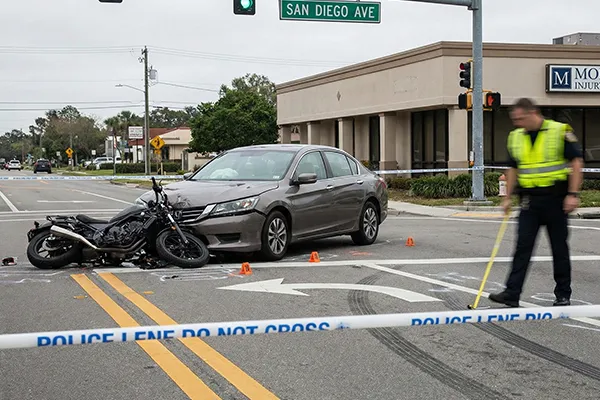
Left-turn motorcycle cases are about proof discipline. When the scene is preserved and the right-of-way analysis is clear, the defense loses its favorite weapon: turning a yield violation into a rider-fault story.
How magnitude is evaluated in San Diego left-turn motorcycle cases
Evidence Evaluation in San Diego Cases
- Police reports vs medical records: the report helps with scene and witness context, but medical records control causation, progression, and functional impact.
- Scene photos vs repair documentation: scene photos matter most—signal phase, skid marks, gouge marks, debris field, and sight lines; repair documentation can help counter “minor impact” arguments.
- Treatment timeline consistency: gaps are where insurers argue you recovered or the injury is unrelated; consistent care tightens causation.
- Tie to real San Diego claims handling: adjusters push early rider-blame; objective scene evidence and consistent care reduce that leverage.
Settlement vs Litigation Reality
Pre-suit, the insurer can speculate about speed and visibility because there’s no forcing mechanism. After filing in San Diego Superior Court, depositions and discovery pressure the defense to commit to a story—and inconsistencies become expensive.
- Discovery obligations: the driver must explain the turn decision, what they saw, and why they proceeded.
- Leverage: clear right-of-way proof increases the carrier’s risk calculation.
- Risk: once the defense story is locked under oath, unsupported blame defenses lose power.
San Diego-Specific Claim Wrinkles
- Traffic density and rear-end patterns: dense corridor driving creates impatient left turns at lights, especially when drivers try to “beat” oncoming traffic; that impatience is a repeat mechanism in San Diego intersections.
- Multi-vehicle freeway collisions: left-turn motorcycle cases usually happen at intersections, but riders can still be hit by a turning vehicle after freeway exits where sight lines and speed changes are compressed. When it applies, the fight is separating intersection duty from “freeway chaos” blame-shifting.
- Common Southern California insurer resistance patterns: “you were speeding,” “you appeared suddenly,” “you were lane-splitting,” and “minimal damage” are standard plays unless the file is built to survive expert scrutiny.
Lived Experiences
Michelle
The driver admitted the left turn but the insurer still tried to pin it on me and rush a low settlement. Once my attorney organized the intersection proof and built a clean medical timeline, the defense stopped debating and the resolution finally matched the reality of my injuries.
Christian
I kept hearing that motorcycles are “hard to see,” like that made it my fault. After my attorney treated it like a San Diego Superior Court case from the start, the story got tested and the outcome followed the evidence, not assumptions.
California Statutory Framework & Legal Authority
These are the exact statutes cited on this page, linked to the official LegInfo source, with a plain-English explanation of what each governs and why it matters in a San Diego personal injury claim.
|
Attorney Advertising, Legal Disclosure & Authorship
ATTORNEY ADVERTISING.
This content is provided for general informational and educational purposes only and does not constitute legal advice.
Under the California Rules of Professional Conduct and applicable State Bar of California advertising regulations,
this material may be considered attorney advertising.
Viewing or reading this content does not create an attorney-client relationship.
Laws and procedures governing personal injury claims vary by jurisdiction and may change over time.
You should consult a qualified California personal injury attorney regarding your specific situation before taking any legal action.
Responsible Attorney:
Richard Morse, California Attorney (Bar No. 289241).
Morse Injury Law is a practice name and location used by Richard Peter Morse III, a California-licensed attorney.
About the Author & Legal Review Process
This article was prepared by the legal editorial team supporting Richard Peter Morse III,
with the goal of explaining California personal injury law and claims procedures in clear, accurate, and practical terms for injured individuals in San Diego and surrounding communities.
Legal Review:
This content was reviewed and approved by Richard Morse, a California-licensed attorney (Bar No. 289241),
who concentrates his practice on personal injury litigation and insurance claim disputes.
With more than 13 years of experience representing injury victims throughout California,
Mr. Morse focuses on serious personal injury matters including motor vehicle collisions, uninsured and underinsured motorist claims,
premises liability, catastrophic injury, and wrongful death.
His practice emphasizes claims evaluation, insurance carrier accountability, and litigation in California courts when fair resolution cannot be achieved.
|