
Commercial trucking claims differ from standard auto accidents because they trigger the Federal Motor Carrier Safety Regulations (FMCSR) regarding Hours of Service and weight limits. Under the doctrine of Respondeat Superior, the trucking company is often liable for its driver’s negligence. Our investigation prioritizes the immediate preservation of the Electronic Logging Device (ELD) records before the statutory retention period expires and the evidence is destroyed.

Trucking Accident Attorney in San Diego: what do you have to do right now under California Law to protect the case?
Here’s the single rule: preserve evidence before the trucking company “process” destroys it. Under California Law, the first week decides whether you can prove liability, hours-of-service reality, and causation — or whether you’re stuck arguing from scraps.
What I look for in San Diego truck crashes that insurers don’t want documented
I’ve spent 13+ years litigating California injury cases with trial in mind, and I learned early how trucking carriers and their insurers build defenses: fast contact, controlled evidence, and a narrative that turns a preventable crash into “unavoidable traffic conditions.” In San Diego, if litigation is necessary, the reality is this gets decided in San Diego Superior Court, and the record you build before filing is what survives discovery.
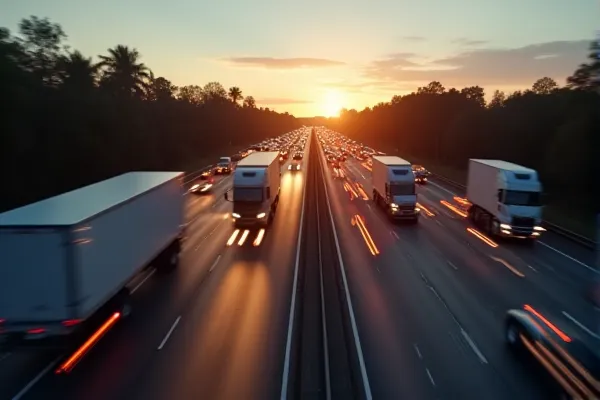
A realistic anonymized example: a box truck merges hard on I-5 near downtown during congestion, forcing a passenger vehicle into an adjacent lane where it’s struck and pinned. The carrier immediately blames “unsafe lane change by the smaller vehicle,” then quietly repairs the truck and cycles the driver to a different route. Strategy: secure the police report, preserve vehicle and electronic data, identify all responsible parties, and build a clean medical timeline while tracking the statute of limitations under CCP § 335.1. Resolution came only after the defense understood the file was being prepared for deposition and trial realities, not phone-call negotiations.
- Trucking cases turn on missing proof: logs, maintenance, onboard data, and witness timelines vanish unless preserved.
- Carriers use “complexity” as cover: multiple entities means multiple excuses unless you pin down responsibility early.
- Medical timing matters: gaps become causation weapons, especially in spine and head injury claims.
Why California Law and San Diego Superior Court venue materially change leverage
California Law controls negligence, comparative fault, damages, and the procedural deadlines that govern whether your case is even heard. Venue controls how quickly facts get forced into the open. If the case is filed in San Diego Superior Court, discovery obligations and sworn testimony replace “adjuster opinions,” and defense positions get tested against documents and timelines.
Deadlines can also compress when public entities are involved — road design, signage, construction zones, or government vehicles. If that’s in the chain, the claim presentation timeline under Gov. Code § 911.2 can control viability long before anyone debates value.
The “Immediate 5”: trucking-crash questions San Diego victims ask when the insurer starts pushing
1) What deadline applies to a San Diego trucking injury claim, and what can shorten it?
Most injury lawsuits are governed by CCP § 335.1, but that’s not the only clock that matters. If a public entity may share responsibility, the claim presentation deadline under Gov. Code § 911.2 can arrive far earlier and can control whether you can sue at all.
- Practical reality: the evidence deadline is often shorter than the legal deadline.
- Leverage reality: insurers price cases differently when they know a filing deadline is pressuring you.
2) How do I stop the trucking company from losing or overwriting key evidence?
You treat trucking evidence like it has an expiration date, because it does. A carrier can repair equipment, rotate drivers, and overwrite electronic data quickly, and once it’s gone, you’re arguing from inference instead of proof. Under California Law, early preservation steps are part of building a case that can actually be litigated in San Diego Superior Court.
- What you preserve: vehicle condition, onboard data, communications, inspection and maintenance records, and witness identities.
- Why it matters: it prevents the defense from turning uncertainty into a “no-liability” narrative.
3) Who can be legally responsible in a San Diego truck collision besides the driver?
Truck cases often involve layered responsibility: the driver, the motor carrier, and sometimes other entities tied to dispatching, loading, or maintenance. California negligence principles under Civ. Code § 1714 still apply, but proving who controlled what — and when — is where value is won or lost.
- Defense tactic: point the finger at a different entity so no one “owns” the failure.
- Your job: identify responsibility early so the case doesn’t fracture into excuses.
4) Does the truck’s speed limit or “commercial vehicle rules” matter in San Diego claims?
Yes, because it shapes liability arguments and reconstruction. For example, commercial speed and safety expectations can come into play under CVC § 22406, and commercial vehicles are subject to inspection and equipment compliance duties reflected in statutes like CVC § 34500. The defense often frames collisions as “traffic conditions,” but the case is built on what the truck was required to do and whether it did it.
- Proof impact: speed, following distance, and lane discipline become measurable issues.
- Valuation impact: clearer fault usually means less discounting and stronger settlement posture.
5) Should I talk to the trucking insurer, and what can they use to cut the claim down?
Trucking insurers push early contact because early statements can be used to create comparative fault arguments and causation disputes. Under Civ. Code § 1714, any “shared responsibility” narrative becomes a valuation lever, and ambiguity around symptoms or timelines becomes a causation lever. The safest approach is to let records and facts speak — not an improv interview taken before you know your diagnosis.
- What they look for: inconsistent timelines, prior symptoms, and uncertainty about lane position or speed.
- What protects you: consistent medical documentation and preserved scene and vehicle proof.

Truck cases don’t get “valued” fairly because you argued well on the phone. They get valued when the defense realizes the proof will hold up in a San Diego Superior Court case file, through discovery, depositions, and expert scrutiny.
- Discovery forces production: records, communications, and sworn answers replace vague denials.
- Depositions lock stories: shifting narratives become visible and punishable.
- Litigation risk gets priced: measurable risk changes settlement posture.
Magnitude expansion: what actually changes value in San Diego trucking cases
A) Evidence Evaluation in San Diego Cases
In truck claims, the insurer will often concede “something happened” but attack causation and severity. Police reports help, but medical records and objective documentation usually drive damages, while vehicle condition and documentation drive liability. The mistake is assuming the carrier will keep the evidence you need to prove your case.
- Police reports vs medical records: the report may support fault; records support injury proof.
- Scene photos vs repair documentation: photos show context; repair and vehicle proof rebut narratives.
- Treatment timeline consistency: gaps are the defense’s cleanest causation argument.
B) Settlement vs Litigation Reality
Once a case is filed in San Diego Superior Court, the defense can’t live forever in “review.” The parties face deadlines, subpoenas, sworn discovery responses, and deposition testimony. That structure is what turns a carrier’s “position” into a position they have to defend with evidence.
- Leverage changes: delay tactics weaken when court schedules govern the file.
- Risk changes: defense witnesses and records get tested, not summarized.
- Procedure matters: the case lives or dies on what can be proven.
C) San Diego-Specific Claim Wrinkles
San Diego’s truck traffic isn’t abstract — it’s I-5, I-805, SR-94, SR-52, port and border corridors. Merging, stop-and-go compression, and chain reactions are amplified here. Truck cases usually turn on preventable decisions: speed for conditions, distance, lane discipline, and maintenance.
- Traffic density: rear-end and lane-change patterns are predictable and heavily litigated.
- Multi-vehicle collisions: carriers try to split fault to reduce exposure across multiple claims.
- Resistance patterns: early blame-shifting, controlled evidence, and low valuation.
Verified Outcomes
Christopher
“The trucking insurer called immediately and acted like the case would be ‘quick’ if I just gave a statement. Once the records and evidence were preserved and organized, the blame-shifting stopped and the outcome finally matched the documentation.”
Jessica
“They tried to say my injuries were unrelated because my pain increased a few days later. After the medical timeline and crash evidence were lined up, the carrier backed off the causation argument and the resolution reflected my actual limitations.”
Authority Link Reference Table
|
Attorney Advertising, Legal Disclosure & Authorship
ATTORNEY ADVERTISING.
This content is provided for general informational and educational purposes only and does not constitute legal advice.
Under the California Rules of Professional Conduct and applicable State Bar of California advertising regulations,
this material may be considered attorney advertising.
Viewing or reading this content does not create an attorney-client relationship.
Laws and procedures governing personal injury claims vary by jurisdiction and may change over time.
You should consult a qualified California personal injury attorney regarding your specific situation before taking any legal action.
Responsible Attorney:
Richard Morse, California Attorney (Bar No. 289241).
Morse Injury Law is a practice name and location used by Richard Peter Morse III, a California-licensed attorney.
About the Author & Legal Review Process
This article was prepared by the legal editorial team supporting Richard Peter Morse III,
with the goal of explaining California personal injury law and claims procedures in clear, accurate, and practical terms for injured individuals in San Diego and surrounding communities.
Legal Review:
This content was reviewed and approved by Richard Morse, a California-licensed attorney (Bar No. 289241),
who concentrates his practice on personal injury litigation and insurance claim disputes.
With more than 13 years of experience representing injury victims throughout California,
Mr. Morse focuses on serious personal injury matters including motor vehicle collisions, uninsured and underinsured motorist claims,
premises liability, catastrophic injury, and wrongful death.
His practice emphasizes claims evaluation, insurance carrier accountability, and litigation in California courts when fair resolution cannot be achieved.
|