
In California, non-economic damages (pain and suffering) for medical malpractice are capped by MICRA. However, Economic Damages—the cost of your child’s past and future medical care—are UNCAPPED. For conditions like Cerebral Palsy or HIE, which require 24/7 nursing and therapy for 50+ years, these costs often exceed $10 Million. We hire life care planners to calculate every dollar your child will need for the rest of their life, ensuring the settlement covers them forever.

Birth Injuries Lawyer: What is the urgent San Diego step parents must take before the hospital controls the narrative?
Under the legal framework of California Law, the single most important rule is to preserve the record early—complete medical charts, fetal monitoring strips, NICU notes, and timestamps. We apply the Morse Injury Law advantage to secure these raw documents before anyone “summarizes” what happened. Because medical timing is the core of the liability case in San Diego Superior Court venues, do not rely on verbal explanations. Instead, use our client resources guide to demand the full evidence immediately.
How birth injury cases actually get proved in San Diego when Cerebral Palsy or HIE is on the table

I’ve handled enough high-stakes injury claims to tell you the truth: hospitals don’t “fight” first—they package. Under California Law, a birth injury case rises or falls on objective timing and documentation, and that’s exactly why it gets contested.
In one San Diego matter, the baby’s early distress was visible on the monitor, but the charting was selective and the timeline was fuzzy until we forced the complete record. Once the case posture moved toward San Diego Superior Court, the excuses tightened and the paperwork started telling the story the parents weren’t given.
- We locked down fetal heart tracing strips and the nurse flowsheets before “archiving” became a problem.
- We matched every intervention to a time stamp: calls made, escalation delayed, decision-to-delivery window.
- We built causation around medical proof—not feelings—because that’s what survives a defense attack.
Why California Law and San Diego Superior Court venue matter in birth injury litigation
Birth injuries are not “just medical.” They’re professional negligence claims, and the rules you live under change the second you understand that. Under CCP § 340.5, medical malpractice has its own statute of limitations framework, and it doesn’t care how long it took you to emotionally process what happened.
Venue matters because once a case is positioned for San Diego Superior Court, the defense has to defend with evidence, not bedside tone. Discovery has teeth, depositions become unavoidable, and the “we did everything right” narrative has to line up with the monitor strips, charting, and expert medicine.
- Duty and breach are evaluated through professional standards and the medical record, anchored in negligence principles under Civ. Code § 1714.
- Damage proof in catastrophic pediatric cases is future-facing under Civ. Code § 3333, and it must be supported—not guessed.
- Procedure is a weapon on both sides, and deadlines are how defenses win without ever addressing fault.
The “Immediate 5”: questions San Diego parents ask when cerebral palsy, HIE, or shoulder dystocia is suspected
1) What deadlines apply to a birth injury case in California, and how do minors affect the timeline?
Medical malpractice claims are governed by CCP § 340.5, which sets time limits tied to injury and discovery and includes specific caps and rules that differ from ordinary negligence. For minors, tolling may apply in limited ways, but you do not treat tolling like a safety net—especially when critical evidence, staff memories, and data retention windows are shrinking.
- Assume the clock is running and act like you’ll have to prove every date.
- Do not wait for a final cerebral palsy diagnosis to preserve the delivery record.
2) What documents matter most if HIE is suspected and “cooling” or NICU transfer happened?
HIE cases are timing cases. The core evidence is the fetal monitoring strips, Apgar scores, cord blood gases, resuscitation records, NICU admission notes, seizure documentation, and imaging interpretations—plus exact time stamps for escalation and delivery. If a safety rule or protocol exists in writing, it becomes relevant because a documented deviation can support negligence-per-se principles under Evidence Code § 669 when the legal elements fit.
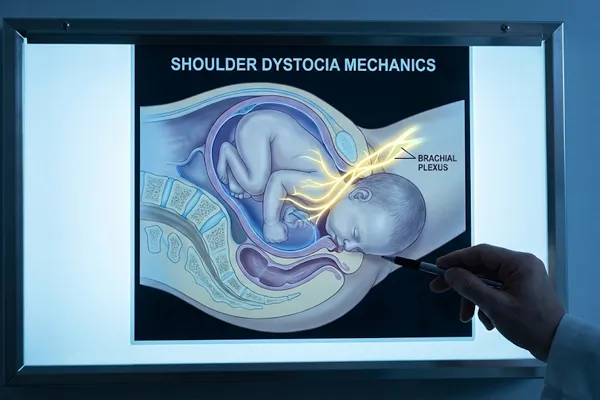
3) In shoulder dystocia cases, what gets litigated: the complication itself or how the team responded?
It’s not enough for a hospital to say “shoulder dystocia happens.” The legal question is whether the response met the professional standard and whether avoidable traction, delay, or poor escalation contributed to injury. In practice, that means the delivery note quality, nurse charting, time stamps, documented maneuvers, and neonatal exams become the fight, because that’s what decides whether causation is supportable under Civ. Code § 1714 and damages under Civ. Code § 3333.
4) How do we prove future care needs in cerebral palsy cases without “padding” the numbers?
Future care is not a slogan; it’s a medically supported plan. Under Civ. Code § 3333, future costs must be tied to competent evidence: therapy needs, equipment replacement cycles, home modification requirements, attendant care hours, and medical follow-up. In real claims handling, the defense attacks vagueness first—so the plan has to be specific, sourced, and internally consistent.
5) What changes once the case is filed in San Diego Superior Court?
Filing makes the defense respond with proof. Discovery scope is enforced under CCP § 2017.010, depositions are governed by CCP § 2025.010, and document demands are structured under CCP § 2031.010. That matters because birth injury cases hinge on what the record actually says and what staff can defend under oath.
Here’s the insurer reality: the earlier the case file looks “complete,” the harder it is to discount. If the record is scattered, the defense will spend the first year arguing about what happened instead of paying for what it caused.
- Obtain the full chart, not just discharge summaries.
- Preserve fetal monitor strips and time stamps before they’re hard to retrieve.
- Document current care needs and foreseeable milestones without exaggeration.
Magnitude expansion: where these cases actually get won or lost in San Diego
A) Evidence Evaluation in San Diego Cases
Parents are often told “everything was appropriate,” but litigation is about documentation, not reassurance. Charts, monitor strips, imaging, and objective time stamps carry weight because they’re the first things a defense expert reads before forming an opinion.
- Monitor data vs. narrative notes: the strip often contradicts the summary if delays occurred.
- NICU course: seizures, cooling, and lab results can clarify timing and severity.
- Consistency: changing stories become credibility problems once depositions begin.
B) Settlement vs Litigation Reality
Hospitals and insurers price risk. If the file is organized and the timeline is clean, they see trial exposure. If the file is scattered, they see bargaining leverage. Filing in San Diego Superior Court isn’t about theatrics—it’s about forcing a fact-based defense.
There are no guarantees. But there is a difference between a case that can be proven and a case that can be “explained.” Courts deal in proof.
C) San Diego-Specific Claim Wrinkles
San Diego medical systems are large, and care is often fragmented: prenatal provider, hospitalist, OB team, NICU team, transfer team. Fragmentation creates finger-pointing unless you build the timeline like a single chain.
- Transfers create gaps; gaps create defenses unless you close them with records and time stamps.
- Multiple providers can dilute responsibility; discovery is how you assign it.
- Retention windows for certain data can be shorter than parents expect—move early.
Lived Experiences
Mark1
“We were told to focus on recovery and not worry about paperwork, but the story kept shifting. Richard treated it like a timing case—records first, opinions second—and the resolution finally reflected the lifelong care our child will need.”
Kaitlyn2
“The hospital made it sound like shoulder dystocia was ‘just one of those things.’ Richard forced the complete record, and once the facts were organized, the defense stopped talking in generalities and started talking in numbers.”
California Statutory Framework & Legal Authority
|
Attorney Advertising, Legal Disclosure & Authorship
ATTORNEY ADVERTISING.
This content is provided for general informational and educational purposes only and does not constitute legal advice.
Under the California Rules of Professional Conduct and applicable State Bar of California advertising regulations,
this material may be considered attorney advertising.
Viewing or reading this content does not create an attorney-client relationship.
Laws and procedures governing personal injury claims vary by jurisdiction and may change over time.
You should consult a qualified California personal injury attorney regarding your specific situation before taking any legal action.
Responsible Attorney:
Richard Morse, California Attorney (Bar No. 289241).
Morse Injury Law is a practice name and location used by Richard Peter Morse III, a California-licensed attorney.
About the Author & Legal Review Process
This article was prepared by the legal editorial team supporting Richard Peter Morse III,
with the goal of explaining California personal injury law and claims procedures in clear, accurate, and practical terms for injured individuals in San Diego and surrounding communities.
Legal Review:
This content was reviewed and approved by Richard Morse, a California-licensed attorney (Bar No. 289241),
who concentrates his practice on personal injury litigation and insurance claim disputes.
With more than 13 years of experience representing injury victims throughout California,
Mr. Morse focuses on serious personal injury matters including motor vehicle collisions, uninsured and underinsured motorist claims,
premises liability, catastrophic injury, and wrongful death.
His practice emphasizes claims evaluation, insurance carrier accountability, and litigation in California courts when fair resolution cannot be achieved.
|