Can Employers Be Liable For On The Job Driving Accidents?

The concept of employer liability in on-the-job driving accidents hinges on a legal principle called “respondeat superior,” which essentially means “let the master answer.” In the context of trucking and delivery, this means the company employing the driver can be held responsible for the actions of that driver while they are acting within the scope of their employment. This isn’t limited to simply owning the vehicle; it extends to the hiring, training, and supervision of the driver.
Determining whether an employer is liable isn’t always straightforward. Courts will examine several factors, including whether the driver was on a designated route, following company policies, and performing work-related tasks at the time of the accident. A driver making an unauthorized detour for personal errands, for example, might not be considered acting within the scope of their employment. However, even seemingly minor deviations don’t automatically absolve the employer of responsibility.
With over 13 years of experience practicing personal injury law in San Diego, I’ve seen firsthand how insurance companies attempt to shift blame and minimize payouts in these cases. I was trained by a former insurance defense attorney, giving me intimate knowledge of how insurance companies evaluate, devalue, and deny claims. They often focus on the driver’s actions, hoping to avoid the much larger liability associated with the employer. That’s why it’s crucial to have an attorney who understands these tactics and can build a strong case against all responsible parties.
What evidence is needed to prove employer liability in a truck accident case?
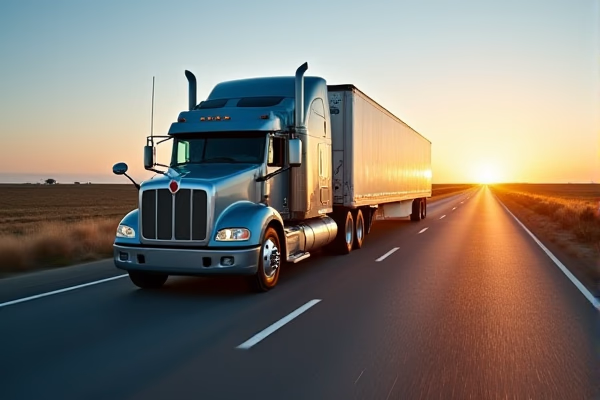
Establishing employer liability requires gathering comprehensive evidence. This includes the driver’s employment contract, company policies regarding safe driving practices, and the driver’s training records. Crucially, we’ll need to obtain the driver’s logbooks and Electronic Logging Device (ELD) data to verify their hours of service and compliance with federal regulations. 49 CFR § 395 outlines these requirements, and violations can be strong evidence of negligence.
Beyond the driver’s records, we’ll investigate the company’s hiring practices. Did they conduct a thorough background check? Were there any red flags in the driver’s history that were ignored? We’ll also examine maintenance records to ensure the vehicle was properly inspected and maintained. Negligent maintenance, such as faulty brakes or worn tires, can be a direct cause of an accident and further implicate the employer.
Finally, witness statements and the police report are essential. These documents can provide valuable insights into the circumstances of the accident and help establish the driver’s negligence. In some cases, dashcam footage or other digital evidence can be critical in reconstructing the events leading up to the crash.
Can I sue my employer directly if I was injured in a work accident while driving?
Generally, in California, workers’ compensation is the exclusive remedy against your employer for on-the-job injuries. This means you typically cannot sue your employer directly for negligence. However, there are exceptions. Under Labor Code § 3852, you may still have the right to pursue a separate civil claim against any negligent third parties who contributed to the accident, such as the driver of another vehicle or a company responsible for maintaining the roadway.
It’s important to understand that workers’ compensation benefits may not fully cover all your losses, including pain and suffering, emotional distress, and loss of enjoyment of life. A third-party lawsuit can allow you to recover these additional damages. Furthermore, even if you receive workers’ compensation benefits, pursuing a third-party claim won’t necessarily affect your eligibility for those benefits.
The complexities of workers’ compensation and third-party liability require the guidance of an experienced attorney. We can thoroughly evaluate your case and determine the best course of action to maximize your recovery.
What if the company claimed the driver was an independent contractor, not an employee?
Companies sometimes misclassify drivers as independent contractors to avoid liability for their actions. However, simply labeling someone an “independent contractor” doesn’t make it so. California’s “ABC test,” outlined in Labor Code § 2775, determines whether a worker is truly an independent contractor or an employee. This test considers the level of control the company exercises over the driver’s work.
If the company dictates the driver’s schedule, provides equipment, or closely monitors their performance, they are likely exercising enough control to establish an employer-employee relationship. Even if the driver signed a contract stating they are an independent contractor, a court can disregard that contract if it doesn’t accurately reflect the reality of the working relationship. In San Diego delivery truck litigation, this is a common issue.
Proving employee status can be challenging, but it’s crucial for establishing employer liability. We’ll conduct a thorough investigation to gather evidence of the company’s control over the driver and build a strong case to overcome any attempts at misclassification.
What is “vicarious liability” and how does it apply to trucking companies?
“Vicarious liability,” also known as “respondeat superior,” is the legal doctrine that holds a principal responsible for the actions of their agent. In the context of trucking, the trucking company is the principal, and the driver is their agent. Under Civ. Code § 2338, the trucking company can be held liable for the driver’s negligence if the driver was acting within the scope of their employment at the time of the accident.
This means the company is responsible for ensuring their drivers are properly trained, supervised, and compliant with all safety regulations. If a driver violates these regulations or engages in negligent behavior, the company can be held liable for the resulting damages. Even if the company didn’t directly cause the accident, they can still be held responsible for the driver’s actions.
Establishing vicarious liability requires proving that the driver was acting within the scope of their employment. This can involve demonstrating that the driver was on a designated route, following company policies, and performing work-related tasks. It’s a complex legal issue that requires the expertise of an experienced attorney.
What are the time limits for filing a lawsuit after a truck accident?
In California, you generally have **two years** from the date of the truck accident to file a lawsuit. Because trucking companies often begin evidence destruction (like purging ELD data) as soon as the law allows, immediate filing is critical to preserve the integrity of the claim. This is especially important in cases involving potential employer liability, as the company may attempt to conceal evidence of negligence. CCP § 335.1 outlines these deadlines.
If the accident involved a government-owned vehicle or a dangerous road condition maintained by a public entity, a formal administrative claim **MUST** be presented within **6 months** (180 days). Failure to meet this strict deadline under the Government Tort Claims Act can result in the permanent loss of your right to recover. Gov. Code § 911.2 governs these claims.
Don’t delay seeking legal counsel after a truck accident. An attorney can ensure all necessary deadlines are met and that your claim is properly filed to protect your rights.