
Can Fedex Be Sued After A Truck Accident In San Diego?

The complexities arise from the legal status of FedEx drivers and the company’s intricate network of contracts. Is the driver an employee of FedEx, or an independent contractor? This distinction dramatically impacts your ability to recover damages. As a personal injury attorney practicing in San Diego for over 13 years, I’ve seen firsthand how FedEx aggressively defends these claims, often leveraging the contractor status to limit liability. I was trained by a former insurance defense attorney, giving me intimate knowledge of how insurance companies evaluate, devalue, and deny claims.
FedEx operates through various service levels, each with different employment arrangements. Some drivers are directly employed by FedEx Express, while others operate as independent contractors through FedEx Ground or FedEx Freight. Understanding which model applies to the driver involved in your accident is the first crucial step in building a successful case. It’s not enough to simply assume; a thorough investigation is required.
Can I Sue FedEx Directly After a Truck Accident?
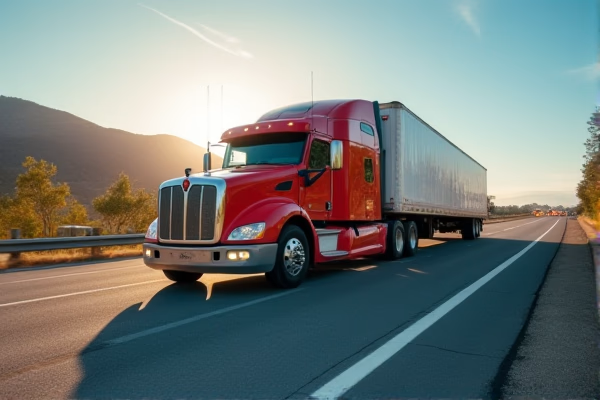
Generally, you can sue FedEx directly if the driver involved in the accident was a direct employee of FedEx Express. In these cases, the principle of **vicarious liability** (respondeat superior) applies. This means FedEx is legally responsible for the negligent acts of its employees committed within the scope of their employment. Civ. Code § 2338 outlines this legal framework.
However, if the driver is an independent contractor, the path to recovery becomes more challenging. You’ll need to demonstrate that FedEx exercised significant control over the driver’s operations, blurring the line between contractor and employee. This could include control over routes, schedules, training, or the type of vehicle used.
Even if a driver is classified as a contractor, FedEx can still be held liable for its own negligence. This includes negligent hiring, training, or maintenance of the vehicle. Proving these claims requires a detailed investigation into FedEx’s safety protocols and the driver’s history.
What if the FedEx Driver Was an Independent Contractor?
Suing FedEx when the driver is an independent contractor requires a different approach. You’ll need to establish a direct link between FedEx’s actions (or inactions) and the cause of the accident. This often involves demonstrating that FedEx was negligent in its oversight of the contractor.
For example, if FedEx knew or should have known that the driver had a history of traffic violations or lacked the proper CDL endorsements, they could be held liable for negligent hiring. Similarly, if FedEx failed to adequately inspect the driver’s vehicle, leading to a mechanical failure, they could be held responsible for negligent maintenance.
California’s ‘ABC test’ determines if a delivery driver (Amazon/FedEx) is an employee or contractor. Even if labeled a ‘contractor,’ a company may be liable if they exercise control over the driver’s work, a key factor in San Diego delivery truck litigation. Labor Code § 2775 provides the specific criteria for this test.
How Long Do I Have to File a Lawsuit Against FedEx?
California law provides a **two-year** window from the date of the truck accident to file a lawsuit. CCP § 335.1 dictates this statute of limitations. Because trucking companies often begin evidence destruction (like purging ELD data) as soon as the law allows, immediate filing is critical to preserve the integrity of the claim.
However, it’s crucial to understand that the two-year period begins to run from the date of the accident, not the date you discover the extent of your injuries. This means it’s essential to consult with an attorney as soon as possible to ensure you don’t miss the deadline.
Furthermore, if the accident involved a government-owned vehicle or a dangerous road condition maintained by a public entity, a separate administrative claim **MUST** be filed within **6 months** (180 days) under the Government Tort Claims Act. Gov. Code § 911.2 outlines these requirements. Failure to meet this deadline can result in the permanent loss of your right to recover.
What Types of Damages Can I Recover in a FedEx Truck Accident Claim?
If you’re successful in your claim against FedEx, you may be entitled to recover a range of damages, including medical expenses, lost wages, pain and suffering, and property damage. You can also seek compensation for future medical costs and lost earning capacity.
In cases involving severe injuries, you may also be able to recover damages for emotional distress, disfigurement, and loss of enjoyment of life. The amount of compensation you’re entitled to will depend on the severity of your injuries, the extent of your losses, and the strength of your evidence.
It’s important to note that FedEx will likely attempt to minimize your damages. They may argue that your injuries are not as severe as you claim, or that your lost wages are overstated. That’s why it’s crucial to have an experienced attorney on your side who can effectively negotiate with FedEx and fight for the full compensation you deserve.
What Evidence Do I Need to Gather After a FedEx Truck Accident?
Gathering evidence is crucial to building a strong case against FedEx. This includes the police report, witness statements, photos of the accident scene, and your medical records. It’s also important to document your lost wages and any other expenses you’ve incurred as a result of the accident.
In addition, it’s helpful to obtain any available information about the driver’s history, including their driving record and training qualifications. FedEx is required to maintain detailed records of its drivers, but obtaining this information can be challenging. An attorney can help you navigate this process and ensure you have the evidence you need to support your claim.
Dashcam footage, if available, can be invaluable in establishing liability. Additionally, data from the truck’s Electronic Logging Device (ELD) can reveal important information about the driver’s hours of service and potential fatigue. Federal **Hours of Service (HOS)** regulations dictate exactly how long a driver can be behind the wheel. Violations of these federal safety standards, often proven through Electronic Logging Device (ELD) data, are used to demonstrate driver fatigue. 49 CFR § 395 provides the detailed regulations.
What Should I Do If FedEx Asks for a Recorded Statement?
If FedEx asks for a recorded statement, **do not provide one without first consulting with an attorney.** Insurance companies often use recorded statements to try to minimize your claim or find grounds to deny it. They may ask leading questions or attempt to trick you into making statements that could harm your case.
An attorney can advise you on whether or not to provide a statement and, if so, how to answer questions in a way that protects your rights. It’s generally best to let your attorney handle all communications with FedEx and their insurance company.
Furthermore, be cautious about signing any releases or waivers without first reviewing them with an attorney. These documents could prevent you from recovering the full compensation you deserve.
What if I Have Workers’ Compensation Benefits?
If you were a commercial driver injured on the job in San Diego, you are entitled to workers’ compensation. However, workers’ compensation is generally the **exclusive remedy** against the employer. Separate personal injury claims are typically limited to **negligent third parties** who are not the employer. Labor Code § 3600 outlines these rules.
This means you can still pursue a claim against FedEx if their negligence contributed to your injuries, even if you’re receiving workers’ compensation benefits. For example, if a FedEx truck driver ran a red light and caused the accident, you can sue the driver and potentially FedEx for your damages.
It’s important to understand the interplay between workers’ compensation and third-party claims. An attorney can help you navigate this complex legal landscape and ensure you’re pursuing all available avenues of recovery.
How Can an Attorney Help Me With My FedEx Truck Accident Claim?
Suing FedEx after a truck accident can be a complex and challenging process. An experienced attorney can provide invaluable assistance by investigating the accident, gathering evidence, negotiating with FedEx, and representing you in court.
I have over 13 years of experience handling personal injury claims in San Diego, and I’m intimately familiar with the tactics FedEx uses to defend these cases. I was trained by a former insurance defense attorney, giving me unique insight into how insurance companies evaluate claims. I can help you understand your rights, protect your interests, and fight for the full compensation you deserve.
Don’t try to navigate this process alone. Contact my office today for a free consultation and let me assess your case.
What if the Truck Driver Was Speeding?
In California, commercial trucks (including semi-tractors with three or more axles) are strictly prohibited from exceeding **55 miles per hour** on any highway. CVC § 22406 outlines this speed limit. In San Diego freeway crashes, proving a violation of this speed limit is a primary tool for establishing statutory negligence.
If the truck driver was exceeding the speed limit at the time of the accident, it creates a strong presumption of negligence. This is because exceeding the speed limit is a violation of the law and demonstrates a disregard for the safety of others.
Evidence of speeding can come from various sources, including the truck’s Event Data Recorder (EDR), dashcam footage, and witness statements. An attorney can help you obtain this evidence and use it to strengthen your claim.
What if FedEx Claims I Was Partially at Fault?
California’s ‘pure’ comparative fault system applies to trucking claims. Even if a truck driver argues you shared responsibility, you can still recover damages; however, your total compensation will be reduced by your percentage of fault. Civ. Code § 1714 outlines this legal principle.
FedEx may attempt to argue that you were partially at fault for the accident by claiming you were speeding, distracted driving, or failed to yield the right-of-way. It’s important to have an attorney on your side who can investigate the accident and gather evidence to refute these claims.
An attorney can also help you negotiate with FedEx to minimize your percentage of fault. Even a small reduction in your fault percentage can significantly increase the amount of compensation you recover.
What Happens if a Truck Accident Results in a Wrongful Death?
When a truck accident results in a fatality, specific family members have the right to file a wrongful death claim. This allows for the recovery of financial support, funeral expenses, and the loss of the decedent’s love, companionship, and guidance. CCP § 377.60 details the process and eligible claimants.
Wrongful death claims are often complex and emotionally challenging. An attorney can provide compassionate guidance and support throughout the legal process. They can also help you gather evidence, negotiate with FedEx, and represent you in court.
It’s important to act quickly in a wrongful death case, as there are strict deadlines for filing a claim. Contact an attorney as soon as possible to protect your rights.