
Can Speed And Braking Data Prove Negligence?

Determining negligence in a truck accident often hinges on proving fault. While witness testimony and accident reconstruction can be valuable, the data recorded by modern trucks – specifically speed and braking information – provides a powerful, objective source of evidence. These records, often accessible through the truck’s Event Data Recorder (EDR) or ELD, can paint a clear picture of the driver’s actions leading up to a crash. Understanding how this data is used and what it reveals is crucial for anyone involved in a truck accident with injury.
The Federal Motor Carrier Safety Administration (FMCSA) mandates that most commercial trucks be equipped with ELDs to track hours of service, vehicle location, and other critical data. However, the EDR, a separate system, captures a wealth of information related to vehicle operation, including speed, braking force, throttle position, and steering angle. Both sources of data can be invaluable in establishing liability, particularly when combined with other evidence like dashcam footage and the driver’s logbooks.
How Does Speed Data Prove Negligence?
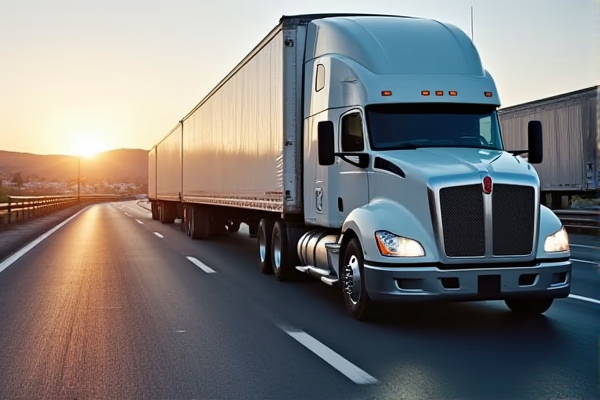
In California, commercial trucks are strictly prohibited from exceeding 55 miles per hour on any highway. CVC § 22406 outlines these speed restrictions. Proving a violation of this speed limit is a primary tool for establishing statutory negligence. Even a seemingly small difference in speed can significantly increase the severity of an accident. The data from the EDR or ELD provides irrefutable evidence of the truck’s speed at the time of the collision, making it difficult for the trucking company to dispute.
Furthermore, speed data can be used to demonstrate a driver’s failure to exercise reasonable care. If a truck is traveling at an excessive speed for the prevailing conditions – such as rain, fog, or heavy traffic – it can be considered negligent even if the driver is within the posted speed limit. This is because the driver has a duty to operate the vehicle safely, taking into account all surrounding circumstances.
Analyzing speed data requires expertise. We often work with accident reconstruction specialists who can interpret the data and present it in a clear and compelling manner to insurance adjusters and, if necessary, a jury.
What Can Braking Data Reveal About a Truck Driver’s Actions?
Braking data provides insight into the driver’s reaction time and the effectiveness of the truck’s braking system. Sudden, hard braking can indicate that the driver was distracted, following too closely, or failed to anticipate a hazard. Conversely, a lack of braking before a collision suggests the driver was inattentive or failed to take evasive action.
The force and timing of the braking can also reveal whether the truck’s brakes were functioning properly. If the braking data shows a significant delay in response time or inconsistent braking force, it could indicate a mechanical defect. This can lead to a claim against the trucking company for negligent maintenance.
We’ve handled cases in San Diego where the braking data revealed the driver didn’t even attempt to brake until the very last moment, clearly demonstrating a lack of due care. This evidence was critical in securing a favorable settlement for our client.
How is ELD Data Obtained in a Truck Accident Case?
Obtaining ELD and EDR data requires a swift and strategic approach. Trucking companies are not obligated to voluntarily provide this information. We typically initiate a formal discovery process, including sending a demand letter requesting the data and, if necessary, filing a subpoena to compel its production. It’s crucial to act quickly, as trucking companies often begin evidence destruction (like purging ELD data) as soon as the law allows, to preserve the integrity of the claim.
It’s also important to understand that ELD data is subject to specific regulations and limitations. The data may be overwritten or altered, so it’s essential to obtain it as soon as possible and work with a qualified expert to ensure its authenticity and accuracy.
I have over 13 years of experience representing clients injured in truck accidents throughout San Diego. Trained by a former insurance defense attorney, I have intimate knowledge of how insurance companies evaluate, devalue, and deny claims. This experience allows me to anticipate their tactics and build a strong case on behalf of my clients.
Can Speed and Braking Data Be Used in Court?
Yes, speed and braking data are generally admissible as evidence in court, provided it can be properly authenticated and presented. We work with accident reconstruction experts who can analyze the data, prepare detailed reports, and testify as to its accuracy and relevance. The expert will explain the data to the judge and jury in a clear and understandable manner, highlighting its significance in establishing liability.
However, it’s important to note that the trucking company may challenge the admissibility of the data, arguing that it was improperly obtained or that it’s unreliable. We anticipate these challenges and prepare accordingly, ensuring that the data is presented in a way that meets the legal standards for admissibility.
Successfully presenting this data often requires a thorough understanding of the FMCSA regulations and the technical aspects of ELD and EDR systems.
What Happens if the Truck Didn’t Have an ELD or EDR?
While most modern trucks are equipped with ELDs and EDRs, older vehicles may not have these systems. In these cases, we rely on other sources of evidence to establish negligence, such as witness testimony, accident reconstruction, the driver’s logbooks, and the truck’s maintenance records. We can also investigate the driver’s cell phone records to determine if they were distracted at the time of the accident.
Even without ELD or EDR data, it’s still possible to build a strong case against the trucking company. However, it may require more extensive investigation and a greater reliance on circumstantial evidence.
In San Diego, we’ve successfully litigated cases without ELD data by focusing on the driver’s history of safety violations and the trucking company’s negligent hiring practices.
What Should I Do If I’ve Been Involved in a Truck Accident?
If you’ve been involved in a truck accident, it’s crucial to take immediate action to protect your rights. First, seek medical attention, even if you don’t feel seriously injured. Many injuries, such as whiplash and traumatic brain injuries, may not be immediately apparent. Second, contact an experienced attorney as soon as possible. An attorney can advise you on your legal options, investigate the accident, and gather evidence to support your claim.
Do not speak to the insurance company without first consulting with an attorney. Insurance adjusters are trained to minimize payouts, and they may try to trick you into making statements that could harm your case. Let an attorney handle all communications with the insurance company on your behalf.
Finally, preserve all evidence related to the accident, including photos of the scene, witness contact information, and any medical records or bills you’ve incurred.
How Long Do I Have to File a Lawsuit After a Truck Accident?
In California, CCP § 335.1 provides a **two-year** window from the date of the truck accident to file a lawsuit. Because trucking companies often begin evidence destruction (like purging ELD data) as soon as the law allows, immediate filing is critical to preserve the integrity of the claim.
However, there may be exceptions to this deadline, such as cases involving government liability or claims against multiple parties. It’s essential to consult with an attorney as soon as possible to determine the applicable deadline in your specific case.
Waiting too long to file a lawsuit can result in the permanent loss of your right to recover compensation.
What if the Truck Driver Was a Contractor, Not an Employee?
Determining whether a truck driver is an employee or an independent contractor can be complex. California’s ‘ABC test’ determines if a delivery driver (Amazon/FedEx) is an employee or contractor. Labor Code § 2775 outlines this test. Even if labeled a ‘contractor,’ a company may be liable if they exercise control over the driver’s work, a key factor in San Diego delivery truck litigation.
If the driver was misclassified as a contractor, the trucking company may still be liable for their negligence under the doctrine of vicarious liability. This is because the company may have exercised sufficient control over the driver’s work to be considered their employer.
We often investigate the relationship between the driver and the trucking company to determine the proper classification and establish liability.
What if the Truck Accident Involved a Government Vehicle or Road Condition?
If a truck accident involves a government-owned vehicle or a dangerous road condition maintained by a public entity, a formal administrative claim **MUST** be presented within **6 months** (180 days). Gov. Code § 911.2 outlines this strict deadline under the Government Tort Claims Act. Failure to meet this strict deadline can result in the permanent loss of your right to recover.
These claims are often complex and require specific documentation and procedures. It’s essential to consult with an attorney as soon as possible to ensure that the claim is filed correctly and on time.
We have extensive experience handling claims against government entities in San Diego and can guide you through the process.
What if the Insurance Company Offers a Policy Limits Tender?
A policy limits tender is an offer from the insurance company to settle your claim for the maximum amount of their policy coverage. While it may seem like a generous offer, it’s important to carefully consider whether it adequately compensates you for your injuries and losses. Accepting a policy limits tender releases the insurance company from any further liability, even if your damages exceed the policy amount.
We carefully evaluate each policy limits tender to determine if it’s fair and reasonable. If the tender is insufficient, we will negotiate with the insurance company to obtain a higher settlement or file a lawsuit to pursue your full recovery.
We also investigate whether there are other sources of recovery available, such as excess insurance policies or other responsible parties.
How Can Dashcam Footage Help My Truck Accident Claim?
Dashcam footage can provide invaluable evidence in a truck accident claim. It can capture the events leading up to the collision, the impact itself, and the immediate aftermath. This footage can be used to establish liability, demonstrate the driver’s negligence, and corroborate your version of events.
However, it’s important to note that dashcam footage may be lost or destroyed. We immediately request any available dashcam footage from the trucking company and other potential sources. We also take steps to preserve the footage, such as obtaining a preservation letter to prevent its deletion.
Digital evidence, including ECM/EDR data, telematics, and GPS information, is crucial in modern truck accident litigation.