
Do Semi Trucks Have Black Boxes?

Semi-trucks, like passenger vehicles, are increasingly equipped with data recording devices, commonly referred to as “black boxes,” though they are officially known as Event Data Recorders (EDRs). These devices capture a wealth of information in the moments leading up to, during, and after a collision. Understanding what data is recorded, how to access it, and how it can be used in a legal claim is crucial for anyone injured in an accident involving a commercial truck.
Unlike the simple recorders found in older cars, modern truck EDRs are sophisticated systems. They don’t just record speed; they track braking force, throttle position, steering angle, engine data, transmission settings, and even driver actions like cruise control usage. This data can paint a detailed picture of the truck’s operation and help determine if driver fatigue, mechanical failure, or negligence played a role in the accident. However, obtaining this data isn’t always straightforward.
As a personal injury attorney practicing in San Diego for over 13 years, I’ve seen firsthand how insurance companies attempt to minimize or withhold EDR data. They know this information can be incredibly damaging to their case. I was trained by former insurance defense attorneys, giving me intimate knowledge of how these companies evaluate, devalue, and deny claims. It’s vital to act quickly to preserve this evidence before it’s altered or destroyed. Often, trucking companies have policies in place for immediate data retrieval and analysis, giving them a significant advantage.
What information is typically stored on a semi-truck’s black box?
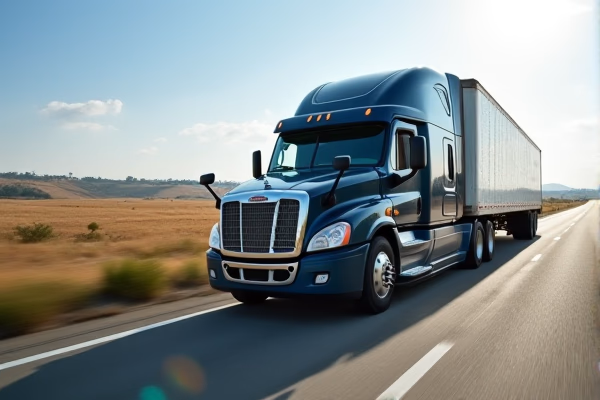
The data stored on a truck’s EDR is extensive and can be critical in reconstructing the events of an accident. Key data points include vehicle speed, brake application, engine RPM, transmission gear, steering wheel position, and the activation of safety systems like ABS and stability control. Crucially, the EDR also records the time leading up to the crash, providing a timeline of the truck’s operation. This can reveal if the driver was speeding, abruptly braking, or making erratic maneuvers.
Beyond the mechanical data, some EDRs also capture information about the driver’s actions, such as cruise control settings and the use of the accelerator and brake pedals. Newer systems may even record video footage from forward-facing and in-cab cameras, providing a visual record of the driver’s behavior. Accessing this video footage, if available, is often a priority in truck accident investigations.
How can I get access to the data from a semi-truck’s black box?
Obtaining EDR data requires a formal legal process. You’ll typically need to send a “spoliation letter” to the trucking company, demanding preservation of all relevant evidence, including the EDR data. Following this, a subpoena can be issued to compel the trucking company to produce the data. It’s important to note that the data is often in a proprietary format, requiring specialized software and expertise to interpret.
The trucking company may attempt to resist providing the data, claiming it’s protected by trade secrets or privacy concerns. An experienced attorney can navigate these legal challenges and ensure the data is properly obtained and analyzed. Furthermore, it’s crucial to understand that the data itself may not be conclusive. It needs to be interpreted in the context of other evidence, such as witness statements, police reports, and the truck’s maintenance records.
What if the trucking company claims the black box data is unavailable?
If a trucking company claims the EDR data is unavailable, it’s essential to investigate the reason. Common excuses include a malfunctioning device or a data overwrite. However, these claims should be met with skepticism. Trucking companies are legally obligated to maintain their vehicles in safe operating condition, which includes ensuring the EDR is functioning properly.
An attorney can investigate whether the company followed proper maintenance procedures and whether the data loss was legitimate. In some cases, it may be possible to reconstruct the data using other sources, such as the truck’s engine control module (ECM) or the driver’s logbook. Even if the EDR data is unavailable, other evidence may still be sufficient to prove negligence.
Can the trucking company use the black box data against me?
Yes, the trucking company can absolutely use the EDR data against you. They may argue that the data shows you were partially at fault for the accident, or that your vehicle was operating improperly. That’s why it’s crucial to have an attorney involved from the beginning. An attorney can analyze the data independently and identify any inaccuracies or biases.
Furthermore, an attorney can present counter-evidence to challenge the trucking company’s interpretation of the data. For example, if the EDR data shows you were braking, an attorney can argue that you were braking to avoid the truck’s negligence. It’s important to remember that EDR data is just one piece of the puzzle, and it shouldn’t be accepted at face value.
What role does federal regulation play in semi-truck black box data?
Federal regulations, specifically 49 CFR § 395, govern the use of EDRs in commercial vehicles. These regulations establish minimum performance standards for the devices and require trucking companies to maintain the data for a certain period. Understanding these regulations is critical in ensuring the data is properly obtained and analyzed.
Violations of these federal safety standards, often proven through Electronic Logging Device (ELD) data, are used to demonstrate driver fatigue. Furthermore, the regulations address data security and privacy concerns, ensuring that the data is protected from unauthorized access. An attorney familiar with these regulations can help protect your rights and ensure the trucking company complies with all applicable laws.
What is the statute of limitations for filing a claim after a truck accident in California?
In California, you have a **two-year** window from the date of the truck accident to file a lawsuit. Because trucking companies often begin evidence destruction (like purging ELD data) as soon as the law allows, immediate filing is critical to preserve the integrity of the claim. CCP § 335.1 outlines these specific timelines.
What should I do if the accident involved a government-owned truck or a hazardous roadway?
If a truck accident involves a government-owned vehicle or a dangerous road condition maintained by a public entity, a formal administrative claim **MUST** be presented within **6 months** (180 days). Failure to meet this strict deadline under the Government Tort Claims Act can result in the permanent loss of your right to recover. Gov. Code § 911.2 details these requirements.
How does California law determine if a delivery driver is an employee or contractor?
California’s ‘ABC test’ determines if a delivery driver (Amazon/FedEx) is an employee or contractor. Even if labeled a ‘contractor,’ a company may be liable if they exercise control over the driver’s work, a key factor in San Diego delivery truck litigation. Labor Code § 2775 provides the specific criteria for this determination.
Can I hold the trucking company liable for the actions of its driver?
Under the doctrine of **vicarious liability** (respondeat superior), a principal is responsible to third persons for the negligence of their agent in the transaction of business. This holds the trucking company legally liable for the wrongful acts of its drivers committed within the scope of their employment. Civ. Code § 2338 explains the legal basis for this principle.
What are the speed limits for commercial trucks in California?
In California, commercial trucks (including semi-tractors with three or more axles) are strictly prohibited from exceeding **55 miles per hour** on any highway. In San Diego freeway crashes, proving a violation of this speed limit is a primary tool for establishing statutory negligence. CVC § 22406 outlines these speed restrictions.