
How Do Lawyers Investigate Amazon Delivery Truck Crashes?

Investigating Amazon delivery truck crashes requires a nuanced approach, far beyond simply gathering police reports and witness statements. These cases often involve complex issues of employer liability, federal regulations, and the unique operational structure of Amazon’s delivery network. As a personal injury attorney practicing in San Diego for over 13 years, and having been trained by former insurance defense attorneys, I understand the tactics insurance companies use to minimize payouts and deny legitimate claims. They’ll scrutinize every detail, looking for ways to shift blame or undervalue your injuries. That’s why a thorough, proactive investigation is crucial.
The first step is securing the scene, if possible. This means documenting everything: photos of vehicle damage, road conditions, traffic signals, and any visible injuries. However, the real investigation begins with understanding who is responsible. Is it the driver, Amazon itself, or a third-party delivery service partner? Amazon utilizes a complex network of independent contractors and service providers, which can muddy the waters of liability. Determining the correct responsible party is paramount to a successful claim.
I’ve seen countless cases where insurance companies attempt to portray Amazon as merely a technology platform, absolving them of responsibility for the actions of their drivers. However, the reality is often far more involved. Amazon exercises significant control over its delivery network, dictating routes, schedules, and performance metrics. This level of control can establish a principal-agent relationship, making Amazon directly liable for driver negligence under the doctrine of vicarious liability (respondeat superior). Civ. Code § 2338.
What evidence is crucial in an Amazon delivery truck crash case?
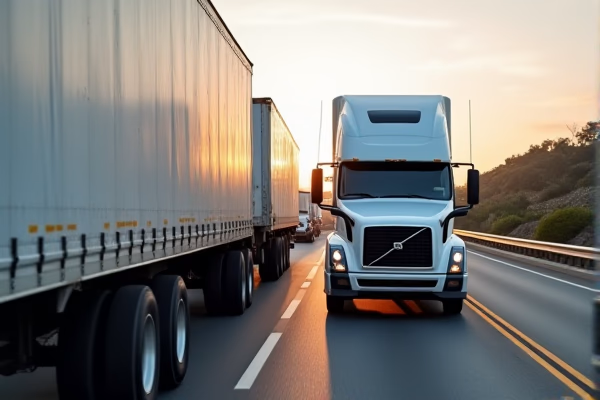
Beyond the standard police report and witness statements, several types of evidence are particularly important in Amazon delivery truck crashes. Electronic Logging Device (ELD) data is critical. These devices track a driver’s hours of service, revealing potential violations of federal regulations. 49 CFR § 395. We often subpoena this data to uncover instances of driver fatigue or exceeding permissible driving limits. Dashcam footage, if available, is also invaluable.
Furthermore, Amazon’s internal communications and safety protocols are key. We’ll seek to obtain records related to driver training, vehicle maintenance, and any prior safety violations. Amazon’s algorithms and performance metrics also play a role. Drivers are often incentivized to deliver packages quickly, which can create pressure to violate safety regulations. We’ll investigate whether these metrics contributed to the accident. Finally, the driver’s qualifications and background check are essential. Any history of reckless driving or safety violations can strengthen your claim.
How do you determine if Amazon properly vetted the delivery driver?
Amazon’s vetting process for delivery drivers is often a point of contention. While they conduct background checks, the depth and thoroughness of these checks can vary significantly. We investigate whether Amazon adequately screened the driver for prior traffic violations, criminal history, and any other red flags that might indicate unsuitability. CACI No. 426. If Amazon was negligent in hiring, supervising, or retaining an unfit driver, they can be held directly liable for your injuries.
This often involves obtaining the driver’s complete driving record, including any commercial driving violations. We also examine the driver’s training records to ensure they received adequate instruction on safe driving practices and Amazon’s safety protocols. If the driver was improperly trained or lacked the necessary qualifications, it can be a strong indication of Amazon’s negligence.
What if the accident involved a government-owned vehicle or roadway in San Diego?
If the Amazon delivery truck was operating on a government-owned vehicle or the accident occurred due to a dangerous road condition maintained by a public entity in San Diego, a separate set of rules applies. Gov. Code § 911.2. You **must** file a formal administrative claim with the government entity within **6 months** (180 days) of the accident. Failure to meet this strict deadline can result in the permanent loss of your right to recover.
This claim process is often complex and requires specific documentation and legal arguments. It’s crucial to consult with an attorney experienced in government liability claims to ensure your claim is properly filed and supported. The government entity will investigate the claim and may deny it outright or offer a settlement. If the claim is denied, you may have the option to pursue litigation, but it’s essential to follow the proper procedures and deadlines.
What role do policy limits play in Amazon delivery truck accident cases?
Determining the available insurance coverage is a critical step in any Amazon delivery truck accident case. Amazon typically carries significant insurance coverage, but the specific policy limits can vary depending on the circumstances. We’ll investigate all potential sources of coverage, including Amazon’s primary insurance policy, any excess or umbrella policies, and the driver’s personal insurance policy.
Once we’ve identified the available coverage, we’ll assess the value of your claim and negotiate with the insurance company to reach a fair settlement. It’s important to understand that insurance companies often attempt to minimize payouts, so it’s crucial to have an attorney experienced in negotiating with them. We’ll fight to ensure you receive the full compensation you deserve for your injuries, lost wages, and other damages.
What should I do if the insurance adjuster asks me to give a recorded statement?
Insurance adjusters often request recorded statements early in the claims process. CCP § 335.1. While you are not legally obligated to provide a statement, doing so can be detrimental to your claim. Insurance companies use these statements to gather information that can be used to devalue your claim or deny it altogether.
It’s best to politely decline the request and consult with an attorney before providing any statement. We can advise you on the best course of action and protect your rights. We can also handle all communications with the insurance company on your behalf, ensuring they do not take advantage of you or pressure you into accepting a settlement that is less than you deserve.