
How Do Lawyers Prove Trucking Negligence?

Proving negligence in a trucking accident is significantly more complex than a typical car crash. It’s not enough to simply show the driver was at fault. We need to establish a breach of duty of care, and in the trucking industry, that duty is exceptionally high. Trucking companies and drivers are held to federal and state regulations designed to ensure safety, and violations of those regulations often form the core of a negligence claim.
The first step is a thorough investigation. This means securing the police report, obtaining witness statements, and, crucially, gathering the truck driver’s logs and the trucking company’s maintenance records. These records are often heavily guarded, and immediate action is vital to prevent them from being altered or destroyed. We also look for any evidence of driver fatigue, distraction, or impairment, as well as any pre-existing mechanical issues with the truck.
I’ve been practicing personal injury law in San Diego for over 13 years, and I’ve seen firsthand how insurance companies attempt to minimize their exposure in trucking cases. I was trained by a former insurance defense attorney, giving me intimate knowledge of how they evaluate, devalue, and deny claims. They’ll scrutinize every detail, looking for any reason to shift blame or reduce the payout. That’s why having an experienced attorney on your side is so critical.
What types of evidence are most important in a trucking negligence case?
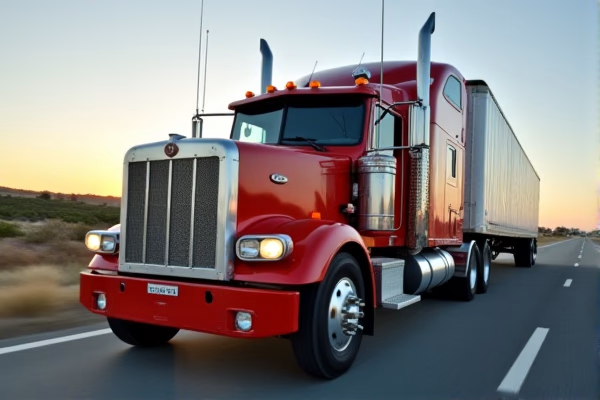
Several types of evidence are crucial in establishing negligence. First, the **driver’s logbook** and **Electronic Logging Device (ELD) data** are paramount. These records reveal whether the driver was adhering to **Hours of Service (HOS)** regulations, as outlined in 49 CFR § 395. Violations, such as driving beyond permitted hours, are strong indicators of negligence. Second, the **truck’s maintenance records** are essential. We examine these records for any evidence of deferred maintenance, faulty repairs, or violations of California’s commercial vehicle safety framework, as defined in CVC § 34500.
Third, the **black box** or **Event Data Recorder (EDR)** on the truck can provide valuable information about speed, braking, and other critical factors leading up to the crash. Fourth, **dashcam footage** from the truck itself or from other vehicles can offer a direct visual account of the accident. Finally, **FMCSA records** detailing the driver’s history, including any prior violations or accidents, are also vital. We often find that a pattern of negligent behavior exists, which strengthens the case significantly.
How can a trucking company be held liable for a driver’s negligence?
Under the doctrine of **vicarious liability** (respondeat superior), a trucking company can be held responsible for the negligent actions of its drivers, as established in Civ. Code § 2338. This means that if a driver is at fault in an accident, the company can be held liable for the resulting damages. However, liability isn’t limited to just the driver’s actions. A company can also be directly liable if it was negligent in hiring, training, or supervising the driver.
For example, if the company failed to conduct a thorough background check, hired a driver with a history of reckless driving, or failed to provide adequate training, they could be held directly liable for **negligent hiring**. Similarly, if the company pressured the driver to violate HOS regulations or failed to properly maintain the truck, they could be found negligent. Proving these types of failures requires a deep dive into the company’s policies and procedures.
What if the truck driver was an independent contractor, not an employee?
Determining whether a driver is an employee or an independent contractor is a complex legal issue. California’s ‘ABC test,’ outlined in Labor Code § 2775, is used to make this determination. If a company exercises significant control over the driver’s work – dictating routes, schedules, or methods – they may be considered an employee, even if labeled as a contractor. Even if a driver is technically classified as an independent contractor, the trucking company can still be held liable if they exercised control over the driver’s work.
This is a common tactic used by trucking companies to avoid liability. They attempt to classify drivers as contractors to shield themselves from responsibility. However, we’ve successfully litigated cases where we’ve proven that the company exerted enough control to establish an employer-employee relationship, making them liable for the driver’s negligence.
What is statutory negligence in the context of trucking accidents?
Statutory negligence occurs when a driver violates a law designed to protect public safety, and that violation directly causes an accident. In California, commercial trucks are strictly prohibited from exceeding **55 miles per hour** on any highway, as stated in CVC § 22406. If a truck driver is traveling above this speed limit at the time of the crash, it’s considered statutory negligence. Proving this often involves analyzing the EDR data or relying on witness testimony.
Other examples of statutory negligence include violations of HOS regulations, improper lane usage, or failure to properly secure cargo. These violations create a presumption of negligence, making it easier to establish liability. In San Diego freeway crashes, proving a violation of a speed limit is a primary tool for establishing statutory negligence.
What should I do immediately after a truck accident?
If you’ve been involved in a truck accident, it’s crucial to take immediate steps to protect your rights. First, **seek medical attention** even if you don’t feel immediately injured. Some injuries may not be apparent right away. Second, **document everything** – take photos of the scene, the vehicles, and your injuries. Third, **do not speak to the insurance company** without first consulting with an attorney. They are skilled at minimizing payouts and may try to get you to make statements that could harm your case.
Finally, **contact an experienced attorney** as soon as possible. We can handle the investigation, gather evidence, and navigate the complex legal process on your behalf. Don’t try to handle this on your own – the trucking company will have a team of lawyers working against you. Protecting your rights and maximizing your recovery requires the expertise of a qualified legal professional.
What is the statute of limitations for filing a truck accident lawsuit in California?
California law provides a **two-year** window from the date of the truck accident to file a lawsuit, as defined in CCP § 335.1. Because trucking companies often begin evidence destruction (like purging ELD data) as soon as the law allows, immediate filing is critical to preserve the integrity of the claim. Waiting too long can result in the loss of your right to recover damages.
It’s important to note that the statute of limitations can be complex, especially in cases involving government entities or multiple parties. We can help you determine the applicable deadline and ensure that your claim is filed on time.
What if the accident involved a government vehicle or a dangerous road condition?
If a truck accident involves a government-owned vehicle or a dangerous road condition maintained by a public entity, a formal administrative claim **MUST** be presented within **6 months** (180 days) under the Government Tort Claims Act, as outlined in Gov. Code § 911.2. This is a strict deadline, and failure to meet it can result in the permanent loss of your right to recover. The claim must be detailed and supported by evidence, and the government entity will have a limited time to respond.
Navigating the government claim process can be challenging. We have extensive experience handling these types of claims and can ensure that your claim is properly prepared and filed on time.
What if the insurance company is delaying the investigation or offering a low settlement?
Insurance companies often employ delay tactics to try to wear down claimants and pressure them into accepting a low settlement. They may request extensive documentation, conduct lengthy investigations, or simply ignore your calls. It’s important to remain persistent and document all communication with the insurance company. We can handle all communication on your behalf and aggressively pursue your claim.
If the insurance company is offering a settlement that doesn’t adequately compensate you for your injuries, medical expenses, lost wages, and other damages, we can file a lawsuit to protect your rights. We’re prepared to take your case to trial if necessary to ensure that you receive the compensation you deserve.
What if I have medical liens that need to be resolved?
Medical liens arise when healthcare providers provide treatment to injured parties and seek reimbursement for their services. These liens can complicate the settlement process, as they must be resolved before you receive your full recovery. We have extensive experience negotiating with healthcare providers to reduce the amount of the liens and ensure that your settlement is maximized.
We can also explore options for resolving medical liens through Medicare or other insurance programs. Our goal is to protect your financial recovery and ensure that you’re not burdened with excessive medical debt.
What is UM/UIM coverage, and how does it apply to trucking accidents?
Uninsured/Underinsured Motorist (UM/UIM) coverage protects you if you’re injured by an uninsured or underinsured driver. In trucking accidents, this coverage can be particularly important if the truck driver’s insurance policy is insufficient to cover your damages. Your own auto insurance policy may provide UM/UIM coverage, and we can help you determine the extent of your coverage and file a claim.
UM/UIM arbitration procedures can be complex, and it’s important to have an experienced attorney on your side to navigate the process effectively. We can represent you throughout the arbitration process and fight to ensure that you receive the full compensation you deserve.