What Evidence Increases Settlement Value?

As a personal injury attorney practicing in San Diego for over 13 years, I’ve seen this scenario play out far too often. Insurance companies are skilled at minimizing payouts, and they rely on a lack of evidence to undervalue legitimate claims. They are trained to look for weaknesses in your case, and they’ll exploit them if they can. That’s why gathering comprehensive evidence is absolutely critical to maximizing your settlement value.
The more compelling evidence you have, the stronger your negotiating position will be. It’s not simply about proving the other driver was at fault; it’s about demonstrating the full extent of your damages – both economic and non-economic. This includes medical bills, lost wages, pain and suffering, and the impact the injury has had on your daily life. I’ve been trained by former insurance defense attorneys, giving me intimate knowledge of how insurance companies evaluate, devalue, and deny claims.
What types of evidence are most valuable in a truck accident claim?
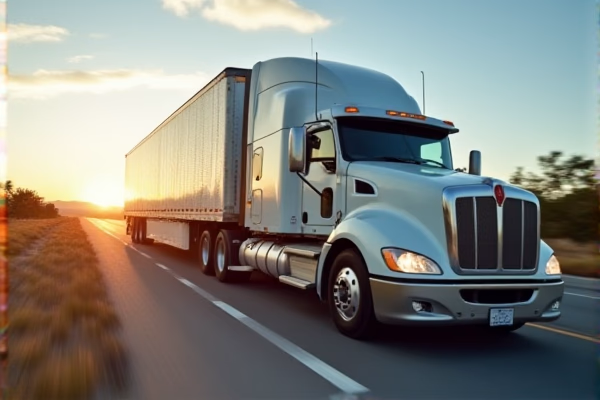
Several types of evidence can significantly increase the value of your truck accident settlement. Police reports are a foundational piece, but they’re often incomplete or biased. Witness statements, especially from independent bystanders, are incredibly powerful. Photos and videos of the accident scene, including damage to all vehicles involved, are essential. Crucially, obtaining the truck’s Event Data Recorder (EDR) data – often referred to as the “black box” – can reveal critical information about speed, braking, and driver fatigue.
Medical records are paramount. These must document the full extent of your injuries, treatment plan, and prognosis. Expert testimony from doctors and other specialists can help explain the severity of your injuries and their long-term impact. Finally, documentation of lost wages, rehabilitation costs, and any modifications needed to your home or vehicle can bolster your economic damages claim.
How does the truck driver’s logbook affect my claim?
Truck driver logbooks, now primarily Electronic Logging Devices (ELDs), are vital pieces of evidence. Federal Hours of Service (HOS) regulations dictate exactly how long a driver can be behind the wheel. Violations of these federal safety standards, often proven through Electronic Logging Device (ELD) data, are used to demonstrate driver fatigue. If a driver was operating outside of these regulations at the time of the accident, it can be a strong indication of negligence and significantly increase your settlement value.
ELD data can also reveal falsification of records, which is a serious offense. In San Diego truck litigation, we often subpoena these records directly from the trucking company to ensure their authenticity and completeness. It’s important to note that trucking companies are legally obligated to maintain accurate logbooks, and any attempt to conceal or alter these records can be used against them in court.
What if the accident involved a government vehicle or roadway defect?
If a truck accident involves a government-owned vehicle or a dangerous road condition maintained by a public entity, a formal administrative claim MUST be presented within 6 months (180 days). Failure to meet this strict deadline under the Government Tort Claims Act can result in the permanent loss of your right to recover. These claims often involve complex investigations and require a thorough understanding of government liability laws.
Evidence in these cases can include maintenance records, repair logs, and incident reports documenting prior complaints about the road condition. We also investigate whether the government entity was aware of the hazard and failed to take appropriate action to address it. Proving negligence on the part of a government entity can be challenging, but it’s often necessary to secure a fair settlement.
Can dashcam footage from other vehicles help my case?
Dashcam footage is incredibly valuable evidence in truck accident claims. It provides an unbiased, objective record of the events leading up to the crash. Even if your own vehicle didn’t have a dashcam, footage from other vehicles in the area can corroborate your account of the accident and establish the other driver’s negligence. We routinely canvass the area for potential dashcam footage and work with local businesses and residents to obtain it.
Furthermore, telematics data from the truck itself – which records speed, braking, and other driving metrics – can be crucial. Similarly, ECM/EDR data provides a detailed account of the truck’s operation. Obtaining this data requires a subpoena and a thorough understanding of its technical complexities.
What role does the trucking company’s safety record play in my settlement?
The trucking company’s safety record is a critical factor in determining settlement value. A history of FMCSA violations, including safety inspections, driver qualifications, and maintenance issues, can demonstrate a pattern of negligence and increase your chances of a successful outcome. We conduct thorough background checks on the trucking company and its drivers to uncover any red flags.
Under the doctrine of vicarious liability (respondeat superior), a principal is responsible to third persons for the negligence of their agent in the transaction of business. This holds the trucking company legally liable for the wrongful acts of its drivers committed within the scope of their employment. A poor safety record can also be used to argue that the company was negligent in its hiring, training, or supervision of the driver.
What if the other driver claims I was partially at fault?
California’s ‘pure’ comparative fault system applies to trucking claims. Even if a truck driver argues you shared responsibility, you can still recover damages; however, your total compensation will be reduced by your percentage of fault. It’s crucial to gather evidence that contradicts their claims and demonstrates your own reasonable care. This can include witness statements, photos of the accident scene, and expert testimony reconstructing the events leading up to the crash.
Insurance companies often employ tactics to inflate your percentage of fault, so it’s important to be prepared to defend your position. We thoroughly investigate all aspects of the accident and work to minimize your liability to maximize your settlement value.
What happens if the truck driver was an independent contractor, not an employee?
Determining whether a delivery driver (Amazon/FedEx) is an employee or contractor is complex. Even if labeled a ‘contractor,’ a company may be liable if they exercise control over the driver’s work, a key factor in San Diego delivery truck litigation. California’s ‘ABC test’ determines if a driver is an employee or contractor. We investigate the level of control the trucking company exerted over the driver, including scheduling, route assignments, and equipment maintenance.
If the driver is deemed an employee, the trucking company is directly liable for their actions. However, even if the driver is classified as an independent contractor, the company may still be liable if they were negligent in hiring or supervising them.
What if I signed a recorded statement to the insurance company?
Recorded statements to insurers can be detrimental to your claim. Insurance adjusters are trained to ask leading questions and elicit information that minimizes their liability. It’s crucial to avoid giving a recorded statement without first consulting with an attorney. If you have already provided a statement, we can review it for inconsistencies or misrepresentations that may weaken your case.
We advise our clients to direct all communication with the insurance company through our office. This ensures that your rights are protected and that you don’t inadvertently say something that could harm your claim.
What if I have medical liens that need to be resolved?
Medical liens and reimbursement claims can complicate your truck accident settlement. These liens represent the right of healthcare providers to recover payment for services rendered. We work with healthcare providers to negotiate reasonable lien amounts and ensure that your settlement funds are distributed appropriately. ER billing vs. medical liens can be a complex issue, and we have experience navigating these challenges.
It’s important to understand the different types of medical liens and their priority. We can also explore options for reducing or eliminating liens through Medicare or other programs.
What if I’m facing a deadline to file a government claim?
If a truck accident involves a government-owned vehicle or a dangerous road condition maintained by a public entity, a formal administrative claim MUST be presented within 6 months (180 days). Failure to meet this strict deadline under the Government Tort Claims Act can result in the permanent loss of your right to recover. These claims often require specific formatting and documentation, and it’s crucial to adhere to all procedural requirements.
We have extensive experience filing government claims and ensuring that they are properly documented and submitted on time.
What if the insurance company makes a policy limits tender?
A policy limits tender is an offer from the insurance company to settle your claim for the maximum amount of their policy coverage. While it may seem like a generous offer, it’s important to carefully consider whether it adequately compensates you for all of your damages. We evaluate the full extent of your losses and advise you on whether to accept or reject the tender.
We also explore potential sources of additional coverage, such as excess insurance policies or other responsible parties.
What if the insurance company is delaying the claim or stalling the investigation?
Delay and stalling tactics by insurers are common. They may request additional information, conduct unnecessary investigations, or simply fail to respond to your inquiries in a timely manner. We aggressively pursue your claim and hold the insurance company accountable for their actions. We can file a lawsuit to compel them to provide information and expedite the investigation.
It’s important to document all communication with the insurance company and keep a record of any delays or unreasonable requests.
As a personal injury attorney in San Diego with over 13 years of experience, I understand the complexities of truck accident litigation. I’ve helped countless clients recover the compensation they deserve after suffering serious injuries. If you’ve been involved in a truck accident, don’t hesitate to contact my office for a free consultation.