
What Happens If A Garbage Truck Causes An Accident In San Diego?

Accidents involving garbage trucks present unique challenges compared to typical car crashes. Their size and weight significantly increase the risk of severe injuries, and the companies operating them often have dedicated legal teams prepared to defend against liability. Understanding your rights and the specific laws governing these incidents is crucial to securing the compensation you deserve.
One of the first things to consider is establishing negligence. This could stem from driver error – distracted driving, speeding, or failing to yield – but also from improper vehicle maintenance or inadequate training of the driver. Garbage trucks are subject to strict federal and state regulations regarding safety inspections and operational standards, and any violation of these rules can be used to build a strong case.
I’ve been practicing personal injury law in San Diego for over 13 years, and I’ve seen firsthand how insurance companies attempt to minimize payouts in these types of cases. I was trained by a former insurance defense attorney, giving me intimate knowledge of how they evaluate, devalue, and deny claims. This insight allows me to anticipate their tactics and build a robust defense for my clients.
What types of damages can I recover after a garbage truck accident?
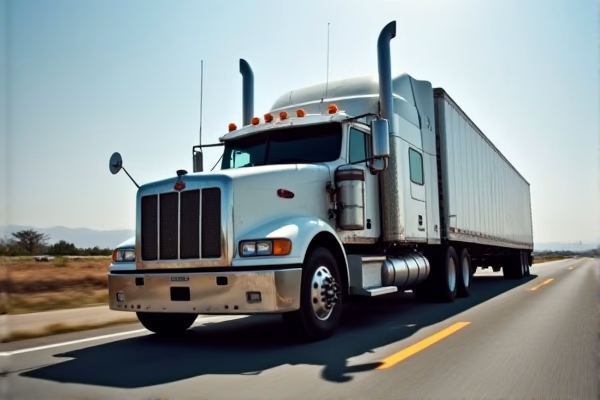
Following a garbage truck accident, you may be entitled to recover a wide range of damages, designed to compensate you for all losses resulting from the incident. These damages can be broadly categorized as economic and non-economic. Economic damages include quantifiable financial losses such as medical expenses – past, present, and future – lost wages, property damage, and rehabilitation costs. These are relatively straightforward to calculate with proper documentation.
Non-economic damages, however, are more subjective and relate to the intangible impacts of the accident. This includes pain and suffering, emotional distress, loss of enjoyment of life, and permanent disfigurement or disability. Establishing the value of these damages requires a thorough understanding of the severity of your injuries and their long-term effects on your quality of life.
In some cases, punitive damages may also be available if the garbage truck company acted with gross negligence or reckless disregard for the safety of others. This is reserved for particularly egregious conduct and is intended to punish the company and deter similar behavior in the future.
How does California law affect my claim against a garbage truck company?
California law provides a **two-year** window from the date of the truck accident to file a lawsuit. Because trucking companies often begin evidence destruction (like purging ELD data) as soon as the law allows, immediate filing is critical to preserve the integrity of the claim. It’s important to note that this statute of limitations applies to both property damage and personal injury claims.
Furthermore, California’s ‘pure’ comparative fault system applies to trucking claims. Even if a truck driver argues you shared responsibility, you can still recover damages; however, your total compensation will be reduced by your percentage of fault. This means that even if you were partially at fault for the accident, you may still be able to recover a portion of your losses.
Under the doctrine of **vicarious liability** (respondeat superior), a principal is responsible to third persons for the negligence of their agent in the transaction of business. This holds the trucking company legally liable for the wrongful acts of its drivers committed within the scope of their employment.
What should I do immediately after an accident with a garbage truck?
The immediate aftermath of a garbage truck accident is critical for preserving your legal rights. First and foremost, ensure your safety and seek medical attention, even if you don’t feel immediate pain. Many injuries, such as internal bleeding or whiplash, may not be apparent right away. Next, if possible, gather information at the scene, including the garbage truck’s license plate number, the driver’s contact information, and the name of the waste management company.
It’s also important to document the accident scene thoroughly. Take photos of the damage to all vehicles involved, the surrounding area, and any visible injuries. If there are any witnesses, obtain their contact information as well. Crucially, avoid making any statements to the garbage truck company or their insurance representative without first consulting with an attorney.
Finally, report the accident to the police and obtain a copy of the police report. This report will serve as an important piece of evidence in your claim.
What role do federal regulations play in garbage truck accident claims?
Federal **Hours of Service (HOS)** regulations dictate exactly how long a driver can be behind the wheel. Violations of these federal safety standards, often proven through Electronic Logging Device (ELD) data, are used to demonstrate driver fatigue. Garbage truck drivers, like all commercial drivers, are subject to these regulations, and any breach can be a strong indicator of negligence.
Additionally, commercial vehicles are subject to rigorous safety and inspection regulations. Failure to maintain brakes, tires, or lighting systems according to California’s commercial vehicle safety framework can be used to establish direct liability against the carrier for ‘negligent maintenance’. These regulations are designed to ensure the safe operation of these vehicles, and any violation can have devastating consequences.
Furthermore, the Federal Motor Carrier Safety Administration (FMCSA) maintains a database of safety records for all commercial drivers and trucking companies. This database can provide valuable information about a driver’s history of violations and accidents, which can be used to strengthen your claim.
What if the garbage truck driver was a contractor, not an employee?
California’s ‘ABC test’ determines if a delivery driver (Amazon/FedEx) is an employee or contractor. Even if labeled a ‘contractor,’ a company may be liable if they exercise control over the driver’s work, a key factor in San Diego delivery truck litigation. Misclassifying employees as independent contractors is a common tactic used by companies to avoid liability, but it’s often unsuccessful if the company maintains significant control over the driver’s operations.
Determining whether a driver is an employee or contractor requires a careful analysis of the specific facts of the case. Factors considered include the level of control the company exercises over the driver’s work schedule, the tools and equipment provided by the company, and the method of payment. An experienced attorney can help you navigate this complex legal issue.
It’s important to remember that even if a driver is classified as a contractor, the company may still be liable for their negligence if they were negligent in hiring or supervising the driver.
What if I have workers’ compensation benefits, can I still sue the garbage truck company?
If a commercial driver is injured on the job in San Diego, they are entitled to workers’ compensation. However, workers’ compensation is generally the **exclusive remedy** against the employer. Separate personal injury claims are typically limited to **negligent third parties** who are not the employer. This means that if your injuries were caused by the negligence of another driver or a defective vehicle component, you may still be able to pursue a claim against the responsible party.
California law preserves the right to pursue a separate civil claim against a **negligent third party** whose actions contributed to the truck accident, even when workers’ compensation benefits apply. This allows you to recover damages beyond those available through workers’ compensation, such as pain and suffering and loss of enjoyment of life.
Under Labor Code § 3601, lawsuits against co-employees are also barred unless the injury was caused by the co-employee’s **intoxication** or a **willful act of aggression**.
What if the garbage truck company offers me a policy limits settlement quickly?
Insurance companies often attempt to settle claims quickly for the policy limits, hoping to avoid a costly trial. This is known as a policy limits tender. While accepting a policy limits settlement may seem appealing, it’s crucial to understand the implications before making a decision. A policy limits tender often means the insurance company believes the claim is worth more than the policy limits and is attempting to limit their exposure.
Before accepting any settlement offer, it’s essential to have an attorney thoroughly evaluate your case and determine its true value. An attorney can negotiate with the insurance company on your behalf and potentially secure a higher settlement amount. They can also investigate whether there are other sources of recovery, such as excess insurance policies.
In some cases, it may be necessary to file a lawsuit to protect your rights and pursue a full and fair recovery.
What should I do if the insurance company asks me to give a recorded statement?
Insurance companies routinely request recorded statements from claimants after an accident. While you are not legally obligated to provide a statement, doing so can be detrimental to your claim. Insurance adjusters are trained to ask leading questions designed to minimize your damages and undermine your credibility. They may attempt to elicit statements that contradict your version of events or downplay the severity of your injuries.
It’s best to politely decline the request for a recorded statement and refer the insurance company to your attorney. Your attorney can handle all communication with the insurance company on your behalf and ensure that your rights are protected.
Remember, anything you say in a recorded statement can be used against you in court, so it’s crucial to avoid making any statements without first consulting with legal counsel.
What if there was a dashcam video of the accident?
Dashcam / digital evidence (telematics, ECM/EDR, ELD, GPS) can be invaluable in establishing liability in a garbage truck accident. If the garbage truck was equipped with a dashcam, or if other vehicles at the scene captured footage of the accident, it’s crucial to obtain this evidence as quickly as possible. Dashcam videos can provide a clear and objective record of the events leading up to the accident, which can be used to support your claim.
However, it’s important to be aware that insurance companies may attempt to control access to this evidence. They may argue that the video is privileged or that it’s not relevant to the case. An experienced attorney can help you obtain the dashcam video and ensure that it’s properly preserved and analyzed.
Evidence preservation and documentation timelines (spoliation letters, data overwrite windows) are critical. Garbage truck companies have a legal obligation to preserve evidence related to the accident, but they may not always comply with this obligation. If you suspect that evidence has been destroyed or altered, an attorney can help you file a spoliation letter demanding its preservation.
What if I received medical bills, but the insurance company is only offering to pay a fraction of the amount?
ER billing vs. medical liens and reimbursement claims are common issues in truck accident cases. Insurance companies often attempt to reduce medical expenses by arguing that they are unreasonable or unnecessary. They may also dispute the amount of your medical bills, claiming that they are inflated or that you received unnecessary treatment.
It’s important to gather all of your medical records and bills and provide them to your attorney. An attorney can review these records and determine whether the insurance company’s denial is justified. They can also negotiate with the insurance company on your behalf to secure a fair settlement amount for your medical expenses.
If you have a medical lien, your attorney can help you resolve the lien and ensure that your medical bills are paid.
What if the government owned the road or vehicle involved in the accident?
If a truck accident involves a government-owned vehicle or a dangerous road condition maintained by a public entity, a formal administrative claim **MUST** be presented within **6 months** (180 days). Failure to meet this strict deadline under the Government Tort Claims Act can result in the permanent loss of your right to recover. These claims are often complex and require specific documentation and procedures.
It’s crucial to consult with an attorney as soon as possible if you believe the government may be liable for your injuries. An attorney can help you prepare and file the administrative claim and ensure that it meets all of the necessary requirements.
The Government Tort Claims Act has specific requirements for the content and timing of the claim, so it’s important to act quickly and consult with legal counsel.