
What If Fatigue Caused A Fatal Truck Accident?

When a truck accident is caused by driver fatigue, the legal landscape becomes complex. While it’s often clear that fatigue played a role, proving it in court requires a thorough investigation and a deep understanding of federal and state regulations governing commercial drivers. Trucking companies have a legal duty to ensure their drivers are adequately rested and compliant with these rules. A violation of those rules can be powerful evidence of negligence.
The Federal Motor Carrier Safety Administration (FMCSA) sets strict limits on how long a driver can operate a commercial vehicle without rest. These Hours of Service (HOS) regulations are designed to prevent fatigue-related accidents. However, simply knowing the regulations isn’t enough. We need to uncover evidence demonstrating the driver—and the company—violated those rules. This often involves obtaining the driver’s logbooks, Electronic Logging Device (ELD) data, and potentially even the driver’s work schedule.
As a personal injury attorney practicing in San Diego for over 13 years, I’ve seen firsthand how insurance companies attempt to minimize their liability in truck accident cases. I was trained by a former insurance defense attorney, giving me intimate knowledge of how insurance companies evaluate, devalue, and deny claims. They will often argue the driver was within compliance, or that other factors contributed to the accident. That’s why it’s crucial to have an attorney who understands these tactics and can build a strong case on your behalf.
What evidence is needed to prove a truck driver was fatigued?
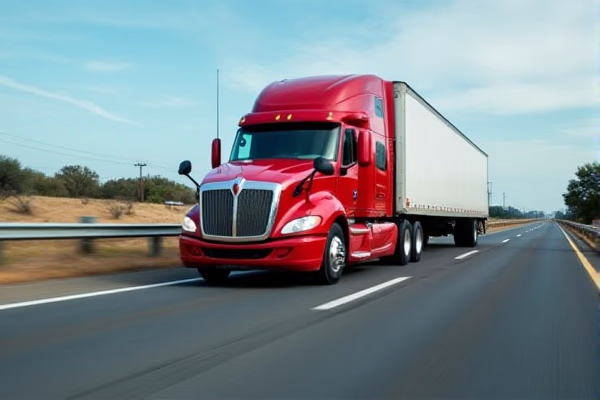
Establishing driver fatigue isn’t always straightforward. It requires gathering compelling evidence to demonstrate the driver was operating while impaired. Key pieces of evidence include the driver’s logbooks, which document their hours of service, and Electronic Logging Device (ELD) data, which provides a more accurate record of driving time. We also look for maintenance records, dispatch logs, and any communication between the driver and the company that might indicate pressure to drive beyond their limits.
Beyond these records, we investigate the driver’s work schedule, looking for patterns of excessive hours or inadequate rest. Witness testimony can also be valuable, particularly if someone observed the driver appearing drowsy or erratic before the accident. In some cases, expert testimony from a sleep specialist may be necessary to explain the effects of fatigue on a driver’s cognitive abilities.
What are the trucking company’s responsibilities regarding driver fatigue?
Trucking companies have a significant legal responsibility to ensure their drivers are fit to operate a commercial vehicle. This includes implementing policies and procedures to prevent fatigue, such as limiting driving hours, providing adequate rest breaks, and monitoring driver compliance with HOS regulations. They are also required to properly train their drivers on the dangers of fatigue and the importance of adhering to safety standards.
If a company fails to meet these obligations, they can be held liable for accidents caused by driver fatigue. This is known as negligent hiring, training, or supervision. We often uncover evidence of systemic issues within the company, such as pressure on drivers to meet unrealistic deadlines or a lack of enforcement of safety regulations.
How does federal regulation impact a truck accident claim?
Federal regulations, specifically those outlined in 49 CFR § 395, play a critical role in truck accident claims involving fatigue. These regulations dictate everything from driving hours to vehicle maintenance and driver qualifications. Violations of these regulations can create a presumption of negligence against the trucking company, making it easier to recover damages.
For example, if a driver’s logbooks show they exceeded the maximum driving hours allowed, or if the ELD data reveals falsified records, this can be strong evidence of negligence. We leverage these federal regulations to build a compelling case against the responsible parties and secure the compensation you deserve.
What if the driver is an independent contractor, not a direct employee?
Determining whether a driver is an employee or an independent contractor can be complex, but it has significant implications for liability. California’s ‘ABC test’ determines if a delivery driver (Amazon/FedEx) is an employee or contractor. Even if labeled a ‘contractor,’ a company may be liable if they exercise control over the driver’s work, a key factor in San Diego delivery truck litigation. If the company exerts significant control over the driver’s work schedule, routes, or equipment, they may be considered an employer for legal purposes.
This means the company could be held liable for the driver’s negligence, even if they claim the driver is an independent contractor. We carefully analyze the relationship between the driver and the company to determine the appropriate level of liability.
What is the statute of limitations for filing a truck accident claim in California?
In California, you have a limited time to file a lawsuit after a truck accident. CCP § 335.1 “…California law provides a **two-year** window from the date of the truck accident to file a lawsuit. Because trucking companies often begin evidence destruction (like purging ELD data) as soon as the law allows, immediate filing is critical to preserve the integrity of the claim.” Waiting too long can result in the loss of your right to recover compensation. It’s crucial to consult with an attorney as soon as possible to understand your rights and ensure your claim is filed within the deadline.