
Are Dump Truck Drivers Held To Commercial Driving Laws?

The question of whether dump truck drivers are held to the same rigorous standards as other commercial drivers is a critical one, and the answer is a resounding yes. While they may not always be hauling goods across state lines, dump truck operators are subject to a complex web of federal and California regulations designed to ensure public safety. These regulations cover everything from licensing and vehicle maintenance to hours of service and drug testing. Ignoring these rules can have devastating consequences, as Alistair’s case tragically demonstrates.
A key aspect of this legal framework is the concept of vicarious liability. Under the doctrine of **vicarious liability** (respondeat superior), a principal is responsible to third persons for the negligence of their agent in the transaction of business. This means that the trucking company employing the driver can be held liable for the driver’s actions, even if the company itself wasn’t directly negligent. This is a crucial point for injured parties, as it often provides a deeper pocket to pursue compensation from.
I’ve been practicing personal injury law in San Diego for over 13 years, and I’ve seen firsthand how insurance companies attempt to minimize their exposure in these cases. Trained by a former insurance defense attorney, I have intimate knowledge of how they evaluate, devalue, and deny claims. They will often focus on the individual driver’s actions, attempting to portray them as solely responsible, while downplaying the company’s role in inadequate training, faulty maintenance, or pressure to violate safety regulations. It’s my job to cut through that noise and hold all responsible parties accountable.
Are dump truck drivers required to have a Commercial Driver’s License (CDL)?
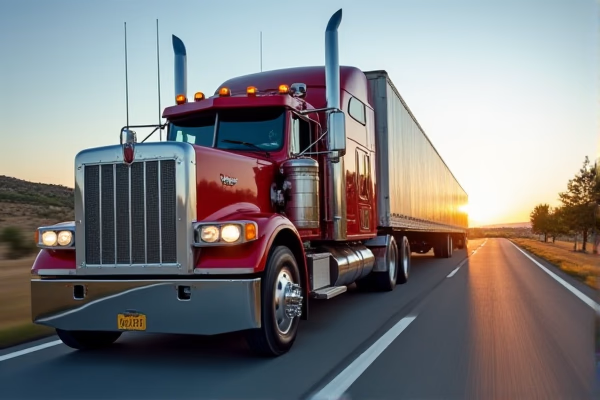
Generally, yes. Any driver operating a dump truck with a gross vehicle weight rating (GVWR) of 26,001 pounds or more is required to possess a valid Commercial Driver’s License (CDL). The specific class of CDL required will depend on the type of vehicle and the cargo being transported. Operating a dump truck without the proper CDL is a serious violation that can lead to significant penalties, and it’s often a strong indicator of negligence in a civil lawsuit.
Furthermore, a CDL isn’t just a piece of paper; it requires ongoing training and compliance with federal and state regulations. Drivers must pass rigorous knowledge and skills tests, and they are subject to regular medical examinations to ensure they are physically and mentally fit to operate a large commercial vehicle. Any lapse in CDL compliance can be used to demonstrate the driver’s unfitness and the company’s negligence.
What federal regulations apply to dump truck drivers regarding hours of service?
Dump truck drivers are subject to the same **Hours of Service (HOS)** regulations as other commercial drivers, as outlined in **49 CFR § 395**. These regulations dictate exactly how long a driver can be behind the wheel without taking mandatory rest breaks. The purpose of these rules is to prevent driver fatigue, which is a major contributing factor to truck accidents. Violations of HOS regulations are often proven through Electronic Logging Device (ELD) data.
It’s important to note that the HOS regulations are complex and can be difficult to navigate. Drivers are often under pressure from their employers to meet tight deadlines, which can lead them to violate these rules. If a driver has been operating a dump truck while fatigued, it can significantly increase their risk of causing an accident. Evidence of HOS violations is often a key piece of evidence in a trucking claim.
Can a trucking company be held liable for negligent hiring or training of a dump truck driver?
Absolutely. A trucking company is directly liable if it was negligent in hiring, supervising, or retaining an unfit driver. This is critical in cases where the driver has a history of FMCSA violations or lacked the proper CDL endorsements. This is established under **CACI No. 426**. Companies have a duty to thoroughly vet potential employees, conduct background checks, and provide adequate training to ensure they are competent and safe operators.
If a company knowingly hires a driver with a poor driving record or fails to provide them with the necessary training, they can be held liable for any accidents caused by that driver. This is especially true if the company was aware of the driver’s deficiencies but failed to take corrective action. Evidence of inadequate hiring practices or training protocols can be a powerful tool in a trucking claim.
What if the dump truck accident was caused by faulty maintenance?
Commercial vehicles are subject to rigorous safety and inspection regulations. Failure to maintain brakes, tires, or lighting systems according to California’s commercial vehicle safety framework can be used to establish direct liability against the carrier for ‘negligent maintenance’. This is outlined in **CVC § 34500**. Trucking companies are required to regularly inspect and maintain their vehicles to ensure they are in safe operating condition.
If a dump truck accident was caused by a mechanical failure, such as faulty brakes or a blown tire, the trucking company can be held liable for failing to properly maintain the vehicle. This often requires expert testimony to demonstrate that the failure was due to negligence on the part of the company. Proper documentation of maintenance records is crucial in these cases.
What should I do if a government-owned dump truck was involved in my accident?
If a truck accident involves a government-owned vehicle or a dangerous road condition maintained by a public entity, a formal administrative claim **MUST** be presented within **6 months** (180 days). Failure to meet this strict deadline under the Government Tort Claims Act can result in the permanent loss of your right to recover. This is outlined in **Gov. Code § 911.2**. These claims are often complex and require specific formatting and documentation.
It’s crucial to consult with an attorney as soon as possible if a government entity is involved in your truck accident. They can help you navigate the complex claims process and ensure that you meet all the necessary deadlines and requirements. Failing to do so can jeopardize your ability to recover compensation for your injuries and damages.