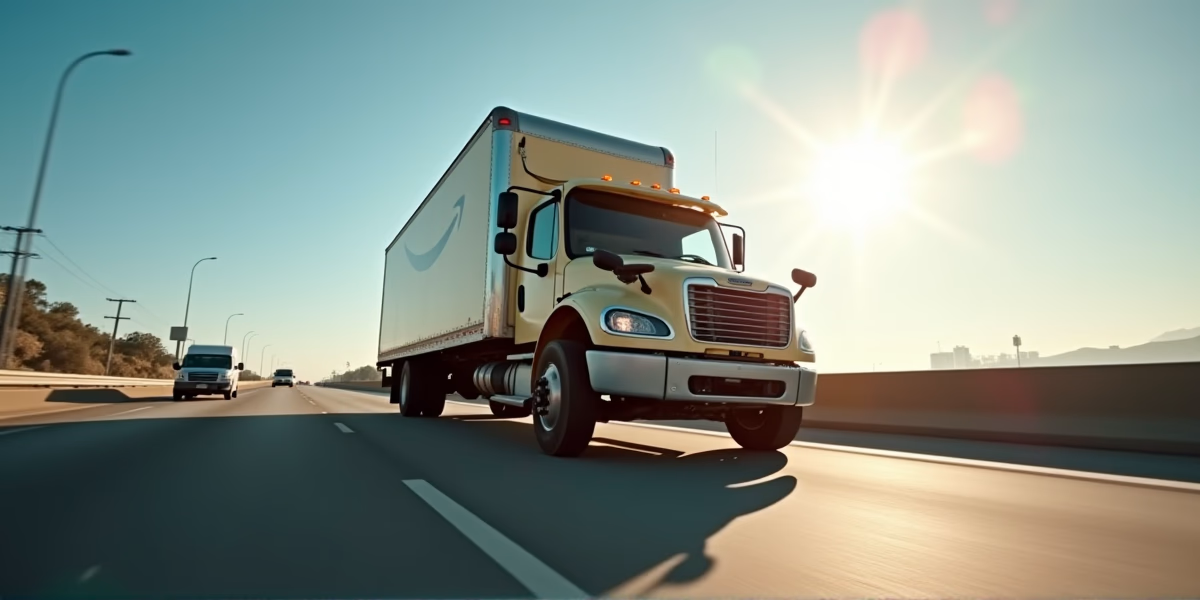
Are Trucking Companies Responsible For Employee Drivers?

The question of whether a trucking company is responsible for the actions of its drivers is a complex one, deeply rooted in the legal principles of agency and vicarious liability. Generally, trucking companies *can* be held liable for the negligence of their drivers, but it’s not automatic. The key is establishing a legally recognized employer-employee relationship and proving the driver was acting within the “scope of their employment” at the time of the accident. This means the driver was performing work duties, following company policies (or deviating from them in a way that still benefits the company), and operating the truck with the intent to further the company’s business.
Determining this relationship isn’t always straightforward. Companies often misclassify drivers as independent contractors to avoid liability for accidents and other legal issues. However, California law takes a very strict view of this classification. If a company exercises significant control over the driver’s work – dictating routes, schedules, or even the manner in which the driving is performed – the driver is likely considered an employee, regardless of what the contract says. This is where a thorough investigation becomes crucial, examining things like company policies, training manuals, dispatch logs, and payment structures.
I’ve spent over 13 years practicing personal injury law here in San Diego, and a significant portion of my practice focuses on truck accident litigation. I was fortunate early in my career to be trained by a former insurance defense attorney, giving me intimate knowledge of how insurance companies evaluate, devalue, and deny claims. This insight allows me to anticipate their strategies and build stronger cases for my clients.
What evidence is needed to prove a trucking company was responsible?
Establishing liability against a trucking company requires more than just proving the driver was at fault. You need to demonstrate the company was negligent in some way. This can take several forms. For example, if the company failed to properly vet the driver’s background, allowing someone with a history of reckless driving to operate a commercial vehicle, that’s negligence. Similarly, inadequate training, failure to enforce safety regulations, or knowingly allowing a fatigued driver to continue operating a truck can all be grounds for a claim.
Critical evidence includes the driver’s employment file, training records, and any disciplinary actions. Dispatch logs and electronic logging device (ELD) data can reveal whether the driver was complying with federal Hours of Service regulations. Maintenance records are also vital, as they can show if the company was properly maintaining the truck and addressing any known mechanical issues. Often, obtaining this information requires a subpoena or a formal discovery request.
Furthermore, proving the company knew or *should have known* about the driver’s unsafe practices is often key. This might involve uncovering prior complaints about the driver, internal safety reports, or even similar accidents involving other drivers within the company.
How does the “ABC test” affect liability in delivery truck accidents?
California’s “ABC test,” as outlined in Labor Code § 2775, is frequently relevant in cases involving delivery drivers for companies like Amazon or FedEx. This test determines whether a worker is an employee or an independent contractor. If a driver is deemed an employee, the company is much more likely to be held liable for their actions.
The ABC test has three prongs. First, the worker must be free to exercise control over how they perform their work. Second, the worker must perform work that is outside the usual course of the company’s business. And third, the worker must be customarily engaged in an independently established trade, occupation, or profession. If any of these prongs are not met, the driver is likely considered an employee.
In San Diego delivery truck litigation, companies often attempt to classify drivers as independent contractors to avoid liability. However, if the company dictates routes, schedules, or provides specific equipment, it’s a strong indication the driver is an employee under the ABC test.
What if the truck accident involved a government vehicle or roadway hazard?
If a truck accident involves a government-owned vehicle or a dangerous road condition maintained by a public entity, the rules change significantly. You must file a formal administrative claim within a very strict timeframe. As stated in Gov. Code § 911.2, this claim **MUST** be presented within **6 months** (180 days) of the accident.
This claim must include detailed information about the accident, your injuries, and the damages you’ve incurred. Failure to meet this deadline under the Government Tort Claims Act can result in the permanent loss of your right to recover. It’s crucial to consult with an attorney immediately if your accident involved a government entity to ensure you comply with all the necessary procedures.
These claims are often complex and require a thorough understanding of California’s Government Tort Claims Act. The government entity will investigate the claim and may deny it, requiring you to file a lawsuit to pursue your case further.
What is “vicarious liability” and how does it apply to trucking companies?
The legal doctrine of “vicarious liability,” also known as *respondeat superior*, is a cornerstone of many trucking accident claims. Under Civ. Code § 2338, a principal (the trucking company) is responsible to third persons for the negligence of their agent (the driver) in the transaction of business. Essentially, the company is held legally liable for the wrongful acts of its drivers committed within the scope of their employment.
This means that even if the driver was personally negligent, the company can be held accountable for their actions. The key is proving the driver was acting as an agent of the company at the time of the accident. This is often established through employment contracts, dispatch records, and evidence of the company’s control over the driver’s work.
Successfully pursuing a claim under the doctrine of vicarious liability can significantly increase your chances of recovering full compensation for your injuries and damages.
What are the penalties for a truck driver exceeding the speed limit in California?
In California, commercial trucks, including semi-tractors with three or more axles, are strictly prohibited from exceeding **55 miles per hour** on any highway. As outlined in CVC § 22406, proving a violation of this speed limit is a primary tool for establishing statutory negligence in San Diego freeway crashes.
Exceeding the speed limit not only increases the risk of an accident but also creates a presumption of negligence. This means the driver is automatically considered at fault, shifting the burden of proof to the driver to demonstrate they were not negligent. Evidence of speeding can come from the truck’s ECM/EDR (Event Data Recorder), dashcam footage, or witness testimony.
Furthermore, a speeding violation can be used to argue that the company was negligent in its hiring, training, or supervision of the driver.
What if the driver has a history of FMCSA violations?
If the truck driver has a history of violations with the Federal Motor Carrier Safety Administration (FMCSA), this can be powerful evidence of negligence. Negligent hiring, supervision, or retention of an unfit driver is a direct cause of action, as described in CACI No. 426. Trucking companies have a duty to thoroughly vet their drivers and ensure they are qualified to operate a commercial vehicle safely.
A background check should reveal any prior accidents, traffic violations, or drug and alcohol offenses. The company also has a responsibility to monitor the driver’s performance and address any red flags. If the company knew or should have known about the driver’s unsafe practices but failed to take action, they can be held liable for the resulting accident.
Obtaining the driver’s FMCSA record requires a formal request, but it can provide valuable insight into their driving history and any potential safety concerns.
How important are maintenance records in a trucking accident claim?
Maintenance records are absolutely critical in a trucking accident claim. Commercial vehicles are subject to rigorous safety and inspection regulations, and failure to maintain brakes, tires, or lighting systems according to California’s commercial vehicle safety framework can be used to establish direct liability against the carrier for ‘negligent maintenance’. This is codified in CVC § 34500.
These records should show regular inspections, repairs, and preventative maintenance. If the records are incomplete, missing, or indicate a pattern of neglected maintenance, it’s a strong indication the company was negligent. This negligence can contribute to the accident, especially if a mechanical failure was a contributing factor.
Expert testimony from a qualified mechanic may be necessary to analyze the maintenance records and determine if the company was adhering to proper safety standards.
What role do federal Hours of Service regulations play in truck accident claims?
Federal **Hours of Service (HOS)** regulations dictate exactly how long a driver can be behind the wheel. Violations of these federal safety standards, often proven through Electronic Logging Device (ELD) data, are used to demonstrate driver fatigue. These regulations are detailed in 49 CFR § 395.
Fatigue is a major contributing factor in many truck accidents. When a driver is overworked and sleep-deprived, their reaction time slows, their judgment is impaired, and their risk of an accident increases significantly. ELD data provides a clear record of the driver’s hours of service, making it easier to prove a violation of federal regulations.
Even if the driver wasn’t involved in an accident immediately after exceeding their hours of service limit, the violation can still be used as evidence of negligence.
What happens if a commercial driver is injured on the job?
If a commercial driver is injured on the job in San Diego, they are entitled to workers’ compensation. However, workers’ compensation is generally the **exclusive remedy** against the employer. This means you typically cannot sue your employer directly for your injuries. Separate personal injury claims are typically limited to **negligent third parties** who are not the employer, as outlined in Labor Code § 3600.
This can be a complex situation, especially if the accident was caused by a faulty vehicle or the negligence of another driver. An experienced attorney can help you navigate the workers’ compensation system and explore your options for pursuing a separate personal injury claim.
It’s important to understand your rights and obligations under California’s workers’ compensation laws to ensure you receive the benefits you deserve.