Can Cargo Loaders Be Held Responsible For A Crash?

Many assume the truck driver is always at fault in these situations, but that’s not necessarily true. Often, the responsibility extends beyond the person behind the wheel. In Javier’s case, we discovered the cargo loader, responsible for securing the truck’s massive shipment of steel coils, had failed to properly restrain the load. This resulted in a significant weight shift during the turn, making it nearly impossible for the driver to maintain control, even before the red light violation.
Determining liability in these scenarios requires a deep understanding of trucking regulations and the legal responsibilities of all parties involved. It’s not just about proving the driver was negligent; it’s about identifying every potential contributor to the crash and holding them accountable for the resulting damages.
For over 13 years, I’ve represented clients injured in truck accidents throughout San Diego. I was trained by a former insurance defense attorney, giving me intimate knowledge of how insurance companies evaluate, devalue, and deny claims. This experience allows me to anticipate their tactics and build a strong case to maximize your recovery.
What are the legal duties of a cargo loader?
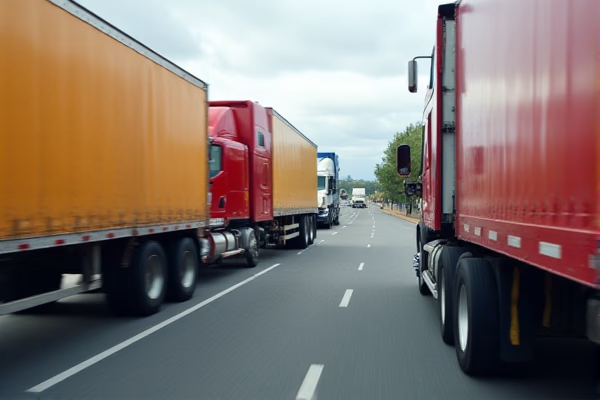
Cargo loaders aren’t simply individuals strapping boxes into a trailer. They have a legally defined duty of care to ensure the load is properly secured, balanced, and compliant with federal and state regulations. This includes verifying the weight distribution, using the correct tie-down equipment, and accurately documenting the loading process. Failure to adhere to these standards can create a dangerous situation on the road, leading to catastrophic consequences.
Specifically, cargo loaders must comply with the Federal Motor Carrier Safety Administration (FMCSA) regulations outlined in 49 CFR § 395, which detail the securement requirements for various types of cargo. These regulations are complex and often require specialized knowledge to interpret correctly. A violation of these rules is considered negligence *per se*, meaning it automatically establishes a breach of duty.
How can a cargo loader’s negligence cause a truck accident?
Improperly secured cargo can lead to a variety of accident scenarios. A shifting load can affect the truck’s center of gravity, making it unstable and prone to rollovers, especially during turns or sudden maneuvers. Uneven weight distribution can also compromise the truck’s braking ability, increasing stopping distances and the risk of rear-end collisions. In severe cases, cargo can completely detach from the truck, creating a road hazard for other vehicles.
Furthermore, inadequate tie-down equipment or a failure to properly inspect the cargo before transport can exacerbate these risks. Even seemingly minor errors in the loading process can have devastating consequences, particularly at highway speeds.
What evidence is needed to prove a cargo loader was negligent?
Establishing negligence on the part of a cargo loader requires gathering compelling evidence. This often includes the driver’s logbook, the bill of lading (which details the cargo’s weight and dimensions), and any documentation related to the loading process. Crucially, we look for evidence of violations of FMCSA regulations, such as improper tie-down procedures or inaccurate weight calculations.
Witness testimony from other loaders or truck drivers can also be invaluable. In some cases, we may need to hire an independent expert to inspect the truck and the cargo to determine if the loading process met industry standards. Dashcam footage, if available, can provide critical visual evidence of the accident and the condition of the load immediately before the crash.
Can the trucking company also be held liable for the cargo loader’s actions?
Absolutely. Under the doctrine of **vicarious liability** (respondeat superior), a principal is responsible to third persons for the negligence of their agent in the transaction of business. This holds the trucking company legally liable for the wrongful acts of its drivers committed within the scope of their employment. This extends to the actions of their cargo loaders as well, as they are considered agents of the company.
Even if the cargo loader is an independent contractor, the trucking company may still be liable if they were negligent in hiring, supervising, or retaining an unfit loader. This is particularly relevant if the loader had a history of safety violations or lacked the proper training. Civ. Code § 2338 provides the legal basis for this type of claim.
What if the cargo loader claims they followed all safety procedures?
It’s common for cargo loaders and trucking companies to assert they adhered to all applicable safety regulations. However, simply claiming compliance isn’t enough. We meticulously investigate the loading process, scrutinizing all documentation and interviewing witnesses to uncover any discrepancies or violations. Often, we find evidence of shortcuts, inadequate training, or a disregard for safety protocols.
Furthermore, even if the loader technically followed the regulations, we can still argue they were negligent if a reasonably prudent loader would have recognized a foreseeable risk and taken additional precautions. This requires demonstrating that the loading process was inherently unsafe, regardless of compliance with minimum standards.
What is the statute of limitations for filing a lawsuit against a cargo loader?
In California, the law provides a **two-year** window from the date of the truck accident to file a lawsuit. Because trucking companies often begin evidence destruction (like purging ELD data) as soon as the law allows, immediate filing is critical to preserve the integrity of the claim. CCP § 335.1 outlines these time constraints.
What happens if the government owned the truck or roadway?
If a truck accident involves a government-owned vehicle or a dangerous road condition maintained by a public entity, a formal administrative claim **MUST** be presented within **6 months** (180 days). Failure to meet this strict deadline under the Government Tort Claims Act can result in the permanent loss of your right to recover. Gov. Code § 911.2 details this process.
What if the driver was classified as an independent contractor?
California’s ‘ABC test’ determines if a delivery driver (Amazon/FedEx) is an employee or contractor. Even if labeled a ‘contractor,’ a company may be liable if they exercise control over the driver’s work, a key factor in San Diego delivery truck litigation. Labor Code § 2775 provides the framework for this analysis.
What if the insurance company offers a policy limits tender early in the claim?
A policy limits tender is an offer from the insurance company to settle your claim for the maximum amount of their policy. While it may seem like a generous offer, it’s often a tactic to avoid further investigation and limit their overall exposure. Before accepting any settlement, it’s crucial to have an experienced attorney evaluate the full extent of your damages and determine if the offer is fair.
We often uncover additional sources of recovery, such as coverage from other insurance policies or the trucking company’s assets, that would significantly increase your compensation. Accepting a policy limits tender prematurely could leave you shortchanged.
What if there is dashcam footage of the accident?
Dashcam footage can be invaluable evidence in a truck accident case. It provides a visual record of the events leading up to the crash, the impact itself, and the condition of the vehicles and cargo immediately afterward. We will immediately seek to obtain any available dashcam footage from the truck, other vehicles involved, and any nearby traffic cameras.
However, it’s important to note that insurance companies may attempt to control the release of this footage. We have the legal tools to compel them to disclose it and ensure it’s properly preserved.