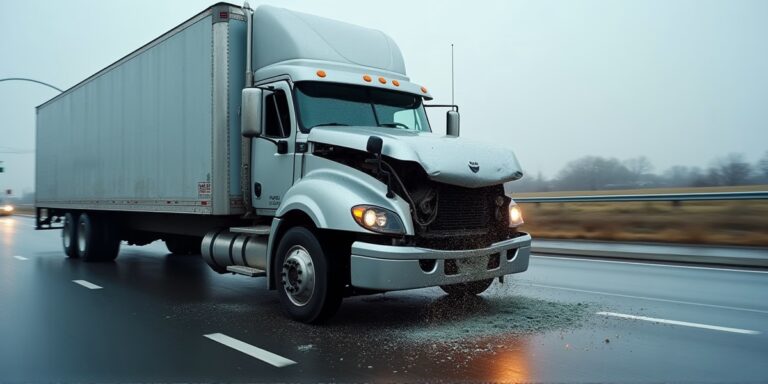
Can Federal Safety Violations Prove Negligence?

When a truck accident occurs, it’s easy to focus on the immediate cause—speeding, distracted driving, or even a simple mistake. However, often hidden beneath the surface are systemic issues within the trucking company that created an environment ripe for disaster. Federal safety regulations are incredibly detailed, and violations of these rules are often a strong indicator of negligence. Proving these violations can be critical to securing full compensation for your injuries and losses.
Trucking companies are legally obligated to adhere to a complex web of federal regulations, overseen by the Federal Motor Carrier Safety Administration (FMCSA). These rules cover everything from driver hours of service to vehicle maintenance and cargo securement. When a company cuts corners, ignores these regulations, or fails to properly train and supervise its drivers, it creates a dangerous situation for everyone on the road. These failures aren’t accidents; they are often deliberate decisions made to increase profits at the expense of safety.
I’ve spent over 13 years representing clients injured in truck accidents throughout San Diego. I was trained by former insurance defense attorneys, giving me intimate knowledge of how insurance companies evaluate, devalue, and deny claims. I understand the tactics they use to minimize payouts, and I’m dedicated to fighting for the maximum compensation my clients deserve. I’ve seen firsthand how trucking companies attempt to conceal federal safety violations, and I know how to uncover the evidence needed to hold them accountable.
Can I Recover Damages if the Trucking Company Violated Federal Regulations?
Absolutely. Federal safety violations are powerful evidence of negligence in a truck accident case. These regulations aren’t merely suggestions; they are the law. A violation demonstrates that the trucking company failed to meet its duty of care to operate safely. This failure directly contributed to the accident and your injuries. The types of violations that can support a claim are numerous and can include falsified logbooks, inadequate vehicle maintenance, and insufficient driver training.
Importantly, proving a violation doesn’t automatically guarantee a successful outcome. You must still establish a direct link between the violation and your injuries. For example, if a driver violated hours-of-service regulations and was fatigued at the time of the accident, we need to demonstrate that fatigue was a substantial factor in causing the crash. This often involves expert testimony, accident reconstruction analysis, and a thorough review of the driver’s records.
What Types of Federal Regulations are Most Often Violated?
Several federal regulations are frequently violated by trucking companies. These include violations of **Hours of Service (HOS)** regulations (49 CFR § 395), which dictate how long a driver can operate a vehicle before being required to rest. We also see frequent violations related to vehicle maintenance (CVC § 34500), where companies fail to properly inspect and repair their trucks, leading to dangerous mechanical failures. Finally, violations of driver qualification standards are common, where companies hire drivers who don’t meet the necessary requirements or have a history of safety issues.
How Can I Prove a Trucking Company Violated Federal Regulations?
Proving a federal safety violation requires a thorough investigation. This often involves obtaining the trucking company’s safety records from the FMCSA, including inspection reports, audit findings, and crash history. We also examine the driver’s logbooks, Electronic Logging Device (ELD) data, and maintenance records. In some cases, we may need to hire an accident reconstruction expert to analyze the crash scene and determine the cause of the accident. Dashcam footage, if available, can also provide crucial evidence.
What if the Trucking Company Claims the Violation Didn’t Cause the Accident?
The trucking company will almost certainly argue that the violation wasn’t the cause of the accident. They may claim the driver was still capable of operating the vehicle safely despite the violation, or that another factor—such as weather conditions or another driver’s negligence—was to blame. This is where expert testimony becomes critical. An accident reconstruction expert can analyze the evidence and provide a professional opinion on the cause of the accident, linking the violation directly to your injuries. We also focus on establishing a pattern of negligence, demonstrating that the company had a history of similar violations.
What is the Deadline to File a Claim After a Truck Accident?
In California, you generally have **two years** from the date of the truck accident to file a lawsuit (CCP § 335.1). Because trucking companies often begin evidence destruction (like purging ELD data) as soon as the law allows, immediate filing is critical to preserve the integrity of the claim. Don’t delay seeking legal counsel, as waiting too long can jeopardize your ability to recover compensation.
What Happens if the Accident Involved a Government Vehicle or Road Hazard?
If a truck accident involves a government-owned vehicle or a dangerous road condition maintained by a public entity, a formal administrative claim **MUST** be presented within **6 months** (180 days). Failure to meet this strict deadline under the Government Tort Claims Act can result in the permanent loss of your right to recover (Gov. Code § 911.2).
What if the Driver Was Classified as an Independent Contractor?
California’s ‘ABC test’ determines if a delivery driver (Amazon/FedEx) is an employee or contractor. Even if labeled a ‘contractor,’ a company may be liable if they exercise control over the driver’s work, a key factor in San Diego delivery truck litigation (Labor Code § 2775).
Can the Trucking Company Be Held Liable for the Driver’s Negligence?
Under the doctrine of **vicarious liability** (respondeat superior), a principal is responsible to third persons for the negligence of their agent in the transaction of business. This holds the trucking company legally liable for the wrongful acts of its drivers committed within the scope of their employment (Civ. Code § 2338).
What if the Truck Was Speeding?
In California, commercial trucks (including semi-tractors with three or more axles) are strictly prohibited from exceeding **55 miles per hour** on any highway. In San Diego freeway crashes, proving a violation of this speed limit is a primary tool for establishing statutory negligence (CVC § 22406).