
Can Gig Trucking Companies Be Sued After Crashes?

This scenario is becoming increasingly common. The rise of gig trucking – where drivers use their own vehicles and are classified as independent contractors – has created a complex legal landscape. While these companies tout flexibility and cost savings, they often attempt to shield themselves from responsibility when accidents happen. However, that doesn’t mean you’re without recourse. In California, there are several avenues to pursue a claim against a gig trucking company, even if they claim the driver was not an employee.
The key to successfully navigating these cases lies in understanding the legal principles of vicarious liability, negligent hiring, and control. We’ve seen numerous instances where these companies exert significant control over their drivers – dictating routes, imposing strict deadlines, and even monitoring performance metrics – which can blur the line between independent contractor and employee status. This control is often the foundation for establishing liability.
I’ve been practicing personal injury law in San Diego for over 13 years, and I’ve seen firsthand how insurance companies attempt to devalue and deny claims. I was previously trained by a former insurance defense attorney, giving me intimate knowledge of their tactics and strategies. This experience allows me to anticipate their arguments and build a stronger case for my clients.
What evidence is needed to sue a gig trucking company?
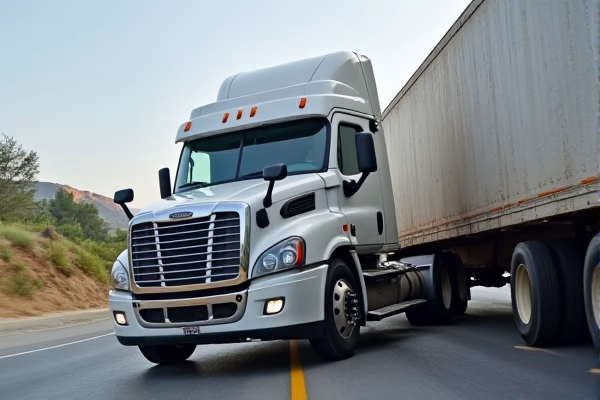
Gathering comprehensive evidence is crucial in any truck accident case, but it’s especially important when dealing with gig trucking companies. This includes the police report, witness statements, photos of the scene and vehicle damage, and your medical records. However, you’ll also need to focus on evidence that demonstrates the company’s level of control over the driver.
Look for documentation of the app’s terms of service, driver contracts, and any communications between the company and the driver. Screenshots of the app interface showing route assignments, performance reviews, or disciplinary actions can be invaluable. Electronic Logging Device (ELD) data, if available, can also reveal whether the driver was in violation of federal Hours of Service regulations. 49 CFR § 395 outlines these regulations.
Furthermore, any evidence of the company’s hiring practices – background checks, driving record reviews, and training protocols – can be used to establish negligent hiring if the driver had a history of violations or was otherwise unfit to operate a commercial vehicle.
Can I sue the driver and the gig trucking company at the same time?
Yes, in many cases, you can pursue claims against both the driver and the gig trucking company. The driver is directly responsible for their negligence, such as speeding, distracted driving, or failing to yield the right-of-way. However, as discussed above, the gig trucking company may also be liable under the doctrine of vicarious liability if they exercised sufficient control over the driver.
It’s important to understand that pursuing claims against multiple parties can be complex. The insurance coverage may differ, and the legal strategies will need to be tailored accordingly. In California, if you are pursuing a workers’ compensation claim against the driver’s employer, you may be limited in your ability to sue the employer directly, but you can still pursue a claim against negligent third parties. Labor Code § 3852 preserves your right to do so.
We often investigate both avenues simultaneously to maximize your potential recovery.
What if the gig trucking company claims the driver was an independent contractor?
The “independent contractor” classification is a common defense tactic used by gig trucking companies. However, simply labeling a driver as an independent contractor doesn’t automatically absolve the company of liability. California courts apply a multi-factor test to determine whether a worker is truly an independent contractor or an employee.
This test, known as the “ABC test,” considers factors such as the level of control the company exerts over the driver, the driver’s ability to work for other companies, and whether the driver provides their own tools and equipment. Labor Code § 2775 details the specifics of this test. If the company is found to have exerted significant control over the driver, they may be deemed an employer, making them liable for the driver’s negligence.
Even if the ABC test isn’t met, you may still be able to establish liability based on other legal theories, such as negligent hiring or entrustment.
How long do I have to file a lawsuit against a gig trucking company?
In California, the statute of limitations for personal injury claims is generally **two years** from the date of the accident. However, it’s crucial to act quickly, even within that two-year window. Trucking companies often begin evidence destruction (like purging ELD data) as soon as the law allows, immediate filing is critical to preserve the integrity of the claim. CCP § 335.1 outlines this timeframe.
Furthermore, if the accident involved a government-owned vehicle or a dangerous road condition maintained by a public entity, you may have a much shorter deadline – just **6 months** – to file a formal administrative claim. Gov. Code § 911.2 details these requirements.
Delaying can jeopardize your ability to recover the compensation you deserve.
What damages can I recover in a lawsuit against a gig trucking company?
If you are successful in your lawsuit, you may be entitled to recover a wide range of damages, including medical expenses (past and future), lost wages, pain and suffering, property damage, and emotional distress. In some cases, you may also be able to recover punitive damages if the company’s conduct was particularly egregious.
We work with experienced economists and medical professionals to accurately assess your damages and build a compelling case for maximum compensation. It’s important to document all your expenses and keep a detailed record of your pain and suffering, as these are often significant components of a successful claim.
Our firm is dedicated to fighting for the rights of injured victims in San Diego and throughout California. We understand the challenges you face and are committed to providing you with the personalized attention and aggressive representation you deserve.
What should I do if an insurance adjuster contacts me after a crash involving a gig trucking company?
Insurance adjusters are trained to minimize payouts and often employ tactics to devalue your claim. It’s crucial to avoid making any statements to the insurance adjuster without first consulting with an attorney. They may ask you to provide a recorded statement, which they can use against you later.
Politely decline to provide a statement and refer them to your attorney. Do not sign any documents or authorize any medical releases without legal counsel. Remember, the adjuster represents the insurance company’s interests, not yours.
Protect your rights by seeking legal guidance before engaging with the insurance company.
How does comparative fault apply in truck accident cases involving gig drivers?
California operates under a “pure” comparative fault system. This means that even if you were partially at fault for the accident, you can still recover damages. However, your total compensation will be reduced by your percentage of fault. For example, if you were found to be 20% at fault, your recovery would be reduced by 20%.
The trucking company will likely attempt to argue that you contributed to the accident in some way. It’s important to have an experienced attorney who can investigate the accident thoroughly and present evidence to minimize your percentage of fault. Civ. Code § 1714 outlines the principles of comparative negligence in California.
We will fight to ensure you receive fair compensation, even if you shared some responsibility for the crash.