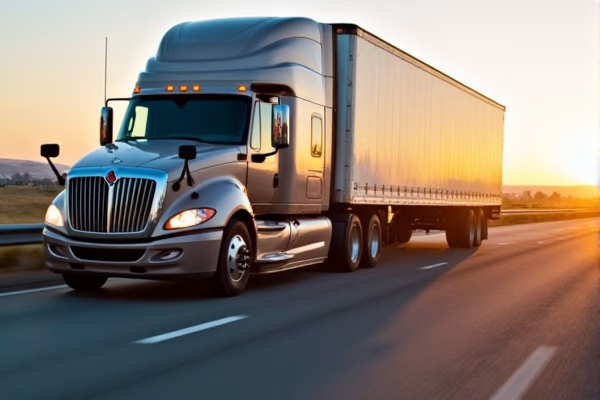
Asier was a successful owner-operator, hauling produce from San Diego to Los Angeles three times a week. A distracted driver slammed into his rig on the I-5, totaling his truck and leaving him with a broken leg. But the immediate costs – the truck replacement, medical bills – were only the beginning. He quickly realized he was losing $1,250 per week in income, and his business was on the brink of collapse. His insurance company offered a paltry settlement that didn’t even cover the lost earnings, let alone the pain and suffering. He needed an attorney who understood the complexities of commercial trucking and the real value of his lost future income.
Recovering lost business income after a truck accident is absolutely possible, but it’s significantly more complex than simply documenting your hourly wage. The insurance companies are experts at minimizing these claims, and they will scrutinize every aspect of your business to find reasons to deny or undervalue your losses. That’s why having an experienced attorney on your side is critical. We’ve seen firsthand how they operate, and we know the strategies they use to devalue claims.
The key to maximizing your recovery lies in proving your lost earnings with a high degree of certainty. This requires a thorough investigation of your business records, including tax returns, profit and loss statements, invoices, and contracts. We will work with forensic accountants to prepare a comprehensive financial analysis that demonstrates the income you would have earned had the accident not occurred. This isn’t just about past earnings; it’s about projecting your future income potential, taking into account factors like market trends, anticipated growth, and the impact of the accident on your ability to operate your business.
I’ve been practicing personal injury law in San Diego for over 13 years, and I’ve dedicated a significant portion of my practice to representing truck drivers and owner-operators. I was trained by a former insurance defense attorney, giving me intimate knowledge of how insurance companies evaluate, devalue, and deny claims. This inside perspective allows me to anticipate their tactics and build a strong case that protects your financial future.
How Do Insurance Companies Calculate Lost Income?
Insurance adjusters typically take a conservative approach to calculating lost income. They will often rely on your reported income from the two or three years prior to the accident, and they may discount this amount to account for fluctuations in your business. They will also scrutinize your tax returns for any deductions or expenses that could reduce your claimed income. Expect them to ask for extensive documentation, and be prepared to provide it. They are looking for any inconsistency or ambiguity that they can use to justify a lower settlement offer.
It’s important to remember that insurance companies are not obligated to pay you for the full amount of your lost income. They are only required to compensate you for the losses that are directly attributable to the accident. This means that they may argue that some of your lost income was due to other factors, such as market conditions or poor business decisions. That’s why it’s so important to have an attorney who can build a strong case that demonstrates the causal link between the accident and your lost earnings.
What Types of Income Can I Recover?
Lost income isn’t limited to your salary or wages. You may also be able to recover other types of income that you lost as a result of the accident, including:
- Lost Profits: This includes the profits you would have earned on future contracts or projects.
- Lost Benefits: If you lost health insurance or other benefits as a result of the accident, you may be able to recover the value of those benefits.
- Lost Opportunity: If the accident prevented you from pursuing a new business opportunity, you may be able to recover the potential profits you would have earned.
What if I Didn’t Report All of My Income?
This is a common concern for owner-operators and independent contractors. If you didn’t report all of your income to the IRS, it can be difficult to prove your lost earnings. However, it’s not necessarily a fatal flaw in your case. We can still use other evidence, such as bank statements, invoices, and contracts, to establish your income. It’s important to be honest with your attorney about your income history, and we will work with you to develop a strategy that maximizes your recovery.
Legal Services & Injury Compensation
Catastrophic Injuries
Loss of Limb
Establishing lifelong vocational and financial burdens.
How Long Do I Have to File a Claim for Lost Income?
In California, you have a **two-year** window from the date of the truck accident to file a lawsuit. Because trucking companies often begin evidence destruction (like purging ELD data) as soon as the law allows, immediate filing is critical to preserve the integrity of the claim. Don’t delay in seeking legal counsel, as waiting too long can jeopardize your ability to recover the full amount of your lost income. CCP § 335.1
What if the Accident Involved a Government Vehicle or Road Hazard?
If a truck accident involves a government-owned vehicle or a dangerous road condition maintained by a public entity, a formal administrative claim **MUST** be presented within **6 months** (180 days). Failure to meet this strict deadline under the Government Tort Claims Act can result in the permanent loss of your right to recover. This is a completely separate timeline from the two-year statute of limitations for a lawsuit, and it’s crucial to understand both deadlines. Gov. Code § 911.2
Authority Link Reference Table
Authority Link Reference Table
|
Statutory Authority
|
Description
|
|
CCP § 335.1
|
Sets the 2-year limitations period for most California personal injury claims. In San Diego trucking cases, preserving evidence early is critical because carriers and insurers often move quickly to control records and narrative.
|
|
Gov. Code § 911.2
|
Requires timely presentation of claims against public entities (often 6 months). This matters when a crash involves roadway design, construction zones, transit agencies, or city/county responsibility.
|
|
CCP § 2017.010
|
Defines the scope of discovery. In trucking litigation, discovery targets driver logs/ELD data, qualification files, inspection/maintenance records, dispatch communications, and safety program documents.
|
|
CCP § 377.60
|
Identifies who has standing to bring a wrongful death claim. This is essential for fatal commercial vehicle crashes where multiple family members may have rights.
|
|
CCP § 377.30
|
Survival action authority. In fatal trucking cases, this can apply to claims the decedent could have brought (often tied to pre-death harms and litigation strategy alongside wrongful death).
|
|
Civ. Code § 1714
|
California’s general negligence framework. Trucking defendants often use comparative-fault narratives (lane position, following distance, speed, “cut-off” claims) to reduce claimed damages.
|
|
Evid. Code § 669
|
Negligence per se when a safety law is violated. This is frequently argued in trucking cases when FMCSA rules or CVC safety provisions are breached.
|
|
Civ. Code § 2338
|
Vicarious liability principles (respondeat superior). Critical when proving a motor carrier, delivery company, or fleet operator is responsible for a driver’s on-duty conduct.
|
|
CVC § 22406
|
Maximum speed limits for certain commercial vehicles and vehicles towing. Supports liability arguments and reconstruction when speed/conditions are disputed.
|
|
CVC § 34500
|
California’s commercial vehicle safety/inspection framework. Often relevant to maintenance failures, equipment defects, and inspection noncompliance.
|
|
Civ. Code § 3294
|
Punitive damages standard (oppression, fraud, or malice). Can matter in extreme trucking conduct cases (e.g., reckless safety policy violations, egregious impairment, or intentional evidence games).
|
|
Howell v. Hamilton Meats
|
Damages valuation authority addressing medical specials (amounts actually paid/owed). Frequently impacts settlement math in catastrophic injury cases.
|
|
Li v. Yellow Cab Co.
|
Foundational California comparative negligence authority. Trucking defendants often argue shared fault to reduce value; this anchors the comparative-fault framework used in negotiations and trial.
|
|
Civ. Code § 1431.2
|
Several liability allocation for non-economic damages. Important when multiple parties share responsibility (carrier, shipper/loader, broker, maintenance vendor, public entities).
|
|
Ins. Code § 11580.2
|
UM/UIM statutory framework. Relevant when a truck, delivery vehicle, or other responsible party is underinsured, unidentified, or coverage disputes arise.
|
|
Federal Motor Carrier Safety Regulations (FMCSA)
|
|
49 CFR Part 395
|
Hours-of-service rules (fatigue). Directly tied to ELD/logbook questions, forced driving, rest break violations, and crash causation analysis.
|
|
49 CFR Part 396
|
Inspection, repair, and maintenance duties. Central for brake failures, tire failures, equipment defects, inspection records, and maintenance contractor liability.
|
|
49 CFR Part 391
|
Driver qualification rules (DQ files). Supports negligent hiring/retention claims and discovery of licensing, medical certification, training, and prior safety history.
|
|
49 CFR Part 382
|
Controlled substances and alcohol testing rules. Relevant to post-crash testing questions, DUI/impairment claims, and carrier compliance obligations.
|
|
49 CFR Part 392
|
Operational driving rules (safe driving, distracted driving policies, etc.). Used to frame duty, safety standards, and negligence arguments tied to driver conduct.
|
|
49 CFR Part 393
|
Parts and accessories necessary for safe operation. Supports defect/equipment theories involving brakes, lights, tires, underride guards, and other safety components.
|
|
49 CFR Part 383
|
Commercial driver’s license (CDL) standards. Relevant to CDL impact questions, qualification issues, endorsements, and compliance expectations for commercial drivers.
|