How Do Juries Decide Truck Accident Cases?

Understanding how a jury will evaluate a truck accident case is crucial to maximizing your recovery. Unlike typical car accidents, truck accident litigation involves a complex interplay of federal regulations, company policies, and the sheer size and weight of the vehicles involved. Jurors aren’t simply looking at who ran a red light; they’re examining whether the trucking company prioritized profits over safety, and whether the driver was adequately trained and monitored.
The first thing a jury will consider is negligence. This means establishing that the truck driver or the trucking company failed to exercise reasonable care, and that this failure directly caused your injuries. This can take many forms – distracted driving, speeding, fatigue, improper maintenance, or a violation of federal Hours of Service regulations. Proving negligence requires compelling evidence, often including police reports, witness testimony, and the truck’s Electronic Logging Device (ELD) data.
I’ve been practicing personal injury law in San Diego for over 13 years, and I’ve seen firsthand how insurance companies attempt to minimize payouts in truck accident cases. Trained by a former insurance defense attorney, I have intimate knowledge of how they evaluate, devalue, and deny claims. They’ll scrutinize every aspect of your case, looking for ways to shift blame or argue that your injuries aren’t as severe as you claim. That’s why it’s essential to have an attorney who understands their tactics and can build a strong case on your behalf.
What evidence do juries rely on most in truck accident cases?
Jurors give significant weight to objective evidence. This includes the police report, which details the accident scene and any initial findings. However, the police report is often incomplete or biased. The “black box” data from the truck itself – the ELD, ECM, and any dashcam footage – is invaluable. This data can reveal the driver’s speed, braking patterns, and hours of service compliance. We also rely heavily on expert testimony from accident reconstruction specialists and medical professionals to establish the cause of the accident and the extent of your injuries.
Beyond the technical data, witness statements are critical. Jurors want to hear from people who saw what happened firsthand. We often conduct independent investigations to locate and interview witnesses who may not have been contacted by the police. Finally, documentation of your medical treatment, lost wages, and pain and suffering is essential to demonstrate the full impact of the accident on your life.
How does the size of the truck affect the jury’s perception of the case?
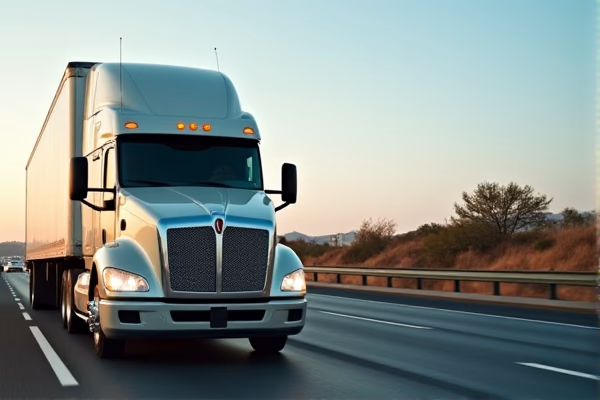
The sheer size and weight of a commercial truck dramatically increase the potential for catastrophic injuries. Jurors understand this intuitively. They recognize that a collision with an 18-wheeler is far more dangerous than a collision with a passenger car. This often leads to a higher degree of scrutiny of the trucking company’s safety practices. Jurors will want to know what measures the company took to prevent accidents, and whether those measures were adequate. They’ll also consider the driver’s training and experience, and whether the company properly vetted them before putting them on the road.
What role do federal regulations play in determining liability?
The trucking industry is heavily regulated by the Federal Motor Carrier Safety Administration (FMCSA). These regulations cover everything from driver hours of service to vehicle maintenance and safety inspections. Violations of these regulations can be strong evidence of negligence. For example, if a driver was operating outside of their allowed hours of service, or if the truck had a known safety defect, it can be easier to establish liability. We often work with experts who specialize in FMCSA regulations to identify any violations that may have contributed to the accident. 49 CFR § 395 outlines these critical safety standards.
Can the trucking company be held liable for the actions of its driver?
Yes, under the doctrine of **vicarious liability** (respondeat superior), a principal is responsible to third persons for the negligence of their agent in the transaction of business. This means the trucking company can be held liable for the wrongful acts of its drivers committed within the scope of their employment. Even if the driver was negligent, the company can still be held responsible if they failed to properly train, supervise, or monitor the driver. Civ. Code § 2338 provides the legal basis for this principle.
What if the driver was an independent contractor, not an employee?
Determining whether a driver is an employee or an independent contractor can be complex. California’s ‘ABC test’ determines if a delivery driver (Amazon/FedEx) is an employee or contractor. Even if labeled a ‘contractor,’ a company may be liable if they exercise control over the driver’s work, a key factor in San Diego delivery truck litigation. The more control the company exerts over the driver’s schedule, routes, and methods of operation, the more likely they are to be considered an employer. Labor Code § 2775 provides the framework for this analysis.
What should I do if the insurance company asks me to give a recorded statement?
Politely decline. Insurance companies record statements to gather information that can be used to devalue your claim. They’re trained to ask leading questions and exploit any inconsistencies in your answers. It’s best to let an attorney handle all communication with the insurance company. We can ensure that your rights are protected and that you don’t inadvertently say anything that could harm your case.
How long do I have to file a lawsuit after a truck accident in California?
California law provides a **two-year** window from the date of the truck accident to file a lawsuit. Because trucking companies often begin evidence destruction (like purging ELD data) as soon as the law allows, immediate filing is critical to preserve the integrity of the claim. CCP § 335.1 outlines this critical deadline.
What if the accident involved a government vehicle or a dangerous road condition?
If a truck accident involves a government-owned vehicle or a dangerous road condition maintained by a public entity, a formal administrative claim **MUST** be presented within **6 months** (180 days). Failure to meet this strict deadline under the Government Tort Claims Act can result in the permanent loss of your right to recover. Gov. Code § 911.2 details these requirements.
What happens if the insurance company makes a policy limits tender?
A policy limits tender is an offer to settle your claim for the maximum amount of the insurance policy. It’s often a tactic to close the case quickly and avoid a trial. Before accepting any policy limits tender, it’s crucial to understand the full extent of your damages and whether there are other potential sources of recovery, such as excess insurance policies or the trucking company’s assets. We can help you evaluate the offer and negotiate a fair settlement.
How can dashcam footage and other digital evidence help my case?
Dashcam footage, ECM data, ELD logs, and GPS information can be incredibly valuable evidence in truck accident cases. This data can provide a clear picture of what happened leading up to the accident, including the driver’s speed, braking patterns, and hours of service compliance. We work with forensic experts to retrieve and analyze this data, and to present it in a compelling manner to the jury.
What is the difference between ER billing and a medical lien?
ER billing represents the initial charges for emergency medical treatment. A medical lien is a legal claim against your settlement proceeds to cover the costs of your ongoing medical care. It’s important to understand the difference between these two types of bills, and to negotiate with healthcare providers to reduce the amount of the lien. We can help you navigate this complex process.
What are common delay tactics used by insurance companies?
Insurance companies often employ delay tactics to wear you down and pressure you into accepting a lower settlement. These tactics can include requesting excessive documentation, scheduling unnecessary medical examinations, and failing to respond to your attorney’s requests in a timely manner. We’re familiar with these tactics and can aggressively push back to ensure that your case moves forward.
What is UM/UIM arbitration, and when is it necessary?
UM/UIM arbitration (Uninsured/Underinsured Motorist) is a process used to resolve claims when the at-fault driver is uninsured or underinsured. This often involves arbitrating with your own insurance company to recover damages. We have extensive experience in UM/UIM arbitration and can help you navigate this complex legal procedure.
Why is it important to preserve evidence after a truck accident?
Evidence can be lost or destroyed over time, especially in truck accident cases. It’s crucial to preserve all relevant evidence, including police reports, witness statements, medical records, and photos of the accident scene. We can send a spoliation letter to the trucking company demanding that they preserve all evidence related to the accident. Failure to do so can result in sanctions and a negative inference at trial.