How Do Lawyers Help Protect Finances After Crashes?

As a personal injury attorney in San Diego with over 13 years of experience, I’ve seen this scenario play out far too often. Trucking accidents are unique because of the sheer size and weight of the vehicles involved, the complex regulations governing the industry, and the aggressive tactics insurance companies employ to minimize payouts. I’ve been trained by former insurance defense attorneys, giving me intimate knowledge of how insurance companies evaluate, devalue, and deny claims.
Protecting your finances after a truck crash requires immediate and strategic action. It’s not just about recovering compensation for your injuries; it’s about safeguarding your future and preventing the insurance company from exploiting your vulnerability. Here’s how an attorney can help.
What steps can I take immediately to protect my assets?
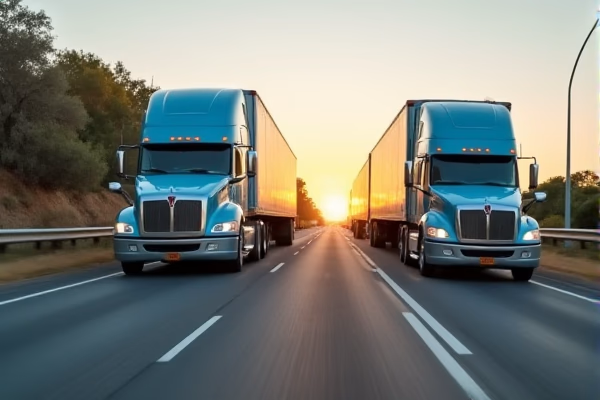
The first 24-48 hours are critical. Insurance adjusters will be reaching out quickly, often before you’ve even had a chance to process what happened. Do not speak to them without legal counsel. Any recorded statement you give can be used against you. Instead, focus on documenting everything: photos of the scene, vehicle damage, your injuries, and any witnesses. Gather all medical records and bills. Most importantly, avoid signing any releases or authorizations.
We will immediately send preservation of evidence letters to the trucking company, demanding they retain all relevant data, including the driver’s logs, maintenance records, and the truck’s Event Data Recorder (EDR) – essentially the truck’s “black box.” This data is often crucial in establishing liability and proving the extent of your damages.
We will also investigate the trucking company’s insurance coverage, identifying all potential sources of recovery. Trucking companies typically carry significant insurance policies, but navigating these policies and understanding the various layers of coverage can be complex.
How do attorneys deal with medical liens and reimbursement claims?
After a serious truck accident, you’ll likely receive substantial medical treatment. Healthcare providers may place liens on any potential settlement or judgment to ensure they are compensated for their services. These liens can significantly reduce your net recovery. An experienced attorney will negotiate with the healthcare providers to reduce the lien amount, often leveraging the fact that the provider may have to pursue a more difficult collection process if a settlement isn’t reached.
We also handle subrogation claims from your own health insurance company. They may seek reimbursement for the medical expenses they’ve paid, even if the accident wasn’t your fault. We’ll carefully review your insurance policy and negotiate with the health insurer to protect your rights.
ER billing practices can also be a source of confusion. Often, ER bills are significantly higher than the actual cost of treatment. We can help you understand these bills and negotiate a fair settlement amount.
What if the accident was caused by a government vehicle or a dangerous road condition?
If a truck accident involves a government-owned vehicle or a hazardous road condition maintained by a public entity, the claims process is significantly different. You **MUST** file a formal administrative claim within **6 months** (180 days) of the accident under the Government Tort Claims Act. Failure to meet this strict deadline can result in the permanent loss of your right to recover.
These claims are often initially denied, requiring us to file a lawsuit to protect your rights. We have extensive experience navigating the complexities of government liability claims in San Diego, including understanding the specific procedures and deadlines involved.
We will gather evidence to demonstrate the government entity’s negligence, such as maintenance records, accident reports, and witness statements.
What role do policy limits tenders play in my case?
Insurance companies often attempt to settle claims for the amount of their policy limits. This is known as a “policy limits tender.” While it may seem like a generous offer, it’s crucial to understand that accepting a policy limits tender releases the insurance company from any further liability.
An attorney will evaluate the full extent of your damages, including medical expenses, lost wages, pain and suffering, and future care costs, to determine if the policy limits are adequate. If not, we will aggressively negotiate with the insurance company to secure a higher settlement. We will also explore the possibility of pursuing claims against other responsible parties, such as the trucking company itself or any third-party vendors.
If the insurance company refuses to offer a fair settlement, we are prepared to file a lawsuit and take your case to trial.
How can an attorney help with comparative fault accusations?
Insurance companies frequently attempt to reduce their liability by alleging that you were partially at fault for the accident. This is known as “comparative fault.” California’s ‘pure’ comparative fault system applies to trucking claims. Even if a truck driver argues you shared responsibility, you can still recover damages; however, your total compensation will be reduced by your percentage of fault.
We will thoroughly investigate the accident to disprove any allegations of comparative fault. This may involve gathering witness statements, reviewing police reports, and analyzing accident reconstruction data. We will present a strong defense of your actions and demonstrate that the truck driver was solely responsible for the accident.
We will also carefully analyze the evidence to identify any contributing factors that were beyond your control, such as a defective truck part or a negligent road condition.
What should I do if the insurance company asks for a recorded statement?
Never provide a recorded statement to the insurance company without first consulting with an attorney. Insurance adjusters are trained to ask leading questions designed to minimize their liability and devalue your claim. They may attempt to trick you into making statements that can be used against you later in the case.
An attorney can advise you on how to respond to the insurance company’s requests and protect your rights. We can also handle all communication with the insurance company on your behalf, ensuring that you don’t inadvertently say anything that could harm your case.
We will conduct our own independent investigation and gather evidence to support your claim, rather than relying on the insurance company’s version of events.
How does evidence preservation and documentation timelines impact my claim?
Trucking companies often begin evidence destruction (like purging ELD data) as soon as the law allows. Immediate filing is critical to preserve the integrity of the claim. We will send a spoliation letter to the trucking company, demanding they preserve all relevant evidence, including the driver’s logs, maintenance records, the truck’s Event Data Recorder (EDR) data, and any video footage.
We will also gather evidence from other sources, such as witness statements, police reports, and accident reconstruction data. It’s important to document everything related to the accident, including your injuries, medical treatment, and lost wages.
We will ensure that all evidence is properly preserved and protected, so that it can be used to support your claim.
What if the driver was an independent contractor, not an employee?
Determining whether a driver is an employee or an independent contractor can have significant implications for your claim. California’s ‘ABC test’ determines if a delivery driver (Amazon/FedEx) is an employee or contractor. Even if labeled a ‘contractor,’ a company may be liable if they exercise control over the driver’s work, a key factor in San Diego delivery truck litigation.
If the driver was an independent contractor, it may be more difficult to hold the trucking company liable. However, we will investigate the relationship between the driver and the company to determine if the company exercised sufficient control over the driver’s work to be considered an employer.
We will carefully review the driver’s contract, insurance policy, and other relevant documents to determine if the company was negligent in hiring, supervising, or retaining the driver.
What are the procedures for UM/UIM arbitration in California?
If the at-fault truck driver is uninsured or underinsured, you may be able to pursue a claim under your own Uninsured Motorist (UM) or Underinsured Motorist (UIM) coverage. This coverage provides compensation for your damages if the at-fault driver doesn’t have enough insurance to cover your losses.
UM/UIM claims often require arbitration, a more formal process than traditional settlement negotiations. We have extensive experience representing clients in UM/UIM arbitration proceedings, and we will aggressively advocate for your rights.
We will prepare a comprehensive arbitration brief, presenting evidence of the truck driver’s negligence and the full extent of your damages. We will also cross-examine witnesses and present expert testimony to support your claim.