Should I Take Photos Of The Truck And Trailer?

As a personal injury attorney in San Diego with over 13 years of experience, I’ve seen this scenario play out far too often. Insurance companies are skilled at minimizing payouts, and they often begin building their defense from the moment of the accident. One of the most crucial steps you can take to protect your claim is to meticulously document the scene, and that starts with taking photos of the truck and trailer.
Why is this so important? Because the physical evidence at the scene is often the most compelling evidence you have. The insurance company will send their own investigators, and their goal is to find reasons to limit their liability. Photos can preserve critical details that might otherwise be lost or disputed. They can show the extent of the damage, identify potential safety violations, and even reveal clues about the cause of the accident.
I was trained by a former insurance defense attorney, giving me intimate knowledge of how insurance companies evaluate, devalue, and deny claims. They’re looking for weaknesses in your case, and a lack of photographic evidence is a significant one. They will argue that the damage wasn’t as severe as you claim, or that the truck was properly maintained. Photos can counter these arguments and strengthen your position.
What specific parts of the truck and trailer should I photograph?
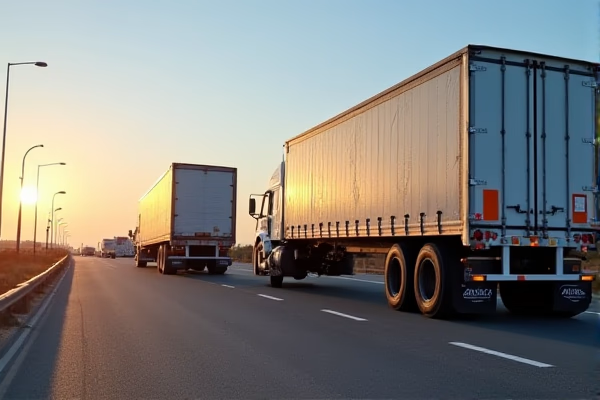
Don’t limit yourself to just the obvious damage. A comprehensive photographic record should include:
- The Entire Truck and Trailer: Capture wide shots showing the overall condition of both vehicles.
- Damage to the Truck and Trailer: Focus on any visible dents, scratches, or broken parts.
- Tire Tread Depth: Photograph the tires, paying close attention to the tread depth. Uneven wear can indicate maintenance issues.
- Lights and Reflectors: Document the condition of all lights and reflectors.
- VIN and DOT Numbers: Clearly photograph the Vehicle Identification Number (VIN) and Department of Transportation (DOT) numbers.
- Undercarriage: If possible, photograph the undercarriage of the truck for any signs of damage or leaks.
- Any Safety Stickers or Markings: Capture any safety stickers or markings on the truck or trailer.
Can photos of the truck and trailer be used as evidence in court?
Absolutely. Photos are considered powerful forms of evidence in court. They can help the judge and jury visualize the accident scene and understand the extent of the damage. However, it’s important to ensure the photos are properly authenticated. This means you need to be able to prove that the photos accurately depict the scene as it was at the time of the accident.
To authenticate your photos, it’s best to include the date, time, and location in each photo. You should also take photos of any landmarks or objects that can help establish the context of the scene. If possible, have a witness present when you take the photos, and ask them to sign a statement confirming that the photos accurately reflect the scene.
What if I didn’t take photos at the scene? Is my claim ruined?
Not necessarily, but it will be more challenging. The police report will contain some information about the accident, but it may not be as detailed as your own photos. The insurance company will also likely take their own photos, but their photos may be biased. It’s still possible to gather evidence after the fact, such as obtaining maintenance records or interviewing witnesses. However, the lack of immediate photographic evidence will undoubtedly weaken your claim.
What should I do if the truck company refuses to let me photograph their vehicle?
You have a legal right to document the scene of an accident. However, you should not trespass on private property or interfere with the truck company’s operations. If the truck company refuses to let you photograph their vehicle, you can contact the police and ask them to take photos on your behalf. You can also hire a professional accident reconstruction specialist to document the scene.
What about dashcam footage or ELD data?
Dashcam footage and Electronic Logging Device (ELD) data can be incredibly valuable evidence in a truck accident case. Dashcam footage can provide a clear recording of the events leading up to the accident, and ELD data can reveal whether the driver was following federal Hours of Service (HOS) regulations. If the truck had a dashcam or ELD, you should request a copy of the footage or data as soon as possible. 49 CFR § 395 outlines the requirements for ELD data retention, and you may be entitled to access this information.
What if the accident involved a government vehicle or a dangerous road condition?
If a truck accident involves a government-owned vehicle or a dangerous road condition maintained by a public entity, a formal administrative claim **MUST** be presented within **6 months** (180 days). Failure to meet this strict deadline under the Government Tort Claims Act can result in the permanent loss of your right to recover. Gov. Code § 911.2 details these requirements. It’s crucial to act quickly and consult with an attorney to ensure you comply with all applicable deadlines.
How can I protect my claim if the driver claims they were acting as an independent contractor?
California’s ‘ABC test’ determines if a delivery driver (Amazon/FedEx) is an employee or contractor. Even if labeled a ‘contractor,’ a company may be liable if they exercise control over the driver’s work, a key factor in San Diego delivery truck litigation. Labor Code § 2775 provides the legal framework for this determination. Gathering evidence of the company’s control over the driver’s schedule, routes, and equipment is essential.
What if the insurance company asks me to give a recorded statement?
You are not legally obligated to give a recorded statement to the insurance company. In fact, it’s generally not advisable to do so without first consulting with an attorney. Insurance adjusters are trained to ask leading questions and elicit information that can be used to devalue your claim. It’s best to let an attorney handle all communications with the insurance company.
What if I have medical liens that need to be resolved?
Medical liens are claims against your settlement proceeds to cover the cost of your medical treatment. These liens can significantly reduce the amount of money you receive. It’s important to negotiate with the medical providers to reduce the amount of the liens. An attorney can help you navigate this process and ensure you receive fair compensation.
What if the truck company tenders their policy limits?
A policy limits tender is an offer from the insurance company to settle your claim for the maximum amount of their insurance coverage. While it may seem like a generous offer, it’s important to carefully consider whether it’s enough to cover all of your damages. An attorney can help you evaluate the offer and determine whether it’s in your best interest to accept it.