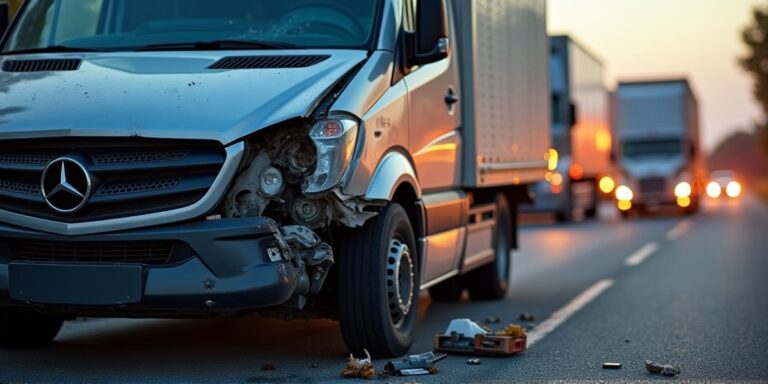
What Happens If An Amazon Delivery Truck Causes A Crash In San Diego?

Dealing with an Amazon delivery truck accident claim presents unique challenges. Amazon utilizes a complex network of independent contractors, which can muddy the waters when determining liability. While the driver is directly responsible for operating the vehicle safely, Amazon’s involvement in hiring, training, and oversight often creates additional avenues for recovery. It’s crucial to understand that Amazon isn’t simply a passive bystander in these accidents; they have a duty to ensure the safety of everyone on the road.
One of the first steps in evaluating a claim is determining the driver’s employment status. Are they a direct employee of Amazon, or are they contracted through a third-party delivery service? This distinction significantly impacts where and how a lawsuit is filed, and the potential sources of insurance coverage. Even if the driver is classified as an independent contractor, Amazon’s control over their routes, delivery schedules, and performance metrics can establish a strong case for vicarious liability.
I’ve been practicing personal injury law in San Diego for over 13 years, and I’ve seen firsthand how insurance companies attempt to minimize payouts in truck accident cases. Trained by a former insurance defense attorney, I have intimate knowledge of how these companies evaluate, devalue, and deny claims. They often focus on blaming the victim, questioning the extent of their injuries, and exploiting loopholes in the insurance policies. That’s why having an experienced attorney on your side is so critical.
What evidence is needed to prove my claim against Amazon after a truck accident?
Gathering comprehensive evidence is paramount in any truck accident claim, but it’s especially important when dealing with Amazon. This includes the police report, witness statements, photos and videos of the accident scene, and your medical records. However, don’t stop there. Obtain the driver’s electronic logging device (ELD) data, which records their hours of service and driving patterns. Also, request Amazon’s internal safety records and training materials for the driver. Dashcam footage, if available, is invaluable.
Furthermore, it’s important to document all communication with the insurance company. Keep detailed records of phone calls, emails, and any settlement offers. Preserving this evidence is critical, as Amazon is known to aggressively pursue evidence destruction as soon as legally permissible. We often send spoliation letters immediately to ensure critical data isn’t lost.
What if the Amazon driver was working for a third-party delivery service?
If the driver was employed by a third-party delivery service, you may have claims against both the driver and the delivery company. However, determining the extent of Amazon’s liability is still crucial. We investigate Amazon’s involvement in the driver’s hiring, training, and supervision. Did Amazon exercise control over the driver’s work? Did they have knowledge of any prior safety violations? If so, Amazon may be held directly liable for the accident under the doctrine of vicarious liability, as outlined in Civ. Code § 2338.
It’s also important to consider the insurance coverage available. The driver may have a personal auto policy, and the delivery company likely has a commercial auto policy. However, these policies may not provide adequate coverage to compensate you for your full damages. We thoroughly investigate all potential sources of recovery to ensure you receive the maximum compensation possible.
How long do I have to file a lawsuit after an Amazon truck accident in California?
In California, you generally have **two years** from the date of the truck accident to file a lawsuit. Because trucking companies often begin evidence destruction (like purging ELD data) as soon as the law allows, immediate filing is critical to preserve the integrity of the claim. This timeframe is governed by CCP § 335.1. Don’t delay seeking legal counsel, as missing this deadline can result in the permanent loss of your right to recover.
Even if you believe you have ample time, it’s best to start the investigation process as soon as possible. Gathering evidence, identifying witnesses, and preserving critical data can be time-consuming. The sooner you act, the stronger your claim will be.
What if the accident involved a government-owned vehicle or a road hazard?
If the Amazon truck accident involved a government-owned vehicle or a dangerous road condition maintained by a public entity, a formal administrative claim **MUST** be presented within **6 months** (180 days). Failure to meet this strict deadline under the Government Tort Claims Act can result in the permanent loss of your right to recover. This is a critical step often overlooked by accident victims. We have extensive experience navigating these complex government claim procedures in San Diego.
The claim must be detailed and include all relevant information, including the date, time, and location of the accident, a description of the government vehicle or road hazard, and the extent of your injuries and damages. It’s essential to consult with an attorney to ensure your claim is properly prepared and submitted on time.
What if the insurance company claims I was partially at fault for the accident?
California’s ‘pure’ comparative fault system applies to trucking claims. Even if a truck driver argues you shared responsibility, you can still recover damages; however, your total compensation will be reduced by your percentage of fault. The insurance company will likely attempt to minimize their liability by blaming you for the accident. They may argue you were speeding, distracted, or failed to yield the right-of-way. It’s important to challenge these claims with evidence and demonstrate that the driver was primarily responsible for the collision, as outlined in Civ. Code § 1714.
We thoroughly investigate the accident scene, review police reports, and interview witnesses to establish the driver’s negligence. We also analyze any available dashcam footage or other evidence to support your claim. Don’t accept the insurance company’s initial assessment of fault without consulting with an attorney.