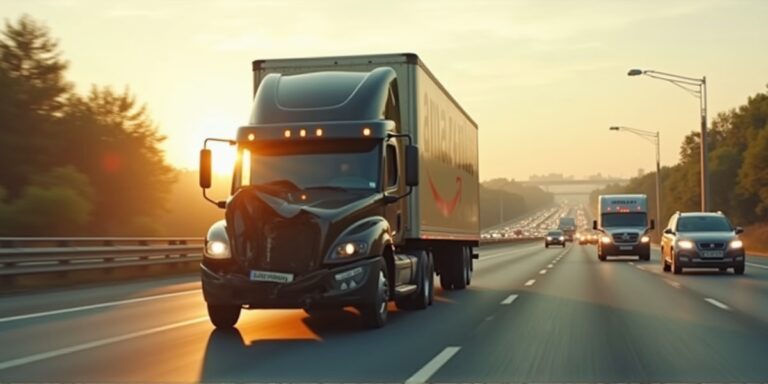

Who Is Liable In Blind Spot Truck Accidents?

Truck accidents involving blind spots present unique challenges. Unlike passenger vehicles, semi-trucks have significantly larger blind spots – often extending 18 feet on either side and up to 20 feet behind the trailer. These areas are obscured from the driver’s direct line of sight, making it difficult to detect smaller vehicles. However, the existence of a blind spot does not automatically absolve the truck driver of responsibility. California law places a high duty of care on commercial drivers to operate their vehicles safely, including being aware of their surroundings and taking reasonable precautions to avoid collisions.
Several factors can contribute to liability in these cases. The most common is driver negligence, which can manifest as speeding, distracted driving (texting, eating, or adjusting the radio), or failing to properly check mirrors and blind spots before changing lanes or merging. Additionally, inadequate training or supervision by the trucking company can also be a contributing factor. If a driver was improperly vetted or lacked sufficient experience, the company may be held liable under the doctrine of respondeat superior. I have, in my 13+ years of practice in San Diego, seen countless cases where inadequate driver training was the root cause of preventable accidents.
I was trained by a former insurance defense attorney, giving me intimate knowledge of how insurance companies evaluate, devalue, and deny claims. They will often attempt to shift blame to the other driver, even in cases where the truck driver was clearly at fault. It’s crucial to have an attorney who understands these tactics and can build a strong case to protect your rights. This understanding is invaluable when dealing with the complex investigations and legal procedures involved in truck accident litigation.
What evidence is needed to prove a truck driver was negligent in a blind spot accident?

Establishing negligence requires gathering compelling evidence. This includes the police report, witness statements, and any available dashcam footage from the truck or nearby vehicles. Crucially, the truck’s Electronic Logging Device (ELD) data can reveal whether the driver was adhering to federal Hours of Service regulations. Violations of these regulations, often proven through ELD data, are used to demonstrate driver fatigue. Furthermore, the truck’s maintenance records can indicate whether the vehicle was properly inspected and maintained, and the driver’s logbooks can show their driving history and any prior violations.
In some cases, expert testimony may be necessary to reconstruct the accident and demonstrate the truck driver’s failure to exercise reasonable care. A biomechanical engineer can analyze the impact forces and determine the severity of your injuries, while a trucking safety expert can assess whether the driver followed industry standards and best practices. The more evidence you can gather, the stronger your case will be.
Can the trucking company be held liable even if the driver wasn’t directly at fault?
Absolutely. Under the doctrine of vicarious liability (respondeat superior), a principal is responsible to third persons for the negligence of their agent in the transaction of business. This holds the trucking company legally liable for the wrongful acts of its drivers committed within the scope of their employment. This means that even if the driver made a mistake, the company can be held accountable if they were negligent in hiring, training, or supervising the driver. For example, if the company knew the driver had a history of reckless driving but failed to take corrective action, they could be held liable for the resulting accident.
Furthermore, the company may be directly liable if they violated federal safety regulations, such as failing to properly maintain the truck or allowing drivers to exceed their maximum driving hours. These violations demonstrate a systemic disregard for safety and can significantly strengthen your claim.
What if the truck driver claims I was partially at fault for being in their blind spot?
California’s ‘pure’ comparative fault system applies to trucking claims. Even if a truck driver argues you shared responsibility, you can still recover damages; however, your total compensation will be reduced by your percentage of fault. The insurance company will likely attempt to minimize their liability by arguing you were contributorily negligent. They may claim you were speeding, failed to signal properly, or otherwise acted carelessly. It’s crucial to have an attorney who can thoroughly investigate the accident and present evidence to counter these claims.
We will analyze all available evidence, including witness statements, dashcam footage, and the police report, to determine the extent of your fault, if any. Often, a skilled attorney can demonstrate that the truck driver had ample opportunity to avoid the collision and that your actions were not the primary cause of the accident.
How does the statute of limitations affect my ability to file a claim?
California law provides a two-year window from the date of the truck accident to file a lawsuit. Because trucking companies often begin evidence destruction (like purging ELD data) as soon as the law allows, immediate filing is critical to preserve the integrity of the claim. Waiting too long can jeopardize your ability to recover compensation, as the statute of limitations will expire and your claim will be dismissed. It’s essential to consult with an attorney as soon as possible to understand your rights and ensure your claim is filed within the required timeframe.
Furthermore, if the accident involved a government-owned vehicle or a dangerous road condition maintained by a public entity, a formal administrative claim MUST be presented within 6 months (180 days). Failure to meet this strict deadline under the Government Tort Claims Act can result in the permanent loss of your right to recover.
What should I do if the insurance company asks me to give a recorded statement?
Politely decline. Insurance companies routinely record statements from accident victims, often with the intention of using the information to minimize their liability. They are skilled at asking leading questions and subtly eliciting admissions that can harm your case. It’s best to let an attorney handle all communications with the insurance company. I will ensure that your rights are protected and that you are not taken advantage of. We can strategically present your case in a way that maximizes your chances of a favorable outcome.
Furthermore, be cautious about signing any documents or authorizations without first consulting with an attorney. These documents may waive your rights or allow the insurance company access to your medical records. Protect yourself by seeking legal counsel before making any decisions.