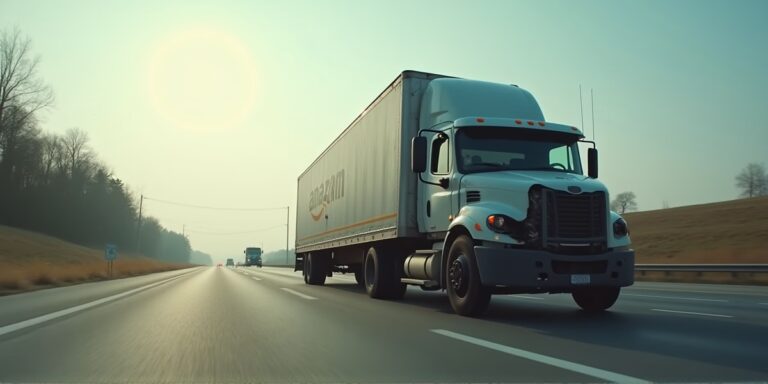
Are Amazon Drivers Required To Follow Commercial Driving Rules?

One of the first questions I address with clients in these situations is whether Amazon drivers are considered employees or independent contractors. The distinction is crucial because it dictates the level of responsibility Amazon bears for the driver’s actions. Amazon often classifies its Flex drivers as independent contractors, but California law doesn’t automatically accept that label at face value. A rigorous “ABC test” is applied, examining the degree of control Amazon exercises over the driver’s work. Factors like mandated delivery routes, performance metrics, and the use of the Amazon delivery app are all carefully scrutinized.
If a court determines a driver is misclassified as an independent contractor, it opens the door to direct liability for Amazon. This means Amazon could be held responsible for the driver’s negligence, just like any other employer. This is a significant advantage for the injured party, as Amazon’s substantial insurance coverage becomes accessible. Furthermore, the legal framework surrounding respondeat superior—Civ. Code § 1714—can be invoked, establishing vicarious liability for Amazon even if the driver is properly classified as an independent contractor, provided the driver was acting within the scope of their employment.
However, even if a driver is deemed an independent contractor, Amazon still has a duty to ensure they operate safely. This includes proper vetting of drivers, ensuring they have valid driver’s licenses and insurance, and providing adequate training. Negligent hiring, supervision, or retention practices by Amazon can create direct liability. Moreover, we often investigate whether Amazon’s demanding delivery schedules incentivize drivers to speed, violate traffic laws, or drive while fatigued. The Federal Motor Carrier Safety Regulations—49 CFR § 395—may be applicable depending on the weight and type of vehicle used.
Another critical aspect of these cases is determining whether the driver was following commercial driving rules. While not all Amazon delivery drivers operate vehicles requiring a Commercial Driver’s License (CDL), all drivers are subject to certain regulations, including restrictions on cell phone use, speeding, and impaired driving. Drivers operating larger vehicles do typically need a CDL and must adhere to stricter Hours of Service (HOS) regulations. Violations of these regulations, often documented through Electronic Logging Device (ELD) data, can be compelling evidence of negligence.
Finally, it’s essential to remember that workers’ compensation may be a factor, but usually does not preclude a third-party claim. If the driver was acting as an employee, workers’ compensation will likely be the exclusive remedy against Amazon. However, under Labor Code § 3852, injured parties can still pursue a civil lawsuit against any negligent third parties—such as another driver or a defective vehicle manufacturer—who contributed to the accident.
In the case of Hector, we’re currently investigating Amazon’s driver screening process, the driver’s hours leading up to the accident, and the overall safety protocols in place. These cases are rarely straightforward, and a thorough investigation is paramount to protecting the rights of the injured party.
What is the “ABC Test” in California?

The “ABC Test,” established by California law, is used to determine whether a worker is an employee or an independent contractor. To be classified as an independent contractor, a worker must meet all three of the following criteria: (A) The worker is free from the control and direction of the hiring party; (B) The worker performs work outside the usual course of the hiring party’s business; and (C) The worker is customarily engaged in an independently established trade, occupation, or profession. If any one of these criteria is not met, the worker is likely considered an employee.
Can I sue Amazon directly if an Amazon driver hits me?
Yes, you may be able to sue Amazon directly, even if the driver is classified as an independent contractor. You can pursue a claim based on the legal doctrine of respondeat superior, holding Amazon vicariously liable for the driver’s negligence if they were acting within the scope of their employment. Furthermore, you can sue Amazon directly for negligent hiring, supervision, or retention if you can demonstrate that Amazon failed to adequately vet the driver or implement proper safety protocols.
What if the Amazon driver was following their delivery schedule when the accident occurred?
If the Amazon driver was following their assigned delivery schedule at the time of the accident, it strengthens the argument for Amazon’s liability. This indicates the driver was acting within the scope of their employment, making Amazon potentially responsible for their actions under the doctrine of respondeat superior. Additionally, demanding delivery schedules that incentivize speeding or other unsafe behaviors can be used as evidence of negligence against Amazon.
What types of evidence are important in an Amazon driver accident case?
Key evidence includes the police report, witness statements, photos of the accident scene, medical records, Amazon driver’s employment records (if available), Amazon’s internal safety policies and training materials, delivery schedules, and any available ELD data. We also examine Amazon’s driver vetting procedures and the driver’s history of prior accidents or violations. Gathering as much documentation as possible is crucial for building a strong case.
What if the Amazon driver was on Workers’ Compensation?
Even if the Amazon driver is receiving workers’ compensation benefits, you may still have the right to pursue a separate civil claim against negligent third parties whose actions contributed to the accident. Workers’ compensation is typically the exclusive remedy against the employer (Amazon if the driver is an employee), but it does not bar you from suing other at-fault parties, such as another driver or a vehicle manufacturer. Labor Code § 3852 allows for this separate cause of action.