
Can Eld Records Prove I Wasnt At Fault For A Crash?

Determining fault in a truck accident is rarely simple. While witness testimony and accident reconstruction can be helpful, Electronic Logging Device (ELD) records are often the most powerful evidence available. These devices, mandated by the Federal Motor Carrier Safety Administration (FMCSA), track a driver’s hours behind the wheel, rest breaks, and other critical data points. In many cases, ELD data can definitively prove or disprove claims of driver fatigue, speeding, or other violations that contributed to the crash.
However, simply obtaining the ELD records isn’t enough. Insurance companies are adept at interpreting this data in their favor, often employing sophisticated forensic analysis to minimize their liability. It’s crucial to have an attorney who understands how these records work and can effectively challenge the carrier’s interpretation. A skilled legal professional can identify discrepancies, uncover hidden violations, and build a compelling case based on the objective evidence contained within the ELD data.
As a personal injury attorney practicing in San Diego for over 13 years, I’ve seen firsthand how insurance companies attempt to devalue and deny legitimate claims. I was trained by a former insurance defense attorney, giving me intimate knowledge of how they evaluate evidence and build their defenses. This experience allows me to anticipate their strategies and proactively gather the evidence needed to protect my clients’ rights.
Can an ELD record definitively prove a driver was *not* fatigued?
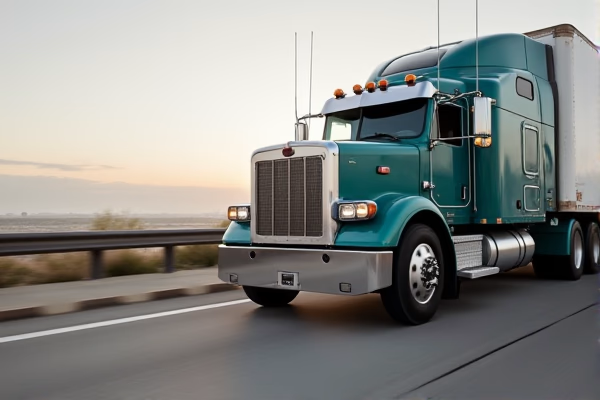
While ELD records are incredibly valuable, they aren’t always a silver bullet. An ELD record showing a driver adhered to the Hours of Service (HOS) regulations doesn’t automatically absolve them of fault. Drivers can still be fatigued even within those limits due to factors like sleep apnea, pre-existing medical conditions, or inadequate rest. Furthermore, ELD data can be manipulated or misinterpreted. It’s essential to verify the accuracy of the records and investigate any potential discrepancies.
For example, a driver might falsely log their rest breaks or tamper with the device itself. We’ve seen cases where drivers use “split-sleeper berth” provisions improperly to mask extended driving hours. A thorough investigation, including reviewing the driver’s logbook, maintenance records, and potentially even interviewing dispatch personnel, is critical to ensure the ELD data accurately reflects the driver’s actual hours of service.
What happens if the trucking company refuses to provide the ELD records?
Trucking companies are legally obligated to preserve ELD data for a specific period after an accident. Refusal to provide these records is a red flag and can be grounds for a lawsuit. We can file a formal request for discovery, and if the company still refuses to cooperate, we can seek a court order compelling them to produce the data. It’s important to act quickly, as evidence can be lost or destroyed over time.
What if the ELD data is incomplete or corrupted?
ELD data isn’t always perfect. Technical glitches, power outages, or even intentional tampering can result in incomplete or corrupted records. If the data is missing or unreliable, we can explore alternative sources of evidence, such as the driver’s logbook, maintenance records, dispatch logs, and witness testimony. In some cases, we may need to hire a forensic expert to recover lost data or analyze the existing data for inconsistencies.
How does the “Hours of Service” (HOS) regulation work, and what violations are most common?
Federal **Hours of Service (HOS)** regulations dictate exactly how long a driver can be behind the wheel. Violations of these federal safety standards, often proven through Electronic Logging Device (ELD) data, are used to demonstrate driver fatigue. Common violations include exceeding the 11-hour driving limit, failing to take mandatory rest breaks, and falsifying logbook entries. Under 49 CFR § 395, drivers are limited in the amount of time they can operate a commercial vehicle without adequate rest.
What role does the driver’s Bill of Lading play in proving fault?
The Bill of Lading (BOL) is a receipt for the goods being transported and contains important information about the driver’s route, delivery schedule, and the shipper’s instructions. This document can reveal whether the driver was pressured to meet unrealistic deadlines or forced to violate HOS regulations to expedite delivery. If the BOL indicates a tight schedule that would require the driver to exceed legal driving limits, it can be strong evidence of negligence.
What if the accident involved a government vehicle or roadway hazard?
If a truck accident involves a government-owned vehicle or a dangerous road condition maintained by a public entity, a formal administrative claim **MUST** be presented within **6 months** (180 days). Failure to meet this strict deadline under the Government Tort Claims Act can result in the permanent loss of your right to recover.
What should I do if I suspect the driver was using a cell phone at the time of the accident?
Distracted driving is a major cause of truck accidents. If you suspect the driver was using a cell phone, we can subpoena the driver’s cell phone records to determine if they were making calls, sending texts, or using other apps at the time of the crash. Dashcam footage, if available, can also provide valuable evidence of distracted driving.
How does comparative fault affect my claim if I was partially at fault for the accident?
California’s ‘pure’ comparative fault system applies to trucking claims. Even if a truck driver argues you shared responsibility, you can still recover damages; however, your total compensation will be reduced by your percentage of fault. Under Civ. Code § 1714, your recovery is directly proportional to your degree of negligence.
What if the truck driver was an independent contractor, not an employee of the trucking company?
California’s ‘ABC test’ determines if a delivery driver (Amazon/FedEx) is an employee or contractor. Even if labeled a ‘contractor,’ a company may be liable if they exercise control over the driver’s work, a key factor in San Diego delivery truck litigation. Labor Code § 2775 outlines the specific criteria used to classify workers in California.