
How Are Trucking Companies Investigated After Accidents In San Diego?

Investigating trucking accidents is far more complex than dealing with a typical car crash. Trucking companies have significant resources to protect themselves, and often begin building a defense immediately. As a personal injury attorney practicing in San Diego for over 13 years, I’ve seen firsthand how these companies operate. I was trained by a former insurance defense attorney, giving me intimate knowledge of how insurance companies evaluate, devalue, and deny claims. Understanding the investigative process – and what evidence is critical – is the first step to securing the compensation you deserve.
The immediate aftermath of a truck accident is crucial. While the police investigation focuses on the initial cause, a thorough investigation into the trucking company itself is essential. This goes far beyond simply identifying the driver. We need to examine the company’s safety record, maintenance logs, driver qualifications, and adherence to federal and state regulations. Often, the root cause of the accident isn’t driver error, but systemic issues within the trucking company itself.
What types of evidence are collected during a trucking company investigation?
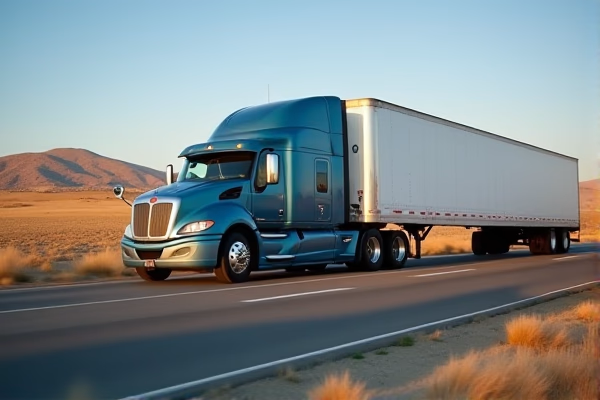
A comprehensive investigation will gather evidence from multiple sources. This includes the police report, witness statements, photos and videos from the scene, and, most importantly, the truck’s Electronic Logging Device (ELD) data. ELD data provides a detailed record of the driver’s hours of service, speed, and location. We also subpoena the driver’s complete personnel file, including their driving history, medical records, and any disciplinary actions. Furthermore, we’ll analyze the truck’s maintenance records to ensure it was properly inspected and repaired. Federal Hours of Service (HOS) regulations dictate exactly how long a driver can be behind the wheel. Violations of these federal safety standards, often proven through Electronic Logging Device (ELD) data, are used to demonstrate driver fatigue.
Beyond the physical evidence, we also look for evidence of negligence in the company’s hiring and training practices. Was the driver properly vetted? Did they receive adequate training for the type of truck they were operating? A history of safety violations or a pattern of inadequate training can be strong indicators of negligence. We’ll also investigate whether the company pressured the driver to violate safety regulations to meet unrealistic deadlines.
Finally, we’ll examine the company’s safety policies and procedures. Were these policies adequate? Were they consistently enforced? A poorly written or unenforced safety policy can be a significant factor in establishing liability.
How does the “ABC test” apply to delivery drivers and trucking companies?
California’s ‘ABC test’ determines if a delivery driver (Amazon/FedEx) is an employee or contractor. Even if labeled a ‘contractor,’ a company may be liable if they exercise control over the driver’s work, a key factor in San Diego delivery truck litigation. This is particularly relevant in the gig economy, where many delivery drivers are classified as independent contractors. However, if the company exerts significant control over the driver’s schedule, routes, or methods of operation, they may be legally considered an employee. This distinction is critical because employees are entitled to greater protections under the law.
Determining employee status often requires a detailed analysis of the working relationship. We’ll examine the company’s contracts, payment structure, and the level of control they exert over the driver’s day-to-day activities. If the driver is found to be an employee, the company is directly liable for their actions, even if the driver was negligent.
The classification of drivers as employees or contractors is a complex legal issue. It’s essential to consult with an attorney who understands the nuances of California’s labor laws to determine your rights.
What is “vicarious liability” and how does it relate to trucking companies?
Under the doctrine of vicarious liability (respondeat superior), a principal is responsible to third persons for the negligence of their agent in the transaction of business. This holds the trucking company legally liable for the wrongful acts of its drivers committed within the scope of their employment. This means that even if the driver was at fault, the trucking company can also be held responsible for your damages. The key is establishing that the driver was acting within the scope of their employment at the time of the accident.
Proving vicarious liability requires demonstrating that the driver was performing work-related duties when the accident occurred. This includes driving the truck, loading or unloading cargo, or performing other tasks assigned by the company. We’ll examine the driver’s logbook, dispatch records, and any other evidence that supports the claim that they were acting within the scope of their employment.
It’s important to note that vicarious liability can extend to even negligent hiring or training practices. If the company knew or should have known that the driver was unfit to operate a truck, they can be held liable for the accident.
What are the government claim deadlines if a roadway or public entity is involved?
…if a truck accident involves a government-owned vehicle or a dangerous road condition maintained by a public entity, a formal administrative claim MUST be presented within **6 months** (180 days). Failure to meet this strict deadline under the Government Tort Claims Act can result in the permanent loss of your right to recover. This is a critical deadline that many accident victims are unaware of. If the accident occurred on a public road due to a hazardous condition, such as a pothole or inadequate signage, you may need to file a claim with the government entity responsible for maintaining the roadway.
The claim process can be complex and requires specific documentation. We’ll work with you to gather the necessary evidence and prepare a comprehensive claim that meets all legal requirements. It’s essential to act quickly to ensure that your claim is filed on time.
Ignoring this deadline can have devastating consequences. If you miss the 180-day deadline, you may be permanently barred from recovering damages from the government entity.
What should I do if an insurance adjuster asks me to give a recorded statement?
Insurance adjusters often request recorded statements early in the claims process. While it may seem harmless, giving a recorded statement can significantly harm your case. They are trained to ask leading questions designed to minimize your damages and find loopholes to deny your claim. They are not on your side, and their primary goal is to protect the insurance company’s bottom line.
Politely decline the request for a recorded statement and refer them to your attorney. Your attorney can handle all communication with the insurance company and ensure that your rights are protected. We’ll advise you on the best course of action and protect you from making statements that could jeopardize your claim.
Remember, you are not obligated to give a recorded statement. In fact, it’s generally best to avoid it altogether. Let an experienced attorney handle the communication with the insurance company on your behalf.