
How Do Lawyers Negotiate Truck Accident Settlements In San Diego?

Negotiating a truck accident settlement is a complex process, significantly different from typical car crash claims. The sheer size and weight of commercial vehicles, combined with the intricate regulations governing the trucking industry, introduce layers of liability and potential recovery sources. As a personal injury attorney practicing in San Diego for over 13 years, I’ve seen firsthand how insurance companies attempt to minimize payouts, often exploiting the victim’s lack of knowledge regarding their rights. I was trained by a former insurance defense attorney, giving me intimate knowledge of how insurance companies evaluate, devalue, and deny claims.
One of the first steps in any truck accident negotiation is identifying all potentially liable parties. This isn’t always straightforward. While the driver is often the first target, the trucking company, the owner of the trailer (if different from the carrier), the maintenance company, and even the shipper could share responsibility. Thorough investigation, including obtaining police reports, witness statements, and the truck’s maintenance records, is crucial to building a strong case.
Successfully negotiating a truck accident settlement requires a deep understanding of both state and federal regulations. These regulations cover everything from driver hours of service to vehicle maintenance and cargo securement. Violations of these rules can be powerful evidence of negligence, significantly strengthening your claim. For example, proving a driver was in violation of federal Hours of Service (HOS) regulations, often proven through Electronic Logging Device (ELD) data, is used to demonstrate driver fatigue.
Furthermore, the legal landscape surrounding truck accidents in California is unique. The statute of limitations for filing a lawsuit is generally **two years** from the date of the accident, but this can be complicated by government entity involvement or the presence of multiple parties. Because trucking companies often begin evidence destruction (like purging ELD data) as soon as the law allows, immediate filing is critical to preserve the integrity of the claim.
What types of damages can I recover in a San Diego truck accident settlement?
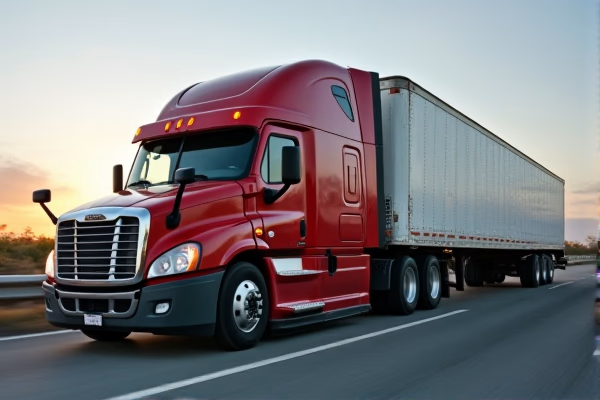
Truck accident victims are entitled to compensation for a wide range of damages, extending far beyond just medical bills. These damages can be broadly categorized as economic and non-economic. Economic damages include medical expenses (past and future), lost wages, property damage, and other out-of-pocket costs. Non-economic damages compensate for pain and suffering, emotional distress, loss of enjoyment of life, and permanent disability. In cases involving particularly egregious conduct by the trucking company, punitive damages may also be available.
Calculating the full extent of your damages requires a detailed analysis of your medical records, employment history, and the long-term impact of your injuries. It’s essential to work with an attorney who understands how to properly document and present these damages to maximize your recovery.
How does the insurance company evaluate my truck accident claim?
Insurance companies employ a variety of tactics to minimize settlement payouts. They will often attempt to discredit your injuries, argue that you were partially at fault, or claim that the driver was not negligent. They may also request a recorded statement, hoping to elicit information that can be used against you. It’s crucial to avoid giving a recorded statement without first consulting with an attorney. Insurance adjusters are trained negotiators, and anything you say can and will be used to devalue your claim.
They will also scrutinize your medical records, looking for pre-existing conditions or gaps in treatment to argue that your injuries are not solely attributable to the accident. Understanding their tactics and preparing accordingly is essential to leveling the playing field.
What if the truck driver was working for a trucking company?
In cases where the truck driver was employed by a trucking company, the doctrine of **vicarious liability** (respondeat superior) comes into play. This holds the trucking company legally liable for the wrongful acts of its drivers committed within the scope of their employment. This means you can pursue a claim against both the driver and the trucking company. However, proving the driver was acting within the scope of their employment can be complex, requiring evidence of their work schedule, dispatch records, and the nature of their assignment at the time of the accident.
Furthermore, the trucking company may also be directly liable if it was negligent in hiring, supervising, or retaining an unfit driver. This is critical in cases where the driver has a history of FMCSA violations or lacked the proper CDL endorsements.
What is the role of a black box or Electronic Logging Device (ELD) data in my case?
Electronic Logging Devices (ELDs) are now mandated for most commercial trucks, recording critical data such as driving hours, speed, and location. This data can be invaluable in proving driver fatigue, speeding violations, and other forms of negligence. However, accessing this data can be challenging, often requiring a subpoena or court order. It’s essential to work with an attorney who has experience obtaining and interpreting ELD data.
Additionally, many modern trucks are equipped with “black boxes” that record even more detailed information about the vehicle’s operation. This data can provide crucial insights into the moments leading up to the accident, helping to establish fault and liability.
How long does it take to settle a truck accident claim in San Diego?
The timeline for settling a truck accident claim can vary significantly depending on the complexity of the case, the severity of your injuries, and the willingness of the insurance company to negotiate in good faith. Simple cases with clear liability may settle within a few months, while more complex cases involving disputed facts or significant injuries can take a year or longer. It’s important to be patient and prepared for a lengthy process.
Often, the insurance company will initially offer a low settlement amount, hoping you will accept it without legal representation. It’s crucial to resist the temptation to settle prematurely and to work with an attorney who can properly evaluate your claim and negotiate a fair settlement on your behalf.
What should I do if the insurance company requests a recorded statement?
I strongly advise against giving a recorded statement to the insurance company without first consulting with an attorney. Insurance adjusters are skilled at eliciting information that can be used to devalue your claim. They may ask seemingly innocuous questions that are designed to trap you into making statements that contradict your later testimony.
If you are contacted by the insurance company, politely decline to give a statement and refer them to your attorney. Your attorney can then handle all communication with the insurance company on your behalf, protecting your rights and ensuring that you are not taken advantage of.
What if my medical bills are being paid by a lien?
Medical liens are common in truck accident cases, particularly when treatment is provided by private healthcare providers. A medical lien is a legal claim against your settlement proceeds to ensure that your medical bills are paid. Negotiating these liens can be complex, as healthcare providers often seek to recover the full amount of their bills, even if they are significantly higher than the standard rates.
An experienced attorney can help you negotiate these liens down to a reasonable amount, protecting your settlement proceeds and ensuring that you receive the maximum possible compensation. It’s important to understand the difference between ER billing and medical liens, as they often have different negotiation strategies.
What is the deadline for filing a claim against the government if the accident involved a public entity?
If a truck accident involves a government-owned vehicle or a dangerous road condition maintained by a public entity, a formal administrative claim **MUST** be presented within **6 months** (180 days). Failure to meet this strict deadline under the Government Tort Claims Act can result in the permanent loss of your right to recover. This is a critical deadline that must be strictly adhered to.
The claim process can be complex, requiring specific documentation and legal arguments. It’s essential to work with an attorney who has experience handling government liability claims to ensure that your claim is properly filed and processed.
What if the insurance company makes a policy limits tender?
A policy limits tender is an offer by the insurance company to settle your claim for the maximum amount of their insurance policy. While this may seem like a good offer, it’s important to carefully consider whether it adequately compensates you for all of your damages.
An experienced attorney can help you evaluate the policy limits tender and determine whether it is fair and reasonable. If the policy limits are insufficient to cover your damages, your attorney can explore other potential sources of recovery, such as the driver’s personal assets or other insurance policies.
How can dashcam footage or digital evidence help my case?
Dashcam footage, ECM/EDR (Event Data Recorder) data, ELD data, and GPS information can be invaluable in establishing fault and liability in a truck accident case. This evidence can provide a clear and objective record of the events leading up to the accident, often contradicting the driver’s testimony.
It’s essential to preserve any available digital evidence as soon as possible, as it can be easily overwritten or destroyed. Your attorney can help you obtain and analyze this evidence, using it to strengthen your claim and negotiate a favorable settlement.
What is comparative fault and how does it affect my settlement?
California’s ‘pure’ comparative fault system applies to trucking claims. Even if a truck driver argues you shared responsibility, you can still recover damages; however, your total compensation will be reduced by your percentage of fault. For example, if you are found to be 20% at fault for the accident, your settlement will be reduced by 20%.
The insurance company will often attempt to argue that you were partially at fault, even if the evidence does not support their claim. It’s essential to work with an attorney who can effectively challenge their arguments and minimize your percentage of fault.
What happens if a truck accident results in a wrongful death?
When a truck accident results in a fatality, specific family members have the right to file a wrongful death claim. This allows for the recovery of financial support, funeral expenses, and the loss of the decedent’s love, companionship, and guidance.
Wrongful death claims can be particularly complex and emotionally challenging. It’s essential to work with an attorney who has experience handling these types of cases and can provide compassionate and effective legal representation.