
How Do Lawyers Prove Intoxication After A Truck Crash?

Proving intoxication after a truck crash is rarely straightforward. It’s not always about a positive blood alcohol content (BAC) reading. While a BAC above the legal limit of 0.08% for non-commercial drivers (and 0.04% for commercial drivers – CVC § 23152(d)) is powerful evidence, it’s not the only way to establish impairment. Often, we build a case based on a combination of factors, including witness testimony, police reports, and the driver’s behavior before, during, and after the accident.
One of the biggest challenges is time. Alcohol metabolizes quickly, so the BAC can drop significantly even in the short period between the crash and a blood test. That’s why immediate action is crucial. We immediately work to preserve evidence, including dashcam footage (if available), the driver’s logbooks, and any communication records that might indicate alcohol use. We also seek court orders to compel the trucking company to release maintenance records and safety protocols.
I’ve been practicing personal injury law in San Diego for over 13 years, and I’ve seen countless cases where insurance companies attempt to downplay the role of alcohol. What sets my firm apart is my background. I was previously trained by a former insurance defense attorney, giving me intimate knowledge of how these companies evaluate, devalue, and deny claims. I understand their tactics, and I know how to build a case that overcomes their defenses.
What evidence can be used to prove a truck driver was intoxicated even without a high BAC?
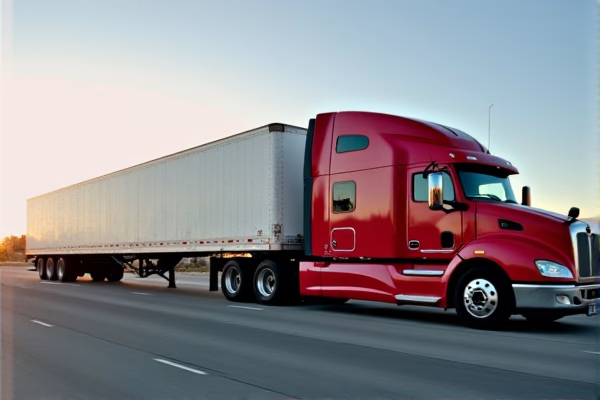
Even without a definitive BAC reading, we can often establish intoxication through circumstantial evidence. This includes observations made by first responders – slurred speech, unsteady gait, the odor of alcohol on the driver’s breath, and erratic driving behavior prior to the crash. Witness statements are also invaluable. Did anyone see the truck swerving or speeding? Were there any admissions of alcohol consumption at the scene?
We also look for physical evidence. Open containers in the cab, receipts for alcohol purchases, and even the driver’s appearance (bloodshot eyes, flushed complexion) can contribute to the overall picture. Expert testimony from toxicologists can help reconstruct the driver’s likely BAC at the time of the accident based on their weight, gender, and the amount of alcohol they consumed.
Can a trucking company be held liable even if the driver wasn’t officially “intoxicated” but still impaired?
Absolutely. Negligent hiring or training can create liability for the trucking company even if the driver’s BAC was below the legal limit. If the company knew, or should have known, about the driver’s history of alcohol abuse or reckless behavior, they have a duty to prevent them from operating a commercial vehicle. This is critical in cases where the driver has a history of FMCSA violations or lacked the proper CDL endorsements – CACI No. 426.
We investigate the driver’s background thoroughly, looking for any red flags that the company ignored. Did they properly vet the driver’s employment history? Did they provide adequate training on the dangers of alcohol and drug use? If we can demonstrate that the company was negligent in their hiring or training practices, we can hold them directly responsible for the accident.
What role do federal regulations and logbooks play in proving intoxication?
Federal **Hours of Service (HOS)** regulations dictate exactly how long a driver can be behind the wheel. Violations of these federal safety standards, often proven through Electronic Logging Device (ELD) data, are used to demonstrate driver fatigue. A fatigued driver is more likely to make poor decisions, including driving under the influence. We subpoena the driver’s logbooks and ELD data to identify any violations of HOS regulations.
Furthermore, inconsistencies in the logbooks can be a telltale sign of falsification. Drivers may attempt to conceal their hours of service violations to avoid penalties. We work with forensic experts to analyze the logbooks and identify any discrepancies that suggest the driver was operating while fatigued or impaired. This is especially important in San Diego, where long-haul trucking routes are common.
What if the driver was on-duty but not actively driving when they consumed alcohol? Does that affect the case?
Not necessarily. Even if the driver wasn’t actively driving at the moment of alcohol consumption, the trucking company can still be held liable if the alcohol use contributed to their impairment later on. California law holds trucking companies responsible for the actions of their drivers while on duty – Civ. Code § 2338.
If the driver consumed alcohol during their break and then operated the vehicle while still impaired, the company can be held liable for negligence. We investigate the driver’s entire on-duty schedule to determine if alcohol use played any role in the accident. This includes reviewing their work assignments, break times, and any communication records that might indicate alcohol consumption.
How does comparative fault affect a claim if the other driver shared some responsibility for the accident?
California’s ‘pure’ comparative fault system applies to trucking claims. Even if a truck driver argues you shared responsibility, you can still recover damages; however, your total compensation will be reduced by your percentage of fault – Civ. Code § 1714. For example, if you are found to be 20% at fault for the accident, your damages will be reduced by 20%.
The insurance company will often attempt to shift blame to the victim, arguing that they were speeding, distracted, or otherwise negligent. We thoroughly investigate the accident to identify all contributing factors and protect your rights. This includes gathering evidence from witnesses, reviewing police reports, and reconstructing the accident scene.