
How Do Lawyers Prove Truck Speeding?

Proving a truck driver was speeding is often a cornerstone of a successful claim against a trucking company. It’s rarely as simple as a police officer citing the driver at the scene. Insurance companies are adept at minimizing liability, and they will aggressively challenge any evidence suggesting a violation of speed limits. As a personal injury attorney in San Diego with over 13 years of experience, I’ve seen firsthand how they attempt to devalue and deny claims, and I understand the tactics they employ. I was trained by a former insurance defense attorney, giving me intimate knowledge of how insurance companies evaluate, devalue, and deny claims.
The good news is that there are multiple avenues for establishing a truck driver’s speed, even without a direct eyewitness account or a police citation. These methods require diligent investigation, a thorough understanding of federal and state regulations, and a willingness to fight for your rights. We often work with accident reconstruction experts who can analyze the data and provide compelling testimony to support your case.
How Can We Prove a Truck Driver Was Speeding After an Accident?
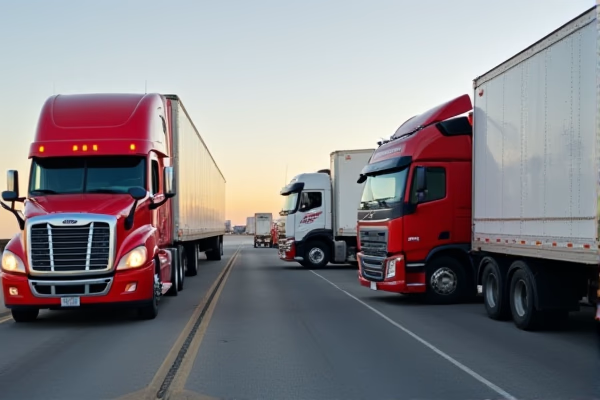
Establishing a truck driver’s speed involves a multi-faceted approach. The first step is securing the police report, but remember that this report is often preliminary and may not contain all the relevant information. We then focus on gathering data from the truck itself, which can be surprisingly revealing. This includes the truck’s Electronic Logging Device (ELD) data, often referred to as the “black box,” which records speed, distance traveled, and hours of service. It’s crucial to act quickly, as trucking companies are legally permitted to purge this data after a certain period.
Beyond the ELD, we examine the truck’s Event Data Recorder (EDR), which captures critical information in the moments leading up to the crash, including braking patterns and speed. We also look for any dashcam footage from the truck itself or from nearby vehicles. Finally, accident reconstruction experts can use the physical evidence at the scene – skid marks, vehicle damage, and the point of impact – to calculate the truck’s speed at the time of the collision.
It’s important to understand that proving speed isn’t always about a number exceeding the posted limit. California law prohibits commercial trucks (including semi-tractors with three or more axles) from exceeding **55 miles per hour** on any highway. In San Diego freeway crashes, proving a violation of this speed limit is a primary tool for establishing statutory negligence.
What Role Does the Electronic Logging Device (ELD) Play in Determining Speed?
The ELD is a critical piece of evidence in most truck accident cases. These devices are mandated by federal regulations (49 CFR § 395) and continuously record a truck’s operating data, including speed, location, and hours of service. This data can be downloaded and analyzed to determine if the driver was adhering to speed limits and federal HOS rules. However, insurance companies often attempt to dispute the accuracy of ELD data, claiming malfunctions or tampering.
We have experience challenging these claims and working with forensic experts to verify the integrity of the data. It’s also important to note that even if the ELD data doesn’t show a blatant speed violation, it can still reveal other critical information, such as whether the driver was fatigued or had been driving for excessive hours, which can contribute to negligence.
Furthermore, the ELD data can be cross-referenced with the driver’s logbook (if one is still maintained) and other documentation to identify inconsistencies and potential falsification of records.
Can Accident Reconstruction Experts Help Prove a Truck Driver Was Speeding?
Absolutely. Accident reconstruction experts are highly trained professionals who specialize in analyzing the physical evidence at the scene of a collision to determine the contributing factors, including speed. They use a variety of techniques, such as vehicle dynamics, crash formulas, and site surveys, to recreate the accident and estimate the truck’s speed at the time of impact.
Their testimony is often crucial in court, as they can provide a clear and objective explanation of how the accident occurred and the role that speed played. They can also identify any mechanical failures or other contributing factors that may have exacerbated the severity of the crash.
The experts will also consider the road conditions, weather, and visibility at the time of the accident to provide a comprehensive analysis.
What Happens if the Police Report Doesn’t Mention Speeding?
A lack of mention of speeding in the police report does not automatically preclude you from pursuing a claim based on excessive speed. Police officers are often focused on immediate safety concerns and may not have the time or resources to conduct a thorough investigation into every aspect of the accident.
Furthermore, the police report is often based on preliminary information and witness statements, which may not be entirely accurate. We conduct our own independent investigation, gathering evidence from multiple sources to build a strong case.
We can also subpoena witnesses and request additional documentation from the trucking company to corroborate our findings.
What if the Trucking Company Claims the Driver Was Below the Speed Limit?
Trucking companies will often present their own evidence to minimize their liability, including statements from the driver and data from the truck’s ELD. It’s crucial to have an experienced attorney who can thoroughly review this evidence and identify any inconsistencies or inaccuracies.
We will also conduct our own investigation, gathering independent evidence to challenge the trucking company’s claims. This may include hiring an accident reconstruction expert, interviewing witnesses, and obtaining dashcam footage.
Remember, the burden of proof lies with the plaintiff (you) to establish negligence. We will work tirelessly to gather the evidence necessary to prove that the truck driver was speeding and that their negligence caused your injuries.
What is the Statute of Limitations for Filing a Truck Accident Lawsuit in California?
In California, you have a limited amount of time to file a lawsuit after a truck accident. According to CCP § 335.1, you generally have **two years** from the date of the truck accident to initiate legal proceedings. Because trucking companies often begin evidence destruction (like purging ELD data) as soon as the law allows, immediate filing is critical to preserve the integrity of the claim.
Failing to file within this timeframe will likely result in the permanent loss of your right to recover damages. It’s essential to consult with an attorney as soon as possible after an accident to ensure that your claim is filed on time.
Don’t delay. Protecting your legal rights requires swift action.
What Should I Do If the Accident Involved a Government Vehicle or Road Hazard?
If the truck accident involved a government-owned vehicle or a dangerous road condition maintained by a public entity, the claims process is significantly different. You must file a formal administrative claim with the government agency within a very short timeframe. According to Gov. Code § 911.2, a formal administrative claim **MUST** be presented within **6 months** (180 days).
This deadline is strict, and failure to meet it can result in the permanent loss of your right to recover. We have extensive experience handling claims against government entities and can ensure that your claim is filed correctly and on time.
Navigating these complex procedures requires specialized knowledge and attention to detail.
What if the Driver Was Classified as an Independent Contractor?
Determining whether a delivery driver (Amazon/FedEx) is an employee or contractor can be complex. California’s ‘ABC test’ determines if a delivery driver (Amazon/FedEx) is an employee or contractor. Even if labeled a ‘contractor,’ a company may be liable if they exercise control over the driver’s work, a key factor in San Diego delivery truck litigation.
We will investigate the driver’s relationship with the trucking company to determine if they were properly classified as an independent contractor. If the company exercised significant control over the driver’s work, they may be liable for their negligence, even if they were technically classified as a contractor.
This often involves examining the driver’s contract, payment structure, and the level of supervision they received.
What is Vicarious Liability (Respondeat Superior) and How Does it Apply to Trucking Accidents?
Under the doctrine of vicarious liability (respondeat superior), a principal is responsible to third persons for the negligence of their agent in the transaction of business. This holds the trucking company legally liable for the wrongful acts of its drivers committed within the scope of their employment.
This means that even if the driver was personally at fault for the accident, the trucking company can also be held liable for your damages. We will investigate the driver’s employment relationship with the trucking company to establish vicarious liability.
This often involves examining the driver’s job description, training records, and the company’s policies and procedures.
What are the Speed Limits for Commercial Trucks in California?
In California, commercial trucks (including semi-tractors with three or more axles) are strictly prohibited from exceeding **55 miles per hour** on any highway. CVC § 22406. In San Diego freeway crashes, proving a violation of this speed limit is a primary tool for establishing statutory negligence.
Even a slight exceedance of this speed limit can be enough to establish negligence, especially when combined with other factors, such as driver fatigue or mechanical failures. We will thoroughly investigate the truck’s speed and any potential violations of speed limits.
This may involve analyzing ELD data, dashcam footage, and accident reconstruction reports.