
What Are Trucking Company Safety Ratings?

Trucking company safety ratings are a critical component of determining liability in an accident involving a commercial vehicle. These ratings, primarily managed by the Federal Motor Carrier Safety Administration (FMCSA), provide a snapshot of a carrier’s compliance with federal safety regulations. However, understanding these ratings can be complex, and a seemingly “satisfactory” rating doesn’t automatically absolve a company of responsibility. It’s essential to dig deeper and assess the underlying data that contributes to that score.
The FMCSA utilizes a Safety Measurement System (SMS) to evaluate carriers based on several key metrics, including crash rates, inspections, and violations. These metrics are then used to assign a safety rating. While the public-facing rating system has evolved, the core principles remain the same: to identify and address high-risk carriers before accidents occur. A carrier can be rated as one of the following: Unsatisfactory, Satisfactory, or Not Rated. It’s important to note that a “Satisfactory” rating is not a guarantee of safety, and a thorough investigation is always necessary following a truck accident.
I’ve spent over 13 years representing clients injured in truck accidents throughout San Diego. Having been trained by a former insurance defense attorney, I possess intimate knowledge of how insurance companies evaluate, devalue, and deny claims. They will often seize on a “Satisfactory” safety rating to downplay the carrier’s negligence, but I know how to uncover the full picture and build a compelling case for my clients.
What factors contribute to a trucking company’s safety rating?
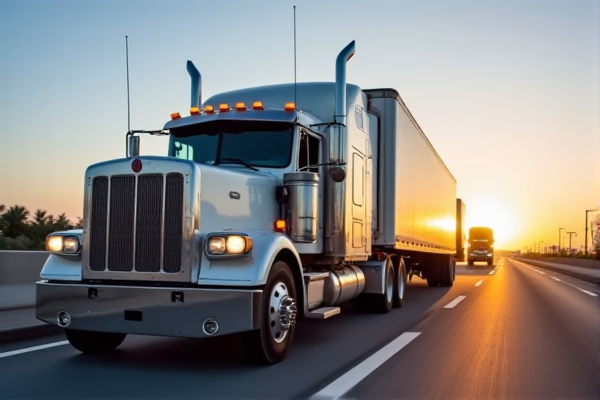
Several factors are considered when determining a trucking company’s safety rating. The most significant are the carrier’s crash rate, the number and severity of inspections, and the types of violations they’ve received. The FMCSA assigns a Behavior Analysis and Safety Improvement Category (BASIC) score to each carrier, based on these metrics. These BASIC scores are then used to calculate the overall safety rating. A high number of violations related to driver fatigue, improper cargo securement, or vehicle maintenance will negatively impact a carrier’s score.
It’s crucial to understand that a carrier’s safety rating is not a static number. It can change frequently based on new data. A company with a recent history of accidents or violations is more likely to have a lower rating, even if they’ve had a good record in the past. Furthermore, the FMCSA’s data isn’t always up-to-date, and there may be unreported incidents that don’t factor into the rating.
Can I use a trucking company’s safety rating as evidence in my case?
Yes, a trucking company’s safety rating can be valuable evidence in a truck accident case. It can demonstrate a pattern of negligence and a disregard for safety regulations. However, it’s not a slam dunk. Insurance companies will often argue that the rating is not directly related to the specific accident in question. They may also attempt to discredit the data or argue that the rating is outdated.
To effectively use a safety rating as evidence, it’s essential to present it alongside other supporting documentation, such as the police report, witness statements, and the driver’s logbook. An experienced attorney can help you gather and analyze this evidence to build a strong case and maximize your chances of recovery.
What if the trucking company has a “Satisfactory” safety rating? Does that mean they aren’t liable?
Absolutely not. A “Satisfactory” safety rating does not automatically shield a trucking company from liability. It simply means they meet the minimum federal safety standards. It doesn’t account for factors such as driver error, improper training, or negligent maintenance practices. In fact, many accidents are caused by issues that wouldn’t necessarily be reflected in a safety rating, such as a driver’s distraction or a mechanical failure that wasn’t properly addressed.
Insurance companies often use a “Satisfactory” rating to lull accident victims into a false sense of security. They may try to convince you that the company is reputable and that your claim is unlikely to succeed. However, it’s crucial to remember that every accident is unique, and a thorough investigation is necessary to determine the true cause and identify all responsible parties.
What should I do if I’ve been injured in a truck accident?
If you’ve been injured in a truck accident, it’s essential to take immediate action to protect your rights. First, seek medical attention, even if you don’t feel seriously injured. Many injuries, such as whiplash or internal bleeding, may not be immediately apparent. Second, contact an experienced truck accident attorney as soon as possible. An attorney can help you gather evidence, navigate the complex legal process, and negotiate with the insurance company on your behalf.
Furthermore, it’s important to avoid speaking to the insurance company without first consulting with an attorney. Insurance adjusters are trained to minimize payouts, and they may try to trick you into making statements that could harm your case. Let an attorney handle all communication with the insurance company and ensure that your rights are protected.
How can an attorney help me investigate a trucking company’s safety record?
An attorney can conduct a thorough investigation into a trucking company’s safety record, going beyond the publicly available FMCSA rating. This includes reviewing the carrier’s maintenance logs, driver qualifications, and accident history. We can also subpoena records from the FMCSA and other relevant agencies to uncover any hidden violations or patterns of negligence. In San Diego, we frequently utilize local court resources to obtain critical data that is not readily accessible to the public.
We also have the experience to interpret the complex regulations governing the trucking industry and identify any potential violations that may have contributed to your accident. This can significantly strengthen your case and increase your chances of recovering the compensation you deserve.
What is the importance of preserving evidence after a truck accident?
Preserving evidence is crucial in any truck accident case, but it’s especially important when dealing with a commercial vehicle. This includes taking photos of the accident scene, obtaining the police report, and gathering witness statements. It’s also essential to preserve any physical evidence, such as damaged vehicle parts or cargo. In many cases, the trucking company will attempt to repair or dispose of evidence before it can be inspected.
An attorney can help you secure and preserve evidence, including sending a spoliation letter to the trucking company demanding that they preserve all relevant records. This letter legally requires them to retain any evidence that could be used in your case. Failure to preserve evidence can result in serious consequences, including sanctions from the court.
What are the deadlines for filing a claim after a truck accident?
California law provides a **two-year** window from the date of the truck accident to file a lawsuit. Because trucking companies often begin evidence destruction (like purging ELD data) as soon as the law allows, immediate filing is critical to preserve the integrity of the claim. However, there may be other deadlines that apply, such as the deadline for filing a claim with your own insurance company or a government entity.
It’s essential to consult with an attorney as soon as possible to understand all applicable deadlines and ensure that your claim is filed on time. Missing a deadline can result in the permanent loss of your right to recover compensation.
What if the truck driver was an independent contractor, not an employee?
Determining whether a truck driver is an employee or an independent contractor can be complex. California’s ‘ABC test’ determines if a delivery driver (Amazon/FedEx) is an employee or contractor. Even if labeled a ‘contractor,’ a company may be liable if they exercise control over the driver’s work, a key factor in San Diego delivery truck litigation. Insurance companies will often argue that the driver was an independent contractor to avoid liability, but an attorney can help you investigate the driver’s employment status and determine whether the company exercised sufficient control to be held responsible.
Factors such as the driver’s level of autonomy, the company’s control over their schedule and routes, and the driver’s access to benefits and equipment can all be relevant in determining their employment status.
What if the accident involved a government vehicle or a dangerous road condition?
If a truck accident involves a government-owned vehicle or a dangerous road condition maintained by a public entity, a formal administrative claim **MUST** be presented within **6 months** (180 days). Failure to meet this strict deadline under the Government Tort Claims Act can result in the permanent loss of your right to recover. These claims have specific requirements and procedures, and it’s essential to consult with an attorney to ensure that your claim is properly filed.
We have extensive experience handling claims against government entities in San Diego and can help you navigate the complex legal process.
What if the trucking company is offering me a settlement?
Before accepting any settlement offer from a trucking company, it’s crucial to consult with an attorney. Insurance companies are often skilled negotiators, and they may try to convince you to settle for less than your claim is worth. An attorney can review the settlement offer and advise you on whether it’s fair and reasonable.
We can also negotiate with the insurance company on your behalf to maximize your compensation and ensure that you receive the full amount you deserve. Don’t sign anything until you’ve had a chance to speak with an attorney.