
What Evidence Is Important After Port Truck Accidents?

Port truck accidents are uniquely complex. Unlike typical car crashes, they often involve multiple parties – the driver, the trucking company, the cargo owner, and potentially the port authority itself. This complexity means gathering and preserving evidence is absolutely critical from the very beginning. As a personal injury attorney practicing in San Diego for over 13 years, I’ve seen firsthand how quickly evidence can disappear, and how devastating that can be to a claim. I was trained by a former insurance defense attorney, giving me intimate knowledge of how insurance companies evaluate, devalue, and deny claims.
The immediate aftermath of a port truck accident is chaotic. Police reports are essential, but they often only scratch the surface. Insurance adjusters will quickly launch their own investigations, and their primary goal is to minimize their company’s liability. That’s why it’s vital to proactively collect evidence yourself, or through legal counsel, to build a strong case. Focus on anything that can help establish fault, the extent of your injuries, and the full scope of your damages.
What types of evidence should I gather after a port truck accident?
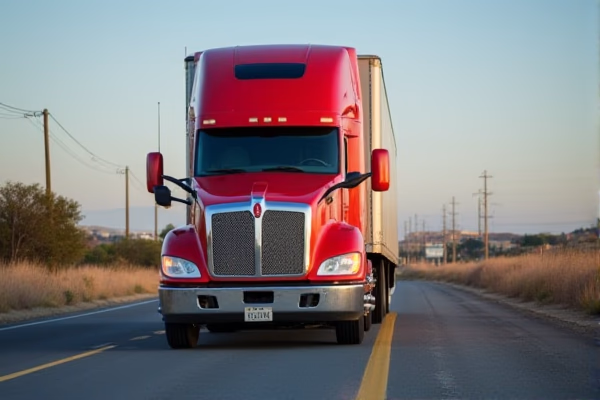
The most valuable evidence in a port truck accident case falls into several categories. First, the police report, witness statements, and photos/videos of the accident scene are foundational. However, don’t stop there. Crucially, obtain the truck driver’s logbooks and Electronic Logging Device (ELD) data. These records reveal hours of service compliance, potential fatigue, and driving patterns. Also, gather information about the truck’s maintenance history – any prior mechanical issues or safety violations can be incredibly telling.
Beyond the immediate accident details, meticulously document your injuries and treatment. Keep a detailed medical journal, including all doctor visits, therapies, and medications. Preserve all bills, pay stubs, and other records related to your lost income. Don’t underestimate the importance of photos and videos documenting your recovery process – these can powerfully illustrate the impact of your injuries on your daily life.
Finally, consider any evidence related to the cargo being hauled. Was it properly secured? Was there any negligence in the loading or unloading process? These details can sometimes point to additional responsible parties.
What if the truck driver claims they weren’t at fault?
Truck drivers and their companies will often dispute liability, even in clear-cut cases. They may claim you were partially at fault, that the accident was unavoidable, or that your injuries are not as severe as you allege. This is where having strong evidence becomes paramount. ELD data, maintenance records, and witness statements can directly contradict their claims.
Independent accident reconstruction experts can also be invaluable. They can analyze the scene, vehicle damage, and other data to determine the cause of the accident and establish fault. Furthermore, a thorough investigation into the driver’s background – including their driving history and any prior violations – can reveal patterns of negligence.
Remember, insurance companies are skilled at finding loopholes and minimizing payouts. Don’t attempt to negotiate with them directly without legal representation. An experienced attorney can protect your rights and ensure you receive the full compensation you deserve.
How long do I have to file a claim after a port truck accident?
In California, the statute of limitations for personal injury claims is generally **two years** from the date of the truck accident. Because trucking companies often begin evidence destruction (like purging ELD data) as soon as the law allows, immediate filing is critical to preserve the integrity of the claim. CCP § 335.1. However, if a government entity was involved – for example, if the accident occurred on a public roadway due to a hazardous condition – the deadline is significantly shorter, often just six months.
Missing this deadline means you will likely lose your right to sue, regardless of the severity of your injuries. It’s crucial to consult with an attorney as soon as possible to understand your rights and ensure your claim is filed within the proper timeframe.
Don’t delay seeking legal counsel. The sooner you act, the better your chances of a successful outcome.
What role do Electronic Logging Devices (ELDs) play in a port truck accident case?
Electronic Logging Devices (ELDs) are mandatory for most commercial trucks and record crucial data about a driver’s hours of service, speed, location, and other driving activity. This data is invaluable in determining if a driver was fatigued or violated federal safety regulations. Violations of federal **Hours of Service (HOS)** regulations dictate exactly how long a driver can be behind the wheel. Violations of these federal safety standards, often proven through Electronic Logging Device (ELD) data, are used to demonstrate driver fatigue. 49 CFR § 395.
Insurance companies will often attempt to downplay the significance of ELD data or claim it’s unreliable. An experienced attorney can work with accident reconstruction experts to analyze the data and identify any violations. Furthermore, we can subpoena the ELD data directly from the trucking company to ensure its authenticity and prevent tampering.
ELD data can be a game-changer in a port truck accident case, providing concrete evidence of driver negligence and increasing the likelihood of a favorable settlement.
What if I was offered a settlement quickly after the accident?
Insurance companies sometimes offer quick settlements shortly after an accident, hoping to resolve the claim before you fully understand the extent of your injuries and damages. While it may seem tempting to accept a fast payout, it’s rarely in your best interest. These initial offers are almost always significantly lower than the true value of your claim.
Before accepting any settlement, it’s essential to have your injuries thoroughly evaluated by a medical professional and to calculate all of your damages, including medical expenses, lost income, pain and suffering, and future care costs. An attorney can negotiate with the insurance company on your behalf to ensure you receive a fair and just settlement.
Don’t be pressured into accepting a settlement before you’re ready. Protect your rights and seek legal counsel before making any decisions.
What if the truck driver was working as an independent contractor?
Determining whether a truck driver is an employee or an independent contractor can be complex, but it has significant implications for liability. If the driver was an employee, the trucking company is directly responsible for their actions. However, if they were an independent contractor, the liability may be more limited. California’s ‘ABC test’ determines if a delivery driver (Amazon/FedEx) is an employee or contractor. Even if labeled a ‘contractor,’ a company may be liable if they exercise control over the driver’s work, a key factor in San Diego delivery truck litigation. Labor Code § 2775.
An experienced attorney can investigate the driver’s employment status and determine if the trucking company exercised sufficient control over their work to be considered an employer. This investigation may involve reviewing contracts, pay records, and other documentation.
Don’t assume that the driver’s independent contractor status shields the trucking company from liability. There are often grounds to hold them responsible, even in these situations.
What should I do if I receive a call from the insurance adjuster requesting a recorded statement?
Insurance adjusters often request recorded statements shortly after an accident. While you are not legally obligated to provide one, doing so can be detrimental to your claim. Adjusters are trained to ask leading questions and elicit information that can be used to minimize your payout.
It’s best to politely decline the request and refer the adjuster to your attorney. An attorney can advise you on whether to provide a statement and, if so, how to prepare for it.
Protect your rights and avoid making any statements to the insurance company without legal counsel.
What if I have medical liens after my accident?
Medical liens arise when healthcare providers treat you for injuries sustained in an accident and seek reimbursement for their services. These liens can complicate your settlement process, as they must be resolved before you receive your full compensation. ER billing vs. medical liens can be a complicated process.
An experienced attorney can negotiate with healthcare providers to reduce the amount of the liens and ensure they are paid fairly. We can also explore options for resolving liens through Medicare or other insurance programs.
Don’t let medical liens prevent you from receiving the compensation you deserve. An attorney can handle the lien resolution process on your behalf.
What is the deadline for filing a claim against the government if the accident involved a public roadway?
If a truck accident involves a government-owned vehicle or a dangerous road condition maintained by a public entity, a formal administrative claim **MUST** be presented within **6 months** (180 days). Failure to meet this strict deadline under the Government Tort Claims Act can result in the permanent loss of your right to recover. Gov. Code § 911.2.
This deadline is significantly shorter than the statute of limitations for personal injury claims, so it’s crucial to act quickly. An attorney can prepare and file the administrative claim on your behalf to ensure it meets all the necessary requirements.
Don’t delay seeking legal counsel if a government entity was involved in your truck accident.
What if the trucking company tenders their policy limits?
When an insurance company tenders their policy limits, they are offering to settle your claim for the maximum amount of coverage available under their policy. While this may seem like a good offer, it’s important to carefully consider whether it adequately compensates you for all of your damages. Policy limits tenders (primary and excess layers) are a common tactic used by insurance companies.
An experienced attorney can evaluate the policy limits and determine if they are sufficient to cover your medical expenses, lost income, pain and suffering, and future care costs. We can also investigate whether there are other sources of recovery, such as excess insurance policies or responsible parties.
Don’t accept a policy limits tender without first consulting with an attorney.
How can dashcam footage or other digital evidence help my case?
Dashcam footage, ECM/EDR (Event Data Recorder) data, ELD (Electronic Logging Device) data, and GPS records can provide crucial evidence in a port truck accident case. This digital evidence can establish fault, speed, driver fatigue, and other critical details. Dashcam / digital evidence (telematics, ECM/EDR, ELD, GPS) can be invaluable in reconstructing the accident.
An attorney can work with accident reconstruction experts to analyze this data and present it in a compelling manner to the insurance company. We can also subpoena this data directly from the trucking company to ensure its authenticity and prevent tampering.
Preserving this digital evidence is essential, as it can be easily lost or destroyed.