
Can Cargo Companies Be Liable For Accidents?

The question of cargo company liability is a frequent one in San Diego, and the answer is rarely straightforward. While the driver is often the first party considered at fault, the responsibility doesn’t end there. Cargo companies – shippers, loaders, and even those responsible for securing the load – can absolutely be held liable for accidents caused by improperly loaded, secured, or distributed cargo. This liability stems from a duty of care to ensure the safe transport of goods, and a breach of that duty can lead to devastating consequences for innocent motorists.
Determining liability requires a thorough investigation into every aspect of the cargo’s journey. Was the load properly balanced? Were the correct tie-downs used? Did the company adhere to federal and state regulations regarding weight limits and securement protocols? These are critical questions that need to be answered to establish negligence. Often, the trucking company will attempt to deflect blame, citing driver error or unforeseen circumstances. However, a skilled attorney can uncover evidence of systemic failures in the cargo company’s procedures that directly contributed to the accident.
For over 13 years, I’ve represented clients injured in truck accidents throughout San Diego. Having been trained by a former insurance defense attorney, I possess intimate knowledge of how insurance companies evaluate, devalue, and deny claims. I understand the tactics they employ and how to build a strong case to maximize your recovery. I’ve seen firsthand how a seemingly minor oversight in cargo securement can lead to catastrophic injuries and financial hardship.
What types of companies can be held liable in a cargo-related accident?
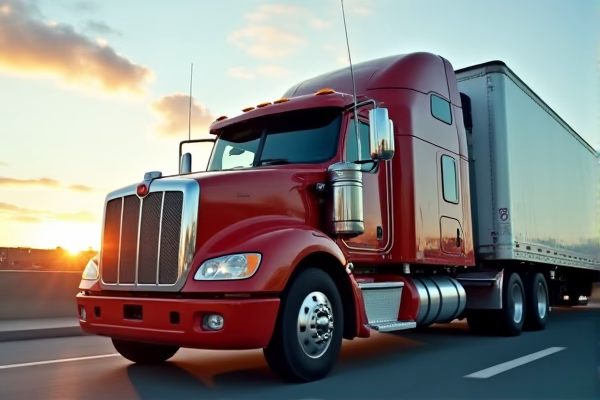
Liability isn’t limited to just the trucking company itself. Several parties can potentially share responsibility. The shipper, the company that originates the cargo, has a duty to accurately describe the weight and nature of the goods being transported. The loader, responsible for physically placing the cargo onto the truck, must ensure it’s properly distributed and secured. Finally, the consignee, the recipient of the cargo, may also bear some responsibility if they knowingly accept an overloaded or improperly secured shipment. Identifying all potentially liable parties is crucial for maximizing your compensation.
Furthermore, companies that contract with third-party logistics providers (3PLs) to manage their shipping can also be held accountable. If the 3PL fails to adequately vet the carriers they use or provide proper oversight, the contracting company may be liable for their negligence. This is especially common in complex supply chains where multiple parties are involved.
How do I prove a cargo company was negligent?
Establishing negligence requires demonstrating that the cargo company breached its duty of care and that this breach directly caused your injuries. This often involves gathering substantial evidence, including the bill of lading (shipping manifest), load securement documentation, driver logs, and maintenance records. Expert testimony from a cargo securement specialist can be invaluable in proving that the load was improperly secured or that the company violated industry standards.
Crucially, we often seek Electronic Logging Device (ELD) data to verify driver hours and ensure compliance with federal Hours of Service (HOS) regulations. Violations of these regulations, often proven through ELD data, are used to demonstrate driver fatigue, a significant contributing factor in many cargo-related accidents. 49 CFR § 395 outlines these federal safety standards.
What if the accident involved hazardous materials?
Accidents involving hazardous materials introduce an additional layer of complexity. Companies transporting hazardous materials are subject to stringent regulations regarding packaging, labeling, and handling. A violation of these regulations can significantly increase the potential liability. In these cases, it’s essential to immediately notify the appropriate authorities and preserve all evidence related to the hazardous material, including the shipping papers and safety data sheets.
Furthermore, the government may also be involved in investigating the accident, particularly if there was an environmental impact. Understanding the interplay between federal, state, and local regulations is critical for navigating these complex claims.
What damages can I recover in a cargo-related accident claim?
If you’ve been injured in an accident caused by improperly loaded or secured cargo, you may be entitled to recover a wide range of damages, including medical expenses (past and future), lost wages, pain and suffering, property damage, and potentially punitive damages if the cargo company’s conduct was particularly egregious. The goal is to fully compensate you for all losses resulting from the accident.
Calculating these damages requires a thorough assessment of your injuries, medical prognosis, and long-term care needs. It’s crucial to work with an attorney who understands the complexities of these calculations and can effectively present your case to the insurance company.
What is the statute of limitations for filing a cargo-related accident claim in California?
In California, you generally have **two years** from the date of the truck accident to file a lawsuit. Because trucking companies often begin evidence destruction (like purging ELD data) as soon as the law allows, immediate filing is critical to preserve the integrity of the claim. CCP § 335.1 governs this timeframe.
Don’t delay in seeking legal counsel. The sooner you act, the better your chances of preserving evidence and building a strong case.
What should I do if an insurance adjuster contacts me?
Insurance adjusters are trained to minimize payouts. They may attempt to downplay your injuries, question your credibility, or pressure you into accepting a settlement that doesn’t fully compensate you for your losses. It’s crucial to avoid making any statements to the insurance adjuster without first consulting with an attorney.
- Do not sign any documents: Any signed document can be used against you.
- Do not provide a recorded statement: Recorded statements can be manipulated and used to undermine your claim.
- Refer all communication to your attorney: Let your attorney handle all interactions with the insurance company.
What if the trucking company claims the driver was an independent contractor?
Determining whether a driver is an employee or an independent contractor is a complex legal issue. California’s ‘ABC test’ determines if a delivery driver (Amazon/FedEx) is an employee or contractor. Even if labeled a ‘contractor,’ a company may be liable if they exercise control over the driver’s work, a key factor in San Diego delivery truck litigation. Labor Code § 2775 provides the framework for this analysis.
We will thoroughly investigate the driver’s relationship with the company to determine if they were misclassified as an independent contractor. If so, the company may be held liable for the driver’s negligence under the doctrine of **vicarious liability** (respondeat superior). Civ. Code § 2338 outlines this principle.