Can Companies Be Liable Even If The Driver Is At Fault?

The legal principle at play here is called **vicarious liability**, specifically the doctrine of *respondeat superior*. Essentially, an employer is responsible for the negligent acts of its employees when those acts occur within the scope of their employment. This means that even if the driver made a mistake, the trucking company can be held legally accountable for the resulting damages. This is because the company controls the drivers, benefits from their work, and has a duty to ensure they operate safely.
However, it’s rarely that simple. Insurance companies are adept at challenging this liability, often arguing the driver was acting outside the scope of their employment, or that the negligence was due to an independent action not attributable to the company. That’s why having an attorney experienced in trucking litigation is crucial. We’ve spent 13+ years successfully navigating these complex cases in San Diego, and I was previously trained by a former insurance defense attorney, giving me intimate knowledge of how insurance companies evaluate, devalue, and deny claims.
What evidence is needed to prove a trucking company was liable?
Establishing a trucking company’s liability requires a thorough investigation. We start by obtaining the driver’s complete personnel file, including their hiring records, training documentation, and any disciplinary actions. We also examine the truck’s maintenance logs to verify proper upkeep and compliance with federal safety regulations. Crucially, we look for any patterns of negligent behavior or systemic issues within the company.
Beyond personnel records, we focus on the driver’s actions leading up to the accident. This includes reviewing their Electronic Logging Device (ELD) data to confirm they weren’t violating Hours of Service (HOS) regulations, and analyzing any dashcam footage or GPS data. Evidence of fatigue, distracted driving, or improper loading procedures can all point to company negligence. In San Diego, we often subpoena these records directly from the trucking company or the driver’s employer.
Finally, we investigate the company’s safety protocols. Did they adequately screen drivers during the hiring process? Did they provide sufficient training on safe driving practices? Were there any known issues with the truck that weren’t addressed? These are all critical questions that can help establish a pattern of negligence and strengthen your claim.
How does the “ABC test” affect liability in delivery truck accidents?
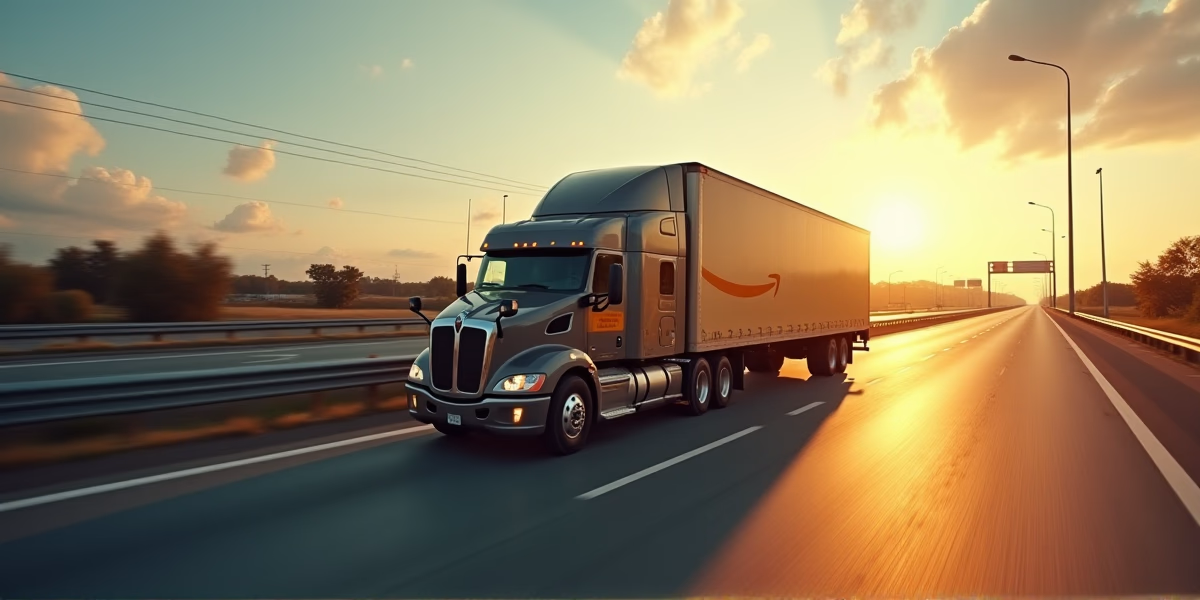
The question of whether a delivery driver is an employee or an independent contractor is increasingly common, particularly with companies like Amazon and FedEx. California’s “ABC test,” as defined in Labor Code § 2775, is used to determine this classification. If a driver is deemed an employee, the company is generally liable for their actions under the doctrine of *respondeat superior*.
The ABC test has three prongs: (A) the worker is free from the control and direction of the hiring company; (B) the worker performs work outside the usual course of the hiring company’s business; and (C) the worker is customarily engaged in an independently established trade, occupation, or profession. If even one of these prongs is not met, the driver is likely considered an employee. In San Diego delivery truck litigation, we often find companies misclassify drivers to avoid liability, so a thorough analysis of the working relationship is essential.
It’s important to note that even if a company labels a driver as a “contractor,” that doesn’t automatically mean they are exempt from liability. If the company exercises significant control over the driver’s work – dictating routes, schedules, or performance standards – a court may still find them to be an employer.
What if the truck driver was intoxicated or violated traffic laws?
While a driver’s intoxication or traffic violation is strong evidence of negligence, it doesn’t automatically absolve the trucking company of responsibility. We still investigate whether the company could have prevented the incident. For example, did they adequately screen the driver for a history of substance abuse? Did they have policies in place to prevent fatigued driving? Did they provide sufficient training on safe driving practices?
In cases involving DUI/alcohol limits, California’s stricter standard for commercial drivers – a BAC of CVC § 23152(d) 0.04 percent – is particularly relevant. Proving a violation of this limit is a powerful tool for establishing statutory negligence. Furthermore, we examine the company’s hiring practices and safety protocols to determine if they were negligent in allowing an unfit driver to operate a commercial vehicle.
We also investigate whether the company knew or should have known about the driver’s reckless tendencies. Did they have a history of traffic violations or accidents? Were there any complaints about their driving behavior? Evidence of prior misconduct can strengthen your claim and demonstrate the company’s negligence.
Can I recover damages if I was partially at fault for the accident?
Yes, even if you shared some responsibility for the accident, you can still recover damages in California. California operates under a “pure” comparative fault system, meaning your compensation will be reduced by your percentage of fault. For example, if you were 20% at fault for the accident, you can still recover 80% of your total damages. Civ. Code § 1714 governs this process.
The insurance company will likely attempt to minimize their liability by arguing you were more at fault than you actually were. That’s why it’s crucial to have an attorney who can thoroughly investigate the accident and gather evidence to support your version of events. We’ll analyze police reports, witness statements, and any available video footage to determine the true cause of the accident and your percentage of fault.
It’s important to remember that even a small percentage of fault can significantly reduce your compensation. That’s why it’s essential to protect your rights and seek legal counsel as soon as possible after an accident.
What happens if the truck accident resulted in a wrongful death?
When a truck accident results in a fatality, the surviving family members have the right to file a wrongful death claim. This allows them to recover financial support, funeral expenses, and the loss of the decedent’s love, companionship, and guidance. CCP § 377.60 outlines the specific requirements for filing such a claim.
These cases are particularly complex and emotionally challenging. The insurance company will likely attempt to minimize their liability by challenging the value of the claim or disputing the extent of the family’s losses. That’s why it’s crucial to have an attorney who is experienced in handling wrongful death claims and can advocate for your rights.
We understand the devastating impact of losing a loved one and are committed to providing compassionate and effective legal representation to families in San Diego. We’ll work tirelessly to ensure you receive the full compensation you deserve.
What is the deadline for filing a claim after a truck accident?
California law provides a **two-year** window from the date of the truck accident to file a lawsuit. Because trucking companies often begin evidence destruction (like purging ELD data) as soon as the law allows, immediate filing is critical to preserve the integrity of the claim. This is especially important in cases involving federal regulations and logbook data.
What should I do if the government is involved in the truck accident?
If a truck accident involves a government-owned vehicle or a dangerous road condition maintained by a public entity, a formal administrative claim **MUST** be presented within **6 months** (180 days). Failure to meet this strict deadline under the Government Tort Claims Act can result in the permanent loss of your right to recover. Gov. Code § 911.2 details these requirements.
What if the driver was classified as an independent contractor but was actually an employee?
California’s ‘ABC test’ determines if a delivery driver (Amazon/FedEx) is an employee or contractor. Even if labeled a ‘contractor,’ a company may be liable if they exercise control over the driver’s work, a key factor in San Diego delivery truck litigation. We will investigate the nature of the working relationship to determine the driver’s proper classification.
What if the insurance company asks me to give a recorded statement?
Insurance companies often request recorded statements shortly after an accident. While you are not legally obligated to provide one, doing so can be detrimental to your claim. They are skilled at asking leading questions and using your words against you. It’s best to politely decline and consult with an attorney before speaking to the insurance company.
What happens if I have medical liens that need to be resolved?
Medical liens are claims placed on your settlement by healthcare providers who treated you for your injuries. We can negotiate with these providers to reduce the amount of the lien and ensure you receive the maximum possible compensation. We also handle ER billing discrepancies and ensure proper reimbursement claims are filed.