Can Multiple Vehicles Be Involved In Tow Truck Accidents?

Tow truck accidents are rarely simple. They often involve multiple parties, making it crucial to understand how liability is determined when more than one vehicle is at play. It’s not uncommon to see a tow truck colliding with the vehicle it’s attempting to tow, another vehicle on the road, or even a pedestrian. Determining who is responsible requires a thorough investigation and a deep understanding of California’s traffic laws and insurance regulations.
The immediate aftermath of an accident is chaotic. Police reports, witness statements, and initial insurance assessments are all vital pieces of the puzzle, but they rarely tell the whole story. Often, the tow truck company, the driver of the other vehicle, and potentially even the vehicle owner are all potential defendants. Navigating these complexities requires an attorney experienced in handling multi-vehicle accidents, especially those involving commercial vehicles like tow trucks.
I’ve been practicing personal injury law in San Diego for over 13 years, and I’ve seen firsthand how insurance companies attempt to minimize payouts in these cases. I was trained by a former insurance defense attorney, giving me intimate knowledge of how they evaluate, devalue, and deny claims. This insight allows me to anticipate their tactics and build a stronger case for my clients.
What happens when a tow truck is towing a vehicle and causes an accident?
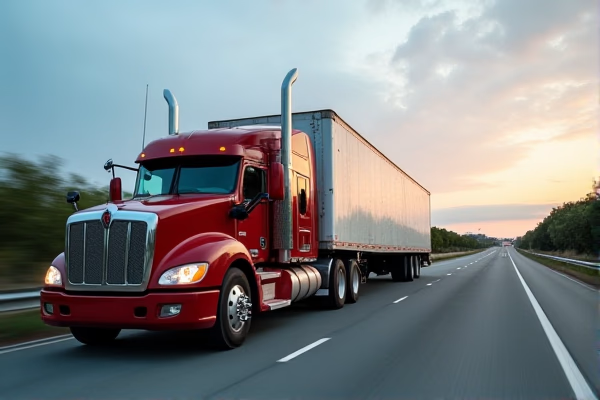
When a tow truck is actively towing a vehicle and an accident occurs, the liability can fall on multiple parties. The tow truck company itself can be held responsible for negligent operation, improper securing of the towed vehicle, or inadequate maintenance of the tow truck. The driver of the tow truck is also directly liable for their actions, including speeding, distracted driving, or failing to follow traffic laws. Furthermore, if the towed vehicle was improperly secured and parts of it become a hazard, the owner of the towed vehicle may also bear some responsibility.
California law dictates specific requirements for towing operations, including the use of safety chains, proper lighting, and adherence to speed limits. Violations of these regulations can be used as evidence of negligence. Establishing a clear chain of responsibility is essential to ensure all responsible parties are held accountable for the damages.
Can the driver of the other vehicle involved in the accident also be at fault?
Absolutely. Even if a tow truck is primarily responsible, the driver of the other vehicle may share some of the blame. This could be due to speeding, distracted driving, failing to yield the right-of-way, or any other violation of traffic laws. California operates under a ‘pure’ comparative fault system, meaning that even if you are partially at fault, you can still recover damages, but your compensation will be reduced by your percentage of fault. Civ. Code § 1714 outlines the principles of comparative negligence in California.
Determining the percentage of fault for each party requires a thorough investigation, including reviewing police reports, witness statements, and potentially reconstructing the accident scene. It’s crucial to have an attorney who can gather and analyze this evidence to build a strong case on your behalf.
What if the accident involved a government vehicle or a roadway hazard?
If a truck accident involves a government-owned vehicle or a dangerous road condition maintained by a public entity, a formal administrative claim **MUST** be presented within **6 months** (180 days). Failure to meet this strict deadline under the Government Tort Claims Act can result in the permanent loss of your right to recover. Gov. Code § 911.2 details the requirements for filing a claim against a public entity in California.
These claims are often complex and require specific documentation and legal arguments. It’s essential to consult with an attorney experienced in handling government liability cases to ensure your claim is properly filed and presented.
How does insurance work in a multi-vehicle tow truck accident?
Insurance coverage in a multi-vehicle tow truck accident can be incredibly complicated. Multiple insurance policies may be involved, including the tow truck company’s policy, the driver of the other vehicle’s policy, and potentially your own policy. Determining which policy is responsible for covering your damages requires a thorough understanding of California’s insurance laws and regulations.
Insurance companies will often attempt to minimize their payouts and may try to shift blame to other parties. It’s crucial to have an attorney who can negotiate with the insurance companies on your behalf and fight for the maximum compensation you deserve. They will also attempt to get you to give a recorded statement, which can be used against you later.
What should I do immediately after a tow truck accident involving multiple vehicles?
Following a tow truck accident, especially one involving multiple vehicles, it’s crucial to take immediate steps to protect your rights. First, ensure everyone is safe and call 911 if necessary. Then, exchange information with all involved parties, including insurance details. Document the scene with photos and videos, and obtain witness statements if possible. Finally, and most importantly, consult with an attorney as soon as possible.
The sooner you speak with an attorney, the better. They can guide you through the complex legal process, investigate the accident, and build a strong case on your behalf. Don’t attempt to negotiate with the insurance companies on your own – let an experienced attorney handle it for you.
What is the statute of limitations for filing a lawsuit after a tow truck accident?
In California, you have a **two-year** window from the date of the truck accident to file a lawsuit. Because trucking companies often begin evidence destruction (like purging ELD data) as soon as the law allows, immediate filing is critical to preserve the integrity of the claim. CCP § 335.1 outlines the statute of limitations for personal injury claims in California.
Don’t wait until the last minute to file a lawsuit. The sooner you take action, the better your chances of recovering the compensation you deserve.
What if the tow truck driver was an independent contractor, not an employee?
California’s ‘ABC test’ determines if a delivery driver (Amazon/FedEx) is an employee or contractor. Even if labeled a ‘contractor,’ a company may be liable if they exercise control over the driver’s work, a key factor in San Diego delivery truck litigation. Labor Code § 2775 provides the framework for determining employee vs. contractor status in California.
Determining the employment status of the tow truck driver is crucial for establishing liability. An experienced attorney can investigate the driver’s relationship with the tow truck company to determine if they were properly classified as an independent contractor.
What if the tow truck company is claiming the driver was negligent?
Even if the tow truck company attempts to blame the driver, they can still be held liable under the doctrine of **vicarious liability** (respondeat superior), a principal is responsible to third persons for the negligence of their agent in the transaction of business. This holds the trucking company legally liable for the wrongful acts of its drivers committed within the scope of their employment. Civ. Code § 2338 details the principles of vicarious liability in California.
The key is to prove that the driver was acting within the scope of their employment when the accident occurred. An experienced attorney can gather evidence to establish this connection and hold the tow truck company accountable for their driver’s actions.