Can Trucking Companies Be Liable For Drunk Drivers?

The short answer is often yes, but it’s rarely a simple case. While the driver is directly responsible for their choices, the trucking company may bear significant legal liability under a legal principle called “respondeat superior.” This doctrine essentially means an employer is accountable for the negligent acts of its employees when those acts occur within the scope of their employment. Establishing this connection requires a thorough investigation into the driver’s work status at the time of the crash, their route, and whether they were adhering to company policies.
However, proving vicarious liability isn’t automatic. Trucking companies will aggressively defend these claims, often arguing the driver was off-duty, on a personal errand, or otherwise acting outside the bounds of their job description. That’s why it’s crucial to act quickly to preserve evidence, including the driver’s logbooks, dispatch records, and any internal communications. We’ve seen cases where companies attempt to hide evidence of HOS violations or prior safety concerns, making a swift response even more critical.
I’ve been practicing personal injury law in San Diego for over 13 years, and I’ve seen firsthand how insurance companies evaluate, devalue, and deny claims involving commercial vehicles. I was trained by a former insurance defense attorney, giving me intimate knowledge of their tactics and strategies. This experience allows me to anticipate their arguments and build a stronger case for my clients, ensuring they receive the full compensation they deserve.
What evidence is needed to prove a trucking company was liable for a drunk driver?
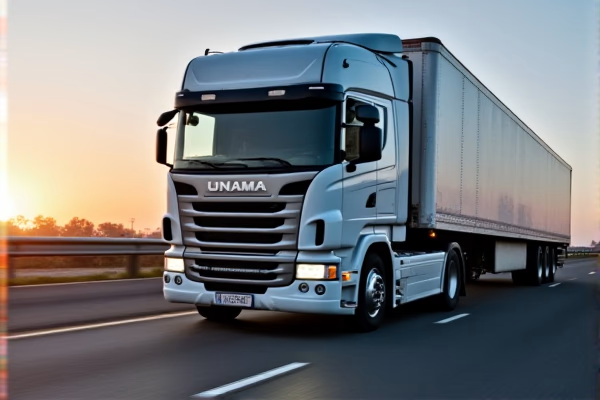
Establishing liability against a trucking company requires a multi-faceted approach to evidence gathering. First, we need to definitively prove the driver was acting within the scope of their employment at the time of the accident. This includes dispatch logs, bills of lading, and the driver’s route information. Second, we must demonstrate the driver’s intoxication, typically through police reports, blood alcohol content (BAC) tests, and witness testimony. Finally, and critically, we need to show the company was negligent in its hiring, training, or supervision of the driver.
Negligence can manifest in several ways. Did the company adequately vet the driver’s background? Were there prior incidents of reckless driving or substance abuse? Did they provide sufficient training on safe driving practices and the dangers of alcohol? Were they aware of any red flags but failed to take appropriate action? These are all questions we’ll investigate thoroughly, often utilizing the discovery process to obtain internal company records and depositions.
In San Diego, we often find evidence of systemic issues within trucking companies, such as pressure to meet unrealistic delivery deadlines, inadequate maintenance schedules, or a culture that prioritizes profits over safety. Documenting these patterns of negligence is key to building a compelling case and holding the company accountable.
Can I sue the trucking company even if the driver had a valid CDL?
The fact that a driver possesses a Commercial Driver’s License (CDL) doesn’t automatically shield the trucking company from liability. A CDL simply indicates the driver has met certain minimum qualifications to operate a commercial vehicle. It doesn’t guarantee they are a safe or responsible driver. In fact, a CDL can sometimes be a starting point for our investigation, as we’ll examine the driver’s CDL record for any violations, suspensions, or disqualifications.
The focus shifts to whether the trucking company exercised reasonable care in its hiring and supervision practices. Did they conduct a thorough background check? Did they verify the driver’s medical fitness? Did they monitor their driving performance? If the company knew, or should have known, about the driver’s propensity for reckless behavior or substance abuse, they could be held liable for negligent hiring or retention.
It’s important to remember that a company has a duty to ensure its drivers are fit to operate a commercial vehicle safely. Simply having a CDL doesn’t fulfill that duty. We’ve successfully litigated cases against trucking companies even when the driver appeared, on the surface, to be properly licensed and qualified.
What if the driver was an independent contractor, not an employee?
Determining whether a driver is an employee or an independent contractor is a complex legal question. Trucking companies often misclassify drivers as independent contractors to avoid liability for their actions. However, California law has strict rules governing this classification, and simply labeling someone an “independent contractor” doesn’t make it so. California’s ‘ABC test’ determines if a delivery driver (Amazon/FedEx) is an employee or contractor. Even if labeled a ‘contractor,’ a company may be liable if they exercise control over the driver’s work, a key factor in San Diego delivery truck litigation.
Under the ‘ABC test,’ a worker is presumed to be an employee unless the company can prove they meet certain criteria. These criteria include demonstrating the worker is free from the company’s control, performs work outside the usual course of the company’s business, and is independently engaged in a trade or business. If the company exercises significant control over the driver’s schedule, route, or methods of operation, they are likely considered an employee, and the company can be held liable for their negligence.
This is a highly fact-specific inquiry, and it often requires a thorough investigation into the nature of the relationship between the driver and the company. We’ll examine contracts, payment records, and other documentation to determine the driver’s true status and whether the company is attempting to shield itself from liability through improper classification.
What is the deadline for filing a lawsuit against a trucking company in California?
California law provides a **two-year** window from the date of the truck accident to file a lawsuit. Because trucking companies often begin evidence destruction (like purging ELD data) as soon as the law allows, immediate filing is critical to preserve the integrity of the claim. This statute of limitations applies to both claims against the driver and the trucking company.
However, it’s important to note that there may be additional deadlines to consider, particularly if the accident involved a government-owned vehicle or a dangerous road condition. If a truck accident involves a government-owned vehicle or a dangerous road condition maintained by a public entity, a formal administrative claim **MUST** be presented within **6 months** (180 days). Failure to meet this strict deadline under the Government Tort Claims Act can result in the permanent loss of your right to recover.
Don’t wait until the last minute to file a claim. The sooner you act, the better your chances of preserving evidence and building a strong case.
What if the driver was covered by multiple insurance policies?
Trucking companies typically carry multiple layers of insurance coverage, including primary liability insurance and excess umbrella policies. Identifying all applicable policies is crucial to maximizing your potential recovery. We’ll conduct a thorough investigation to uncover all available sources of coverage, including the company’s own policies, as well as any policies held by the driver or their leasing company.
Navigating the complexities of multiple insurance policies can be challenging. Each policy may have different limits, exclusions, and coverage terms. We’ll carefully analyze each policy to determine the extent of coverage and develop a strategy for pursuing claims against all responsible parties.
It’s important to understand that insurance companies are often reluctant to pay out large claims. They may attempt to shift blame, deny coverage, or undervalue your damages. That’s why it’s crucial to have an experienced attorney on your side who can fight for your rights and ensure you receive the full compensation you deserve.