How Do Port Truck Accidents Differ From Freeway Crashes?

Port truck accidents present unique challenges compared to typical freeway collisions. While both involve large commercial vehicles, the environment, the types of carriers involved, and the regulatory landscape surrounding port operations create complexities that demand specialized legal expertise. A seemingly straightforward accident can quickly become a labyrinth of interstate commerce laws, independent contractor agreements, and obscure port authority regulations.
One of the most significant differences lies in the sheer volume of traffic and the constant movement of goods. The ports are not designed for the same flow as freeways, leading to increased congestion, tight turns, and a higher risk of collisions. Additionally, many port trucks are operated by smaller, less established companies with potentially inadequate safety protocols and insurance coverage. This often means dealing with carriers who are difficult to locate, underinsured, or actively attempting to minimize their liability.
I’ve spent over 13 years representing clients injured in truck accidents throughout San Diego. Having been trained by a former insurance defense attorney, I have intimate knowledge of how insurance companies evaluate, devalue, and deny claims. This experience allows me to anticipate their tactics and build a stronger case for my clients, ensuring they receive the full compensation they deserve.
What types of companies are typically involved in port truck accidents?
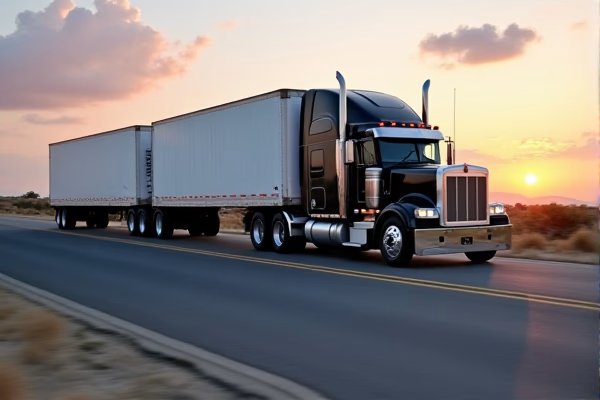
Unlike freeway accidents where you often deal with large, national trucking companies, port accidents frequently involve a network of smaller, independent operators. These include drayage companies – those who transport goods to and from the ports – and owner-operators who lease their trucks and work as contractors. Determining the responsible party can be difficult, as liability may fall on the drayage company, the leasing company, the cargo owner, or even the port authority itself. It’s crucial to investigate each entity thoroughly to identify all potential sources of recovery.
The legal structure of these companies also impacts the claim process. Many operate as limited liability companies (LLCs) or through complex subcontracting arrangements, making it harder to trace assets and secure adequate insurance coverage. We often encounter situations where a company has minimal insurance, despite operating a fleet of trucks.
How does the location of the accident—within the port versus on a public road—affect my claim?
The location of the accident dictates which set of laws and regulations apply. Accidents occurring within the port boundaries may be subject to port authority rules and regulations, while those on public roads fall under standard California traffic laws. This distinction is critical because it impacts the evidence gathering process and the potential claims available. For example, accidents involving government-owned vehicles or dangerous road conditions maintained by a public entity require a formal administrative claim **MUST** be presented within **6 months** (180 days). Failure to meet this strict deadline under the Government Tort Claims Act can result in the permanent loss of your right to recover.
Furthermore, the port environment often presents unique challenges to proving negligence. Surveillance footage may be limited, witness testimony can be unreliable due to the chaotic nature of the port, and reconstructing the accident can be more complex.
What role do independent contractor agreements play in port truck accident claims?
Many port truck drivers are classified as independent contractors, which can complicate the issue of liability. Companies often attempt to shield themselves from responsibility by arguing that the driver was solely responsible for their own actions. However, California’s ‘ABC test’ determines if a delivery driver (Amazon/FedEx) is an employee or contractor. Even if labeled a ‘contractor,’ a company may be liable if they exercise control over the driver’s work, a key factor in San Diego delivery truck litigation. We carefully examine these agreements to determine if the driver was truly an independent contractor or if the company exerted enough control to establish an employer-employee relationship.
The level of control exercised by the company is paramount. Factors such as required training, dispatch instructions, and the company’s ability to dictate routes and schedules all contribute to the determination of employee status.
Are there specific federal regulations that apply to port truck accidents?
Yes, federal regulations play a significant role in port truck accidents. Federal **Hours of Service (HOS)** regulations dictate exactly how long a driver can be behind the wheel. Violations of these federal safety standards, often proven through Electronic Logging Device (ELD) data, are used to demonstrate driver fatigue. Additionally, the Federal Motor Carrier Safety Administration (FMCSA) sets standards for driver qualifications, vehicle maintenance, and cargo securement. We routinely investigate FMCSA records to identify potential safety violations and negligent maintenance practices.
These regulations are designed to protect public safety, and violations can be strong evidence of negligence. We work with accident reconstruction experts to analyze ELD data and other evidence to uncover potential HOS violations and other regulatory breaches.
What should I do if a port truck accident involves a damaged container or improperly secured cargo?
Damaged containers or improperly secured cargo can be a significant factor in port truck accidents. The company responsible for loading and securing the cargo has a duty to ensure it is properly restrained to prevent it from shifting during transit. If the cargo shifts, it can cause the truck to lose control, leading to a collision. It’s crucial to document the condition of the cargo immediately after the accident, including photographs and any available shipping manifests.
We also investigate the chain of custody of the cargo to identify all parties involved in the loading and securing process. This may include the shipper, the warehouse, and the company responsible for securing the container.
What is the statute of limitations for filing a port truck accident claim in California?
California law provides a **two-year** window from the date of the truck accident to file a lawsuit. Because trucking companies often begin evidence destruction (like purging ELD data) as soon as the law allows, immediate filing is critical to preserve the integrity of the claim. Waiting too long can jeopardize your ability to recover compensation, even if the other party was clearly at fault.
It’s essential to consult with an attorney as soon as possible after a port truck accident to understand your rights and ensure you meet all applicable deadlines.
What if the truck driver was working for a workers’ compensation employer at the time of the accident?
If a commercial driver is injured on the job in San Diego, they are entitled to workers’ compensation. However, workers’ compensation is generally the **exclusive remedy** against the employer. Separate personal injury claims are typically limited to **negligent third parties** who are not the employer. This means you can still pursue a claim against the company responsible for the truck’s maintenance, the cargo owner, or any other party whose negligence contributed to the accident.
Determining whether a driver is an employee or independent contractor is crucial in these cases. If the driver is an employee, workers’ compensation may be the sole remedy available. However, if the driver is an independent contractor, you may have the right to pursue a separate personal injury claim.
How do insurance companies handle claims involving port truck accidents?
Insurance companies often employ aggressive tactics to minimize their payouts in port truck accident claims. They may attempt to blame the driver, argue that the cargo was properly secured, or claim that the accident was unavoidable. They may also delay the investigation process or offer a low settlement that doesn’t adequately compensate you for your injuries and losses.
We have extensive experience dealing with insurance companies in port truck accident cases. We understand their tactics and know how to build a strong case to protect your rights.
What evidence is important to gather after a port truck accident?
Gathering evidence is crucial to building a successful port truck accident claim. This includes:
Preserving this evidence is critical, as it can be used to establish negligence and prove your damages.
What if the truck company claims the accident was caused by a mechanical failure?
Truck companies may attempt to deflect blame by claiming the accident was caused by a mechanical failure. However, they have a duty to properly maintain their vehicles and ensure they are safe for operation. We investigate the truck’s maintenance records to determine if there was a history of mechanical problems.
We also work with accident reconstruction experts to analyze the truck’s components and identify any potential defects or failures.