How Do Trucking Regulations Affect Safety In San Diego?

Trucking is a heavily regulated industry, and for good reason. The sheer size and weight of commercial vehicles mean that accidents involving them are often catastrophic. These regulations aren’t merely suggestions; they are the law, and companies that fail to comply can be held legally responsible for the resulting injuries and damages. Understanding these regulations is crucial for anyone injured in a truck accident, as they often form the basis of a negligence claim.
One of the most important sets of regulations governing the trucking industry are the Federal Motor Carrier Safety Regulations (FMCSR). These regulations cover everything from driver qualifications and hours of service to vehicle maintenance and cargo securement. When a trucking company or driver violates these regulations, it creates a dangerous situation for everyone on the road. Proving a violation, however, can be complex, requiring a thorough investigation and often the assistance of experienced legal counsel.
As a personal injury attorney with over 13 years of experience practicing in San Diego, I’ve seen firsthand how trucking companies attempt to minimize their liability in accident cases. I was trained by a former insurance defense attorney, giving me intimate knowledge of how insurance companies evaluate, devalue, and deny claims. This insight allows me to anticipate their tactics and build a strong case on behalf of my clients.
What are the key federal regulations impacting truck safety?
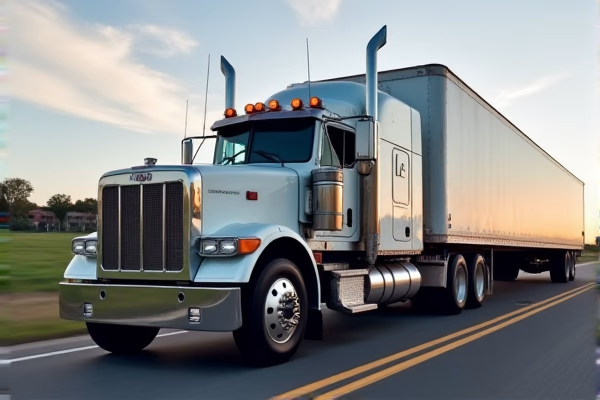
The FMCSRs are extensive, but some of the most frequently violated—and most impactful—regulations include those related to driver hours of service. These rules limit the amount of time a driver can spend behind the wheel without taking breaks, and are designed to prevent driver fatigue. Violations are often detected through Electronic Logging Devices (ELDs), which record a driver’s driving time. Other critical regulations concern vehicle maintenance, requiring regular inspections and repairs to ensure trucks are operating safely. 49 CFR § 395 details these requirements.
Beyond hours of service and maintenance, regulations also address driver qualifications, including licensing, medical examinations, and drug and alcohol testing. Companies are required to thoroughly vet their drivers and ensure they are fit to operate a commercial vehicle. Finally, cargo securement regulations are vital to prevent loads from shifting or falling off trucks, which can cause serious accidents.
How does California law supplement federal trucking regulations?
While the FMCSRs set a national standard, California adds its own layer of regulations to enhance safety. For example, California has stricter rules regarding commercial vehicle speed limits, prohibiting trucks from exceeding 55 miles per hour on most highways. CVC § 22406 outlines these speed restrictions. Additionally, California has specific requirements for commercial driver’s licenses (CDLs) and more stringent enforcement of vehicle inspections.
California also has laws addressing negligent hiring and training of truck drivers. Companies have a duty to exercise reasonable care in selecting and training their drivers, and can be held liable if they hire an unfit driver or fail to provide adequate training. This is especially relevant in cases where the driver has a history of violations or lacks the necessary experience.
What role do maintenance and safety inspections play in preventing accidents?
Regular maintenance and safety inspections are absolutely critical to preventing truck accidents. Commercial vehicles are complex machines with numerous components that can fail if not properly maintained. Brakes, tires, lights, steering, and suspension systems all require regular attention. CVC § 34500 establishes the framework for these inspections. Trucking companies are required to keep detailed records of all maintenance and repairs, and drivers are responsible for conducting pre-trip and post-trip inspections.
Unfortunately, many companies cut corners on maintenance to save money, which can have devastating consequences. If a truck accident is caused by a mechanical failure, the company may be held liable for negligent maintenance. Evidence of inadequate maintenance records, skipped inspections, or known mechanical problems can be crucial in proving this liability.
What happens if a trucking company violates these regulations?
Violating trucking regulations can have serious legal consequences for the company and the driver. Penalties can include fines, suspension of operating privileges, and even criminal charges. More importantly, a violation of a regulation can be used as evidence of negligence in a civil lawsuit. Civ. Code § 2338 establishes the principle of vicarious liability, holding the trucking company responsible for the actions of its drivers.
If a company is found negligent, the injured party may be entitled to compensation for medical expenses, lost wages, pain and suffering, and other damages. The amount of compensation will depend on the severity of the injuries and the extent of the company’s negligence. It is important to consult with an experienced attorney to understand your rights and options.
What should I do if I’ve been injured in a truck accident in San Diego?
If you’ve been injured in a truck accident, it’s crucial to take immediate action to protect your legal rights. First, seek medical attention as soon as possible, even if you don’t feel seriously injured. Some injuries may not be immediately apparent. Second, document everything related to the accident, including photos of the scene, vehicle damage, and your injuries. Third, and most importantly, contact an attorney experienced in handling truck accident cases in San Diego. These cases are complex and require a thorough understanding of trucking regulations and insurance law.
How does the statute of limitations affect my truck accident claim?
In California, you have a limited amount of time to file a lawsuit after a truck accident. CCP § 335.1 provides a **two-year** window from the date of the truck accident to file a lawsuit. Because trucking companies often begin evidence destruction (like purging ELD data) as soon as the law allows, immediate filing is critical to preserve the integrity of the claim.
Waiting too long to file a lawsuit can result in the permanent loss of your right to recover compensation. It’s important to consult with an attorney as soon as possible to ensure you meet the statute of limitations deadline.
What if the truck accident involved a government vehicle or roadway hazard?
If a truck accident involves a government-owned vehicle or a dangerous road condition maintained by a public entity, a formal administrative claim **MUST** be presented within **6 months** (180 days). Gov. Code § 911.2 outlines this requirement. Failure to meet this strict deadline under the Government Tort Claims Act can result in the permanent loss of your right to recover.
These claims are often complex and require specific documentation and procedures. It’s essential to consult with an attorney experienced in handling government liability claims to ensure your claim is properly filed and processed.
What is the “ABC test” and how does it relate to delivery driver accidents?
California’s ‘ABC test’ determines if a delivery driver (Amazon/FedEx) is an employee or contractor. Even if labeled a ‘contractor,’ a company may be liable if they exercise control over the driver’s work, a key factor in San Diego delivery truck litigation. Labor Code § 2775 defines this test.
Determining employment status is crucial because it affects the company’s liability for the driver’s actions. If the driver is deemed an employee, the company is generally liable for their negligence. If the driver is an independent contractor, the company’s liability may be limited.
What is “respondeat superior” and how does it apply to trucking companies?
Under the doctrine of **vicarious liability** (respondeat superior), a principal is responsible to third persons for the negligence of their agent in the transaction of business. This holds the trucking company legally liable for the wrongful acts of its drivers committed within the scope of their employment. Civ. Code § 2338 provides the legal basis for this principle.
This means that even if the driver was negligent, the trucking company can be held liable for their actions. The key is whether the driver was acting within the scope of their employment at the time of the accident.
What are the speed limits for commercial trucks in California?
In California, commercial trucks (including semi-tractors with three or more axles) are strictly prohibited from exceeding **55 miles per hour** on any highway. CVC § 22406 outlines this speed limit. In San Diego freeway crashes, proving a violation of this speed limit is a primary tool for establishing statutory negligence.
Exceeding the speed limit can be a strong indicator of negligence, as it demonstrates a disregard for safety. Evidence of speed, such as ELD data or witness testimony, can be crucial in proving this violation.