Is The Trucking Company Liable If They Forced Me To Drive Tired?

This scenario, unfortunately, is far too common. Trucking companies prioritize profits over safety, often pushing drivers to their limits and beyond. When a driver is injured as a result of this pressure, the company’s liability extends far beyond the negligence of the driver themselves. Understanding the legal framework surrounding driver fatigue and employer responsibility is crucial to securing the compensation you deserve.
The Federal Motor Carrier Safety Administration (FMCSA) has strict regulations in place regarding Hours of Service (HOS) – the maximum amount of time a driver can operate a commercial vehicle. These rules aren’t suggestions; they are legally binding. When a trucking company knowingly encourages or requires a driver to violate these regulations, they are creating a dangerous situation and assuming significant legal risk. This is where the doctrine of vicarious liability comes into play.
I’ve been practicing personal injury law in San Diego for over 13 years, and I’ve seen firsthand how insurance companies attempt to deflect blame in these cases. Trained by a former insurance defense attorney, I have intimate knowledge of how they evaluate, devalue, and deny claims. They’ll often focus on the driver’s actions, attempting to portray the accident as solely the driver’s fault, while downplaying the company’s role in creating a fatigued driving environment. However, California law provides avenues for holding the trucking company accountable.
What evidence do I need to prove the trucking company forced me to drive while fatigued?
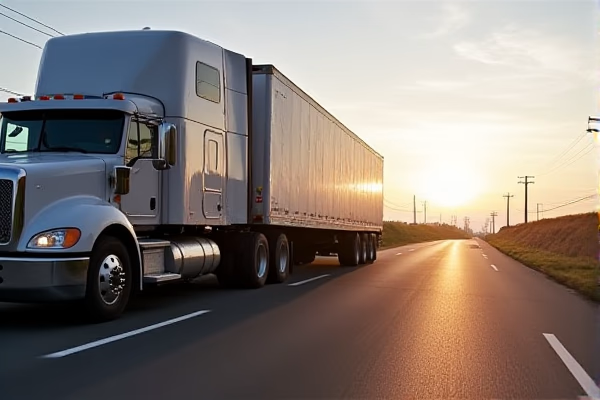
Gathering evidence is paramount. This includes your logbook, dispatch records, any communication (texts, emails, phone logs) with dispatchers or supervisors regarding your driving schedule, and any company policies related to HOS compliance. If you were pressured to falsify your logbook, document the specific instances and the individuals involved. Any witness statements from fellow drivers who observed similar practices are also invaluable. Crucially, the Electronic Logging Device (ELD) data is often the most compelling evidence, as it provides a precise record of your driving activity.
Federal Hours of Service (HOS) regulations dictate exactly how long a driver can be behind the wheel. Violations of these federal safety standards, often proven through Electronic Logging Device (ELD) data, are used to demonstrate driver fatigue.
Can I still recover damages if I share some responsibility for the accident?
Yes, California operates under a ‘pure’ comparative fault system. This means you can recover damages even if you were partially at fault for the accident. However, your total compensation will be reduced by your percentage of fault. For example, if you are found to be 30% responsible for the accident, you can still recover 70% of your damages. The insurance company will undoubtedly attempt to assign you a higher percentage of fault, so it’s critical to have an experienced attorney who can effectively challenge their arguments and present evidence supporting your version of events.
California’s ‘pure’ comparative fault system applies to trucking claims. Even if a truck driver argues you shared responsibility, you can still recover damages; however, your total compensation will be reduced by your percentage of fault.
What if the trucking company claims I was an independent contractor, not an employee?
This is a common tactic used by trucking companies to avoid liability. They may attempt to classify you as an independent contractor to shield themselves from responsibility for your actions. However, California law has a strict test for determining whether a worker is an employee or an independent contractor. The ‘ABC test’ considers factors such as the level of control the company exercises over your work, the tools and equipment you use, and whether you are engaged in an independently established trade or business. Even if you were labeled as a ‘contractor,’ a company may be liable if they exercise control over the driver’s work, a key factor in San Diego delivery truck litigation.
California’s ‘ABC test’ determines if a delivery driver (Amazon/FedEx) is an employee or contractor. Even if labeled a ‘contractor,’ a company may be liable if they exercise control over the driver’s work, a key factor in San Diego delivery truck litigation.
What is the deadline for filing a lawsuit against the trucking company?
In California, you generally have **two years** from the date of the truck accident to file a lawsuit. Because trucking companies often begin evidence destruction (like purging ELD data) as soon as the law allows, immediate filing is critical to preserve the integrity of the claim. Don’t delay seeking legal counsel, as waiting too long can jeopardize your ability to recover compensation.
…California law provides a two-year window from the date of the truck accident to file a lawsuit. Because trucking companies often begin evidence destruction (like purging ELD data) as soon as the law allows, immediate filing is critical to preserve the integrity of the claim.
What should I do if the insurance company asks me to give a recorded statement?
Politely decline to provide a recorded statement without first consulting with an attorney. Insurance companies are skilled at using recorded statements to minimize your claim. They will often ask leading questions designed to elicit information that can be used against you. An attorney can advise you on whether or not to provide a statement and, if so, how to do so in a way that protects your rights.
What happens if I have medical liens that need to be paid from my settlement?
Medical liens arise when a healthcare provider provides treatment for injuries sustained in an accident and seeks reimbursement from your settlement proceeds. It’s common for hospitals, doctors, and other providers to file liens against your recovery. An experienced attorney can negotiate with the lienholders to reduce the amount owed and ensure that your settlement is distributed fairly. We will work to prioritize your needs and maximize your net recovery.
If the accident happened on a public road, are there additional claim deadlines I need to be aware of?
If a truck accident involves a government-owned vehicle or a dangerous road condition maintained by a public entity, a formal administrative claim MUST be presented within 6 months (180 days). Failure to meet this strict deadline under the Government Tort Claims Act can result in the permanent loss of your right to recover. This is a separate claim from your lawsuit against the trucking company and requires specific procedures and documentation.
…if a truck accident involves a government-owned vehicle or a dangerous road condition maintained by a public entity, a formal administrative claim MUST be presented within 6 months (180 days). Failure to meet this strict deadline under the Government Tort Claims Act can result in the permanent loss of your right to recover.
What if the insurance company makes a policy limits tender early in the claim process?
A policy limits tender is an offer from the insurance company to settle your claim for the maximum amount of their policy coverage. While it may seem like a generous offer, it’s often a tactic to avoid further litigation. Before accepting any policy limits tender, it’s crucial to have an attorney evaluate the full extent of your damages and determine if additional coverage is available from other sources, such as an umbrella policy or the trucking company’s commercial insurance.
How can dashcam footage or other digital evidence help my case?
Dashcam footage, ECM/EDR data, ELD data, and GPS information can be incredibly valuable evidence in a trucking accident case. This evidence can provide a clear picture of the events leading up to the accident, including the driver’s speed, braking patterns, and hours of service compliance. It’s essential to preserve this evidence as soon as possible, as it can be easily overwritten or destroyed. We will work with experts to analyze this data and present it effectively to the insurance company.