
Should I Speak With Fedexs Insurance Company?

The problem isn’t necessarily malice, but a fundamental conflict of interest. FedEx’s insurance company, like any insurer, is focused on minimizing payouts. They are skilled negotiators, trained to identify vulnerabilities in a claim and reduce their financial exposure. They’ll likely portray Eldon’s injuries as less severe than they are, downplay the long-term impact of the accident, and attempt to settle for a fraction of what his case is truly worth. This is why speaking directly with FedEx’s insurance company without legal counsel is a significant risk.
One of the first tactics they’ll employ is a recorded statement. While seemingly innocuous, these statements are designed to gather information that can be used against you later. They’ll ask leading questions, probe for inconsistencies, and attempt to obtain admissions that limit your recovery. Even a seemingly harmless comment can be twisted and used to devalue your claim. It’s crucial to remember that anything you say *will* be used against you, and they are not on your side.
I’ve been practicing personal injury law in San Diego for over 13 years, and I’ve seen this scenario play out countless times. I was fortunate enough to be trained by a former insurance defense attorney, giving me intimate knowledge of how these companies evaluate, devalue, and deny claims. I understand their strategies, their tactics, and their internal procedures. This allows me to effectively counter their arguments and fight for the maximum compensation my clients deserve.
What should I do if FedEx’s insurance adjuster contacts me?
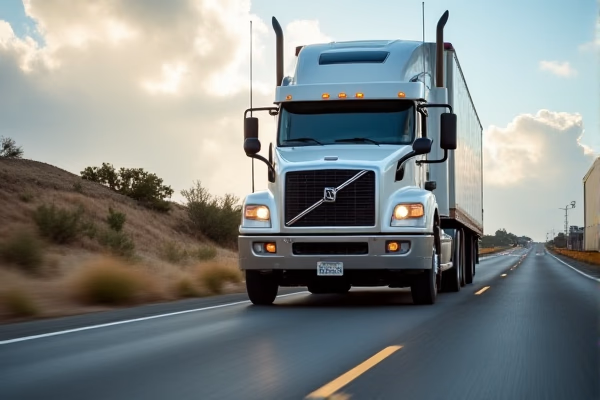
The best course of action is to politely decline to provide any statement whatsoever. You are under no legal obligation to speak with them. Instead, provide them with your attorney’s contact information and direct all future communication through legal counsel. This immediately levels the playing field and prevents them from taking advantage of your vulnerability. A simple, firm response like, “I have retained legal counsel, please contact my attorney, Richard Morse, at [Phone Number]” is sufficient.
Do not sign any documents or authorizations without first consulting with an attorney. These documents often contain waivers that release your legal rights and prevent you from pursuing further compensation. Even if the document appears straightforward, it’s essential to have an experienced attorney review it to ensure you understand the implications. Remember, once you sign something, it’s very difficult to undo.
What if I’ve already given a recorded statement to FedEx’s insurance company?
Don’t panic. While a recorded statement can be damaging, it’s not necessarily fatal to your claim. An experienced attorney can review the statement, identify any inconsistencies or misrepresentations, and develop a strategy to mitigate the damage. We can often use the statement to our advantage, highlighting the adjuster’s leading questions or the lack of clarity in your responses. It’s crucial to have a professional assessment of the situation to determine the best course of action.
How does a lawyer help with a claim against FedEx?
We handle all aspects of your claim, from initial investigation to negotiation and litigation. This includes gathering evidence, obtaining police reports, securing medical records, and consulting with accident reconstruction experts. We’ll build a strong case to demonstrate the full extent of your damages, including medical expenses, lost wages, pain and suffering, and future care costs. We’ll then aggressively negotiate with FedEx’s insurance company to secure a fair settlement. If a fair settlement cannot be reached, we are fully prepared to take your case to trial.
What types of damages can I recover in a FedEx truck accident claim?
You may be entitled to recover a wide range of damages, including: Medical Expenses: Past and future medical bills, including hospital stays, surgery, physical therapy, and medication. Lost Wages: Compensation for lost income due to your injuries. Pain and Suffering: Damages for the physical and emotional distress caused by the accident. Property Damage: The cost of repairing or replacing your vehicle. Loss of Consortium: Compensation for the loss of companionship and support from your spouse. Future Care Costs: Expenses for ongoing medical treatment and rehabilitation.
What if I was partially at fault for the accident?
California’s ‘pure’ comparative fault system allows you to recover damages even if you shared some responsibility for the accident. However, your total compensation will be reduced by your percentage of fault. For example, if you were 20% at fault, you can still recover 80% of your damages. It’s crucial to have an attorney assess the facts of your case to determine your percentage of fault and ensure you receive the maximum compensation possible. Under Civ. Code § 1714, even a small percentage of fault can significantly impact your recovery.
What is the statute of limitations for filing a lawsuit after a truck accident in California?
California law provides a two-year window from the date of the truck accident to file a lawsuit. Because trucking companies often begin evidence destruction (like purging ELD data) as soon as the law allows, immediate filing is critical to preserve the integrity of the claim. Waiting too long can result in the permanent loss of your right to recover. CCP § 335.1 outlines these strict deadlines.
What should I do if the accident involved a government-owned FedEx vehicle or a dangerous road condition?
If a truck accident involves a government-owned vehicle or a dangerous road condition maintained by a public entity, a formal administrative claim MUST be presented within 6 months (180 days). Failure to meet this strict deadline under the Government Tort Claims Act can result in the permanent loss of your right to recover. Gov. Code § 911.2 details these requirements.
What if I was classified as an independent contractor but believe I should have been an employee?
California’s ‘ABC test’ determines if a delivery driver (Amazon/FedEx) is an employee or contractor. Even if labeled a ‘contractor,’ a company may be liable if they exercise control over the driver’s work, a key factor in San Diego delivery truck litigation. Labor Code § 2775 provides the framework for this determination.
Can I sue FedEx directly if the driver was negligent?
Under the doctrine of vicarious liability (respondeat superior), a principal is responsible to third persons for the negligence of their agent in the transaction of business. This holds the trucking company legally liable for the wrongful acts of its drivers committed within the scope of their employment. Civ. Code § 2338 establishes this legal principle.
What if the truck driver was speeding?
In California, commercial trucks (including semi-tractors with three or more axles) are strictly prohibited from exceeding 55 miles per hour on any highway. In San Diego freeway crashes, proving a violation of this speed limit is a primary tool for establishing statutory negligence. CVC § 22406 defines these speed restrictions.