What Causes Semi Truck Jackknife Crashes?

Jackknife crashes involving large commercial trucks are among the most dangerous on our roadways. Unlike passenger vehicle accidents, these incidents often involve complex factors related to vehicle maintenance, driver error, and federal regulations. Understanding these causes is critical to protecting your rights if you’ve been injured in a collision with a tractor-trailer.
A jackknife occurs when the trailer of a semi-truck swings out of control, forming a “V” shape with the tractor. This can happen during braking, turning, or acceleration, and the resulting loss of control can lead to devastating consequences. The sheer weight and momentum of a commercial truck exacerbate the severity of these crashes, often causing significant property damage, serious injuries, and even fatalities.
As a personal injury attorney with over 13 years of experience representing clients in San Diego, I’ve seen firsthand the devastating impact of these accidents. I was trained by a former insurance defense attorney, giving me intimate knowledge of how insurance companies evaluate, devalue, and deny claims. This insight allows me to build strong cases and fight for the maximum compensation my clients deserve.
What are the most common reasons a semi-truck jackknifes?
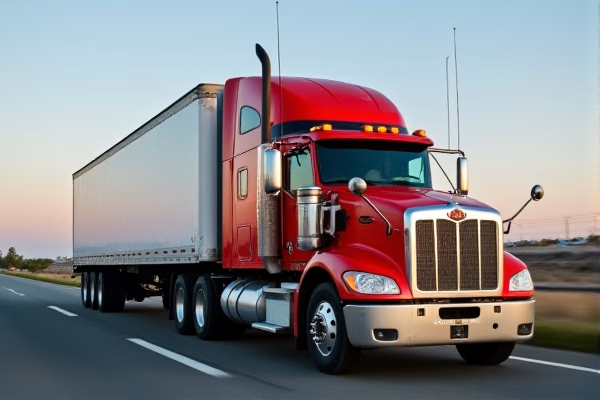
Several factors can contribute to a semi-truck jackknife. Improper braking is a leading cause. Due to the length and weight of the vehicle, truckers must anticipate stops well in advance and apply brakes gradually. Abrupt or excessive braking can lock the wheels, causing the trailer to swing out of control. This is especially true on wet or slippery surfaces.
Another frequent cause is uneven weight distribution. If the cargo isn’t properly secured or loaded, the truck can become unstable, increasing the risk of a jackknife during turns or sudden maneuvers. Federal regulations mandate specific weight limits and securement procedures, and violations of these rules can be a strong indicator of negligence.
Finally, inadequate driver training and experience play a significant role. Truckers must be proficient in handling the unique dynamics of large commercial vehicles, including proper braking techniques, weight distribution principles, and emergency procedures. A lack of training or a driver’s failure to follow established safety protocols can easily lead to a jackknife.
Can weather conditions contribute to a semi-truck jackknife?
Absolutely. Adverse weather conditions, such as rain, snow, ice, and strong winds, significantly increase the risk of a jackknife. Wet roads reduce tire traction, making it more difficult to control the vehicle. Strong winds can destabilize the truck, particularly when carrying a high-profile load.
Truckers have a legal duty to exercise caution when operating in inclement weather. This includes reducing speed, increasing following distance, and being prepared for sudden changes in road conditions. Failure to do so can be considered negligence, especially if the weather was a known factor at the time of the crash.
Furthermore, companies are required to provide drivers with adequate weather information and training on how to safely navigate challenging conditions. If a trucking company failed to provide this support, they may be held liable for the resulting accident.
What role does vehicle maintenance play in preventing jackknife crashes?
Proper vehicle maintenance is paramount in preventing jackknife crashes. Faulty brakes are a major contributor to these incidents. Worn brake pads, leaking brake lines, or malfunctioning anti-lock braking systems (ABS) can significantly reduce braking effectiveness, increasing the risk of a jackknife. Regular inspections and timely repairs are essential.
Tire condition is also critical. Underinflated or worn tires reduce traction and stability, making the truck more susceptible to losing control. Trucking companies are required to conduct regular tire inspections and replace tires as needed.
Beyond brakes and tires, other mechanical issues, such as steering problems, suspension failures, and faulty lighting systems, can also contribute to jackknife crashes. A comprehensive maintenance program is crucial to identifying and addressing these issues before they lead to an accident.
How can I prove a trucking company was negligent in a jackknife crash?
Proving negligence in a jackknife crash often requires a thorough investigation. This includes obtaining the police report, witness statements, and the truck’s maintenance records. The truck’s Electronic Logging Device (ELD) data can provide valuable information about the driver’s hours of service, speed, and braking patterns.
Federal regulations dictate exactly how long a driver can be behind the wheel. Violations of these federal safety standards, often proven through Electronic Logging Device (ELD) data, are used to demonstrate driver fatigue. We also look for evidence of inadequate driver training, improper cargo securement, and violations of weight limits.
In some cases, it may be necessary to hire an accident reconstruction expert to analyze the crash scene and determine the cause of the jackknife. This expert can provide valuable testimony to support your claim.
What if the truck driver claims I was partially at fault for the crash?
California’s ‘pure’ comparative fault system applies to trucking claims. Even if a truck driver argues you shared responsibility, you can still recover damages; however, your total compensation will be reduced by your percentage of fault. It’s crucial to gather evidence to refute any claims of negligence on your part.
This may include witness statements, dashcam footage, and expert testimony. Insurance companies often attempt to minimize their liability by shifting blame to the victim. A skilled attorney can effectively counter these tactics and protect your rights.
We will thoroughly investigate the accident to determine the true cause and ensure you receive fair compensation for your injuries and losses.
What is the deadline for filing a lawsuit after a semi-truck accident in California?
California law provides a **two-year** window from the date of the truck accident to file a lawsuit. Because trucking companies often begin evidence destruction (like purging ELD data) as soon as the law allows, immediate filing is critical to preserve the integrity of the claim.
It’s important to note that this deadline applies regardless of whether you’ve reached a settlement with the insurance company. If you wait too long to file a lawsuit, you may lose your right to recover compensation. Contacting an attorney as soon as possible after the accident is crucial to ensure you meet this deadline.
Furthermore, if the accident involved a government-owned vehicle or a dangerous road condition maintained by a public entity, a formal administrative claim **MUST** be presented within **6 months** (180 days). Failure to meet this strict deadline under the Government Tort Claims Act can result in the permanent loss of your right to recover.
What should I do if a truck driver asks me to give a recorded statement?
You should **never** give a recorded statement to an insurance company without first consulting with an attorney. Insurance adjusters are trained to ask leading questions designed to minimize their liability. They may attempt to trick you into making statements that could harm your claim.
A recorded statement can be used against you later in the legal process. It’s best to politely decline the request and refer the insurance company to your attorney. Your attorney can handle all communication with the insurance company on your behalf.
Remember, you are not obligated to provide any information to the insurance company. Protecting your rights is paramount.
What happens if I have medical bills from multiple providers after a truck accident?
It’s common to accumulate medical bills from various providers after a truck accident, including emergency room visits, doctor appointments, physical therapy, and specialists. These bills can be a significant financial burden, and it’s important to understand your options for reimbursement.
You may be able to seek reimbursement for your medical expenses from the at-fault truck driver’s insurance company. We can help you gather all your medical records and bills and submit them to the insurance company for payment.
In some cases, you may also have a claim against your own health insurance provider or a medical lien from a hospital or doctor. We can help you navigate these complex issues and ensure you receive the maximum compensation for your medical expenses.
What if the trucking company offers me a policy limits settlement?
A policy limits settlement is the maximum amount of coverage available under the trucking company’s insurance policy. While it may seem tempting to accept this offer, it’s crucial to carefully consider your options before doing so.
A policy limits settlement may not be sufficient to cover all your damages, including medical expenses, lost wages, pain and suffering, and future care costs. We can evaluate your claim and determine whether the policy limits are adequate.
If the policy limits are insufficient, we may be able to pursue additional coverage from other sources, such as an umbrella policy or the trucking company’s assets. We will fight to ensure you receive the full compensation you deserve.
How does comparative fault affect my truck accident claim in San Diego?
California operates under a ‘pure’ comparative fault system, meaning you can recover damages even if you were partially at fault for the truck accident. However, your compensation will be reduced by your percentage of fault. For example, if you sustained $100,000 in damages but were found to be 20% at fault, you would only be able to recover $80,000.
Insurance companies often attempt to argue that you were partially at fault to minimize their liability. We will thoroughly investigate the accident to determine the true cause and refute any claims of negligence on your part.
It’s important to have a skilled attorney on your side who can effectively present your case and protect your rights.