What Happens If A Trucking Company Violates Federal Safety Rules?

When a trucking company violates federal safety rules, the consequences can be devastating for those injured in accidents. It’s not simply a matter of a fine or a warning. These regulations are in place to protect everyone on the road, and a breach often indicates a systemic problem within the company, prioritizing profit over safety. As a personal injury attorney practicing in San Diego for over 13 years, I’ve seen firsthand how these violations translate into severe injuries and substantial financial losses for my clients. I was trained by a former insurance defense attorney, giving me intimate knowledge of how insurance companies evaluate, devalue, and deny claims.
The Federal Motor Carrier Safety Administration (FMCSA) sets stringent standards for trucking companies, covering everything from driver hours to vehicle maintenance. When a company disregards these rules, it creates a dangerous situation. Proving a violation is often the key to unlocking a full and fair recovery for accident victims. This is because it establishes negligence, and often, a higher degree of negligence than simply a driver error. It’s not enough to show a driver was speeding; we need to demonstrate the company *allowed* or *encouraged* the behavior through inadequate training, insufficient oversight, or a deliberate disregard for safety protocols.
What types of federal safety rules are trucking companies expected to follow?
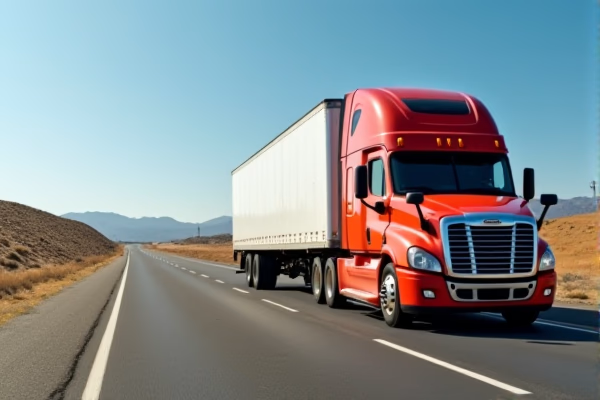
Trucking companies are subject to a complex web of regulations, but some of the most frequently violated – and most impactful in accident cases – relate to driver hours of service, vehicle maintenance, and driver qualifications. Hours of Service (HOS) regulations, outlined in 49 CFR § 395, limit the amount of time a driver can operate a commercial vehicle without rest. These rules are designed to prevent driver fatigue, a leading cause of truck accidents. Vehicle maintenance regulations require regular inspections and repairs to ensure trucks are safe to operate. Driver qualifications include proper licensing, medical certifications, and background checks.
Evidence of violations can come from various sources, including the driver’s logbook (now often Electronic Logging Devices or ELDs), maintenance records, and the company’s safety reports. We often subpoena these records directly from the trucking company and the FMCSA. A pattern of violations can be particularly damning, suggesting a systemic failure to prioritize safety.
How can a violation of federal safety rules help my truck accident claim?
Establishing a federal safety violation strengthens your claim in several ways. First, it demonstrates negligence on the part of the trucking company. Negligence is the legal basis for most truck accident lawsuits, and proving a violation makes it easier to meet that burden. Second, it can lead to punitive damages. Punitive damages are awarded to punish the company for particularly reckless or egregious behavior, and they can significantly increase the value of your claim. Third, it can establish statutory negligence. In San Diego freeway crashes, proving a violation of CVC § 22406 (speed limits) is a primary tool for establishing statutory negligence.
Furthermore, federal regulations often create a presumption of negligence. For example, if a driver violated HOS rules and caused an accident, the court may presume the company was negligent in its hiring, training, or supervision of the driver. This shifts the burden to the company to prove they were *not* negligent, which can be a difficult task.
What if the trucking company claims the violation didn’t cause the accident?
The trucking company will almost certainly argue that the safety violation wasn’t the direct cause of the accident. They might claim the accident would have happened regardless, or that another driver’s actions were the primary cause. This is where a thorough investigation is crucial. We work with accident reconstruction experts to analyze the evidence and demonstrate the causal link between the violation and your injuries. Accident reconstruction involves examining the scene, vehicle damage, and witness statements to determine the sequence of events leading up to the crash.
For example, if a driver violated HOS rules and was fatigued at the time of the accident, we can use expert testimony to explain how fatigue impairs reaction time and judgment, making an accident more likely. We also look for evidence of the company’s knowledge of the driver’s fatigue, such as previous complaints or warnings.
What evidence is needed to prove a federal safety violation?
Gathering evidence is paramount. Key pieces of evidence include the driver’s logbook or ELD data, the truck’s maintenance records, the company’s safety policies and procedures, and any internal communications related to safety. We also obtain the driver’s qualification file, which includes their licensing and medical certifications. Witness statements and police reports can also be valuable sources of information. Evidence preservation and documentation timelines are critical; trucking companies often begin evidence destruction (like purging ELD data) as soon as the law allows, immediate filing is critical to preserve the integrity of the claim.
It’s important to act quickly to preserve this evidence, as it can be lost or destroyed over time. We often send a spoliation letter to the trucking company, demanding they preserve all relevant evidence. This letter puts them on notice that we are investigating the accident and that they have a legal obligation to maintain the evidence.
Can I still pursue a claim if the driver was an independent contractor?
Determining whether a driver is an employee or an independent contractor can be complex. Trucking companies often misclassify drivers as independent contractors to avoid liability. However, California’s ‘ABC test’ determines if a delivery driver (Amazon/FedEx) is an employee or contractor. Even if labeled a ‘contractor,’ a company may be liable if they exercise control over the driver’s work, a key factor in San Diego delivery truck litigation. If the company exercises significant control over the driver’s work, such as dictating their routes, schedules, or equipment, they may be considered an employee for legal purposes. This means the company can be held liable for the driver’s negligence, even if they claim the driver is an independent contractor.
What should I do if I suspect a trucking company violated federal safety rules?
If you’ve been injured in a truck accident and suspect a federal safety violation, it’s crucial to contact an experienced attorney as soon as possible. We can investigate the accident, gather evidence, and determine whether the company violated any regulations. We can also handle all communications with the insurance company and negotiate a fair settlement on your behalf. Don’t try to navigate this complex legal process on your own – a skilled attorney can protect your rights and maximize your recovery.
What is the deadline for filing a lawsuit after a truck accident in California?
California law provides a two-year window from the date of the truck accident to file a lawsuit. Because trucking companies often begin evidence destruction (like purging ELD data) as soon as the law allows, immediate filing is critical to preserve the integrity of the claim. This is known as the Statute of Limitations, and it’s strictly enforced by the courts. Missing this deadline can result in the permanent loss of your right to recover damages.
What if the accident involved a government vehicle or a dangerous road condition?
If a truck accident involves a government-owned vehicle or a dangerous road condition maintained by a public entity, a formal administrative claim MUST be presented within 6 months (180 days). Failure to meet this strict deadline under the Government Tort Claims Act can result in the permanent loss of your right to recover. This claim must be detailed and include all relevant information about the accident, including the identity of the government entity, the location of the accident, and the nature of your injuries.
What if I am receiving workers’ compensation benefits for my injuries?
If a commercial driver is injured on the job in San Diego, they are entitled to workers’ compensation. However, workers’ compensation is generally the exclusive remedy against the employer. Separate personal injury claims are typically limited to negligent third parties who are not the employer. This means you can still pursue a claim against the trucking company or another responsible party, even if you’re receiving workers’ compensation benefits.
What if the insurance company asks me to give a recorded statement?
The insurance company will likely ask you to give a recorded statement soon after the accident. It’s generally best to decline this request. Recorded statements to insurers are often used to minimize the company’s liability and can contain traps for the unwary. The insurance adjuster may ask leading questions or try to elicit information that could harm your claim. Let an attorney handle all communications with the insurance company.
What if I have medical bills from multiple providers?
If you have medical bills from multiple providers, it’s important to gather all of your records and bills. The insurance company may try to dispute the reasonableness of your medical expenses. We can help you navigate this process and ensure you receive full compensation for your medical care. ER billing vs. medical liens can be a complex issue, and it’s important to understand your rights and options.