
What Happens If A Company Skips Required Inspections?

When accidents like Javier’s occur, one of the first things we investigate is whether the trucking company adhered to all applicable safety regulations. Often, the answer is a resounding no. Commercial trucking is a heavily regulated industry for a reason – safety is paramount. Companies are legally obligated to perform regular inspections of their vehicles to identify and address potential mechanical issues before they lead to catastrophic events. When they cut corners, they put everyone on the road at risk, and they become liable for the resulting damages.
Skipping required inspections isn’t just a paperwork violation; it’s a conscious decision to prioritize profit over safety. These inspections are designed to catch critical defects – faulty brakes, worn tires, cracked frames, and malfunctioning lights – all of which can contribute to a truck crash. A neglected maintenance schedule can quickly turn a minor issue into a major hazard, and the consequences can be life-altering, as Javier’s case tragically demonstrates.
As a personal injury attorney with over 13 years of experience representing victims of truck accidents in San Diego, I’ve seen firsthand how often inadequate maintenance is a contributing factor. I was trained by a former insurance defense attorney, giving me intimate knowledge of how insurance companies evaluate, devalue, and deny claims. This insight allows me to build strong cases that hold negligent trucking companies accountable for their actions and secure the compensation my clients deserve.
What Types of Inspections are Trucking Companies Required to Perform?
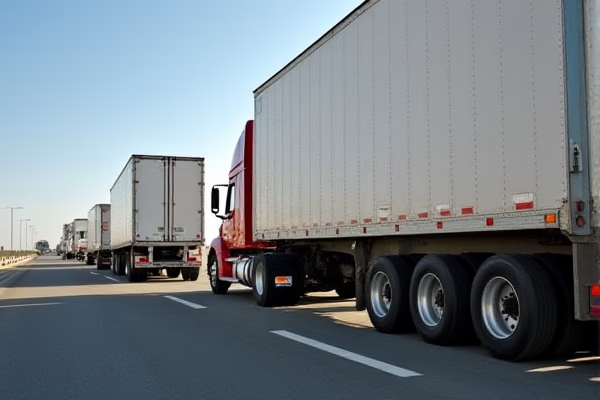
There are several levels of inspections that trucking companies must adhere to. The Department of Transportation (DOT) mandates both annual and periodic inspections. Annual inspections are comprehensive, covering all critical vehicle components. Periodic inspections, often called “walk-around” inspections, are required before, during, and after each trip. Drivers are responsible for conducting these walk-arounds, documenting any defects, and reporting them to the company for repair. These inspections are not merely a formality; they are a vital safety check.
Beyond these DOT-required inspections, companies also have a duty to perform preventative maintenance based on mileage or time intervals. This includes oil changes, tire rotations, brake inspections, and other routine services. The specific maintenance schedule will vary depending on the type of vehicle and its usage, but it must be documented and followed diligently.
What Happens When a Truck Fails an Inspection?
If a truck fails an inspection, it’s taken out of service until the defects are repaired. The driver is prohibited from operating the vehicle until it passes a re-inspection. However, companies sometimes attempt to circumvent these regulations by falsifying inspection reports or operating vehicles with known defects. This is a serious offense and can lead to significant penalties, including fines, suspension of operating licenses, and even criminal charges. More importantly, it creates an unacceptable risk of a truck accident.
Can I Recover Damages if a Company Skipped Inspections?
Absolutely. If we can prove that a trucking company knowingly skipped required inspections or failed to adequately maintain its vehicles, it can form the basis of a strong negligence claim. This is known as “negligent maintenance.” We will gather evidence such as maintenance records, inspection reports, driver logs, and expert testimony to establish the company’s liability. Under the doctrine of **vicarious liability** (respondeat superior), a principal is responsible to third persons for the negligence of their agent in the transaction of business. This holds the trucking company legally liable for the wrongful acts of its drivers committed within the scope of their employment. Civ. Code § 2338
What Evidence is Needed to Prove Negligent Maintenance?
Proving negligent maintenance requires a thorough investigation. We will look for discrepancies in maintenance records, missing inspection reports, and evidence that the company failed to address known defects. Driver logs can also be crucial, as they can reveal whether the company pressured drivers to operate vehicles that were not properly maintained. Expert testimony from a qualified mechanic can help establish that the defects were likely present before the accident and that the company should have been aware of them. Dashcam footage, if available, can also provide valuable evidence.
What if the Trucking Company Claims the Driver Was Responsible?
Trucking companies often attempt to shift blame to the driver, arguing that they were negligent or failed to properly inspect the vehicle. However, the company has a non-delegable duty to ensure that its vehicles are safe, regardless of the driver’s actions. We will investigate the driver’s background, training, and experience to determine whether they were properly qualified and supervised. If the driver was negligent, it doesn’t necessarily absolve the company of responsibility. In many cases, the company is liable for negligent hiring, training, or supervision. This is critical in cases where the driver has a history of FMCSA violations or lacked the proper CDL endorsements. CACI No. 426
How Long Do I Have to File a Lawsuit After a Truck Accident?
In California, the statute of limitations for personal injury claims is generally **two years** from the date of the truck accident. Because trucking companies often begin evidence destruction (like purging ELD data) as soon as the law allows, immediate filing is critical to preserve the integrity of the claim. CCP § 335.1
What Should I Do if I Suspect a Trucking Company Skipped Inspections?
If you believe a trucking company skipped required inspections or failed to adequately maintain its vehicles, it’s essential to contact an experienced truck accident attorney as soon as possible. We can conduct a thorough investigation, gather evidence, and build a strong case to hold the negligent company accountable for your damages. Don’t try to navigate this complex legal process on your own. The insurance company will be looking for ways to minimize your compensation, and you need an advocate on your side who understands the intricacies of trucking regulations.
What is the Role of Electronic Logging Devices (ELDs) in Proving Negligent Maintenance?
Electronic Logging Devices (ELDs) record a driver’s hours of service, vehicle location, and other critical data. This data can be invaluable in proving negligent maintenance. For example, if an ELD shows that a driver was operating a vehicle for excessive hours without proper rest, it can suggest that the company pressured them to violate federal safety regulations. Violations of these federal safety standards, often proven through Electronic Logging Device (ELD) data, are used to demonstrate driver fatigue. 49 CFR § 395
What if the Accident Involved a Government Vehicle or Road Condition?
If a truck accident involves a government-owned vehicle or a dangerous road condition maintained by a public entity, a formal administrative claim **MUST** be presented within **6 months** (180 days). Failure to meet this strict deadline under the Government Tort Claims Act can result in the permanent loss of your right to recover. Gov. Code § 911.2
What if the Driver Was Classified as an Independent Contractor?
California’s ‘ABC test’ determines if a delivery driver (Amazon/FedEx) is an employee or contractor. Even if labeled a ‘contractor,’ a company may be liable if they exercise control over the driver’s work, a key factor in San Diego delivery truck litigation. Labor Code § 2775
What if I Have Workers’ Compensation Benefits? Can I Still Sue?
If a commercial driver is injured on the job in San Diego, they are entitled to workers’ compensation. However, workers’ compensation is generally the **exclusive remedy** against the employer. Separate personal injury claims are typically limited to **negligent third parties** who are not the employer. Labor Code § 3600