What Happens If Multiple Companies Share Responsibility?

This scenario – multiple parties potentially at fault – is surprisingly common in trucking accidents. Unlike a typical car crash involving two drivers, commercial trucking often involves a complex web of companies and individuals. Understanding how liability works in these situations is crucial to maximizing your recovery. It’s not enough to simply identify the driver who was behind the wheel; you need to investigate the entire chain of responsibility.
The legal concept at play here is called “vicarious liability,” and it allows us to hold parties responsible for the negligence of others. For example, a trucking company can be liable for the actions of its drivers, even if the company itself didn’t directly cause the accident. Similarly, a leasing company might be responsible if it failed to properly maintain the vehicle, and a logistics provider could be liable if they improperly loaded the trailer, causing it to become unstable. The key is to prove a connection between each party’s actions (or inactions) and your injuries.
I’ve been practicing personal injury law in San Diego for over 13 years, and I’ve seen firsthand how insurance companies exploit these complexities to minimize payouts. Trained by a former insurance defense attorney, I have intimate knowledge of how they evaluate, devalue, and deny claims. They’ll often try to shift blame, argue that a party wasn’t directly involved, or claim that the driver was an independent contractor, not an employee. That’s why it’s essential to have an attorney who understands these tactics and can build a strong case against all potentially liable parties.
What types of companies are often involved in trucking accidents?
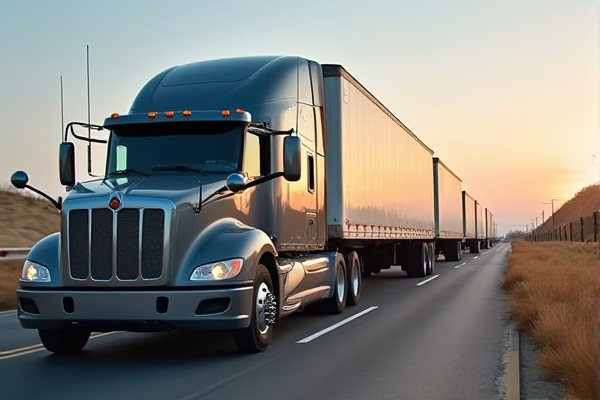
Several different entities can share responsibility in a trucking accident. These typically include the **truck driver** themselves, the **trucking company** employing the driver, the **owner of the truck** (which may be different than the trucking company, especially in leasing situations), the **company responsible for loading the cargo**, and potentially the **maintenance company** responsible for vehicle upkeep. In some cases, even the **manufacturer of a defective truck part** could be held liable.
Determining the precise role of each party requires a thorough investigation. We’ll examine the driver’s logs, maintenance records, dispatch communications, and the contracts between the various companies involved. This investigation often involves obtaining data from the truck’s Electronic Logging Device (ELD) and potentially hiring an accident reconstruction expert to analyze the cause of the crash.
How do I prove a company was negligent if they weren’t directly driving the truck?
Proving negligence against a non-driving party requires establishing a duty of care, a breach of that duty, and a direct link between the breach and your injuries. For example, a trucking company has a duty to properly vet its drivers, provide adequate training, and ensure its vehicles are properly maintained. If they fail to do so – for instance, by hiring a driver with a history of reckless driving or neglecting to repair faulty brakes – they may be liable for your damages.
We’ll gather evidence to demonstrate this negligence, such as the driver’s employment file, maintenance records, and safety inspection reports. We may also subpoena company policies and procedures to determine if they were followed. In some cases, we can even use federal regulations, like those outlined in 49 CFR § 395, to establish a standard of care and prove a violation contributed to the accident.
What if the trucking company claims the driver was an independent contractor?
This is a common defense tactic. Trucking companies often misclassify drivers as independent contractors to avoid liability for their actions. However, California law has strict rules about determining whether a worker is an employee or an independent contractor. The “ABC test,” outlined in Labor Code § 2775, considers factors like the level of control the company exercises over the driver’s work. If the company dictates the driver’s schedule, routes, or methods of operation, they are likely an employee, regardless of what the contract says.
We’ll carefully examine the driver’s contract, work history, and the company’s policies to determine their true employment status. If we can prove the driver was an employee, the trucking company can be held liable for their negligence under the doctrine of vicarious liability, as described in Civ. Code § 2338.
What is “respondeat superior” and how does it apply to trucking accidents?
“Respondeat superior” is a legal term that means “let the master answer.” In the context of trucking accidents, it means that the trucking company is legally responsible for the wrongful acts of its drivers committed within the scope of their employment. This is a critical concept because it allows us to hold the company accountable for the driver’s negligence, even if the company itself wasn’t directly at fault.
To establish respondeat superior, we need to prove that the driver was acting within the scope of their employment at the time of the accident. This typically means they were driving their assigned route, hauling cargo for the company, and following company policies. Any deviation from these duties could weaken our case, so it’s important to gather as much evidence as possible about the driver’s activities leading up to the crash.
How long do I have to file a lawsuit against multiple parties in a trucking accident?
California law provides a **two-year** window from the date of the truck accident to file a lawsuit. Because trucking companies often begin evidence destruction (like purging ELD data) as soon as the law allows, immediate filing is critical to preserve the integrity of the claim. This timeline applies to all potentially liable parties, including the driver, the trucking company, and any other responsible entities.
It’s important to act quickly to investigate the accident, gather evidence, and identify all potential defendants. Delaying the filing of a lawsuit could jeopardize your ability to recover compensation for your injuries. If the accident involved a government-owned vehicle or a dangerous road condition maintained by a public entity, a formal administrative claim **MUST** be presented within **6 months** (180 days). Failure to meet this strict deadline under the Government Tort Claims Act can result in the permanent loss of your right to recover.
What if the truck driver was following all traffic laws but still caused my accident?
Even if a truck driver didn’t violate any traffic laws, they can still be held liable for negligence. Negligence isn’t just about breaking the law; it’s about failing to exercise reasonable care under the circumstances. For example, a driver could be negligent if they were distracted, fatigued, or failed to properly inspect their vehicle before hitting the road.
We’ll investigate the driver’s actions leading up to the accident to determine if they breached their duty of care. This may involve reviewing their logs, dispatch communications, and any available video footage. We may also hire an accident reconstruction expert to analyze the cause of the crash and identify any contributing factors, such as driver error or mechanical failure.
What should I do if the insurance company asks me to give a recorded statement?
You should **never** give a recorded statement to an insurance company without first consulting with an attorney. Insurance companies are skilled at asking leading questions designed to minimize their liability. They may try to trick you into admitting fault or downplaying your injuries. A recorded statement can be used against you later in the claims process, so it’s best to let an attorney handle all communications with the insurance company.
We’ll handle all negotiations with the insurance company on your behalf, protecting your rights and maximizing your recovery. We’ll gather evidence, build a strong case, and fight for the compensation you deserve. Remember, the insurance company is not on your side; they are looking out for their own bottom line.
What if I have medical liens that need to be resolved after my settlement?
Medical liens are claims filed by healthcare providers for unpaid medical bills related to your injuries. These liens can significantly reduce your net recovery, so it’s important to address them early in the claims process. We’ll negotiate with the healthcare providers to reduce the amount of the liens and ensure they are paid fairly.
We have extensive experience dealing with medical liens and can often negotiate substantial discounts. We’ll also explore all available options for resolving the liens, such as Medicare Advantage or private health insurance subrogation. Our goal is to protect your recovery and ensure you receive the maximum compensation possible.
How does comparative fault affect my truck accident claim in San Diego?
California’s ‘pure’ comparative fault system applies to trucking claims. Even if a truck driver argues you shared responsibility, you can still recover damages; however, your total compensation will be reduced by your percentage of fault. For example, if you are found to be 20% at fault for the accident, your recovery will be reduced by 20%.
The insurance company will likely try to argue that you were partially responsible for the accident to minimize their payout. We’ll carefully investigate the circumstances of the crash to disprove their claims and demonstrate that the driver was solely responsible. We’ll gather evidence, such as witness statements and police reports, to support our case.
We have been successfully representing clients in San Diego for over 13 years. Trained by a former insurance defense attorney, I have intimate knowledge of how insurance companies evaluate, devalue, and deny claims. I understand the tactics they use and can build a strong case to protect your rights.