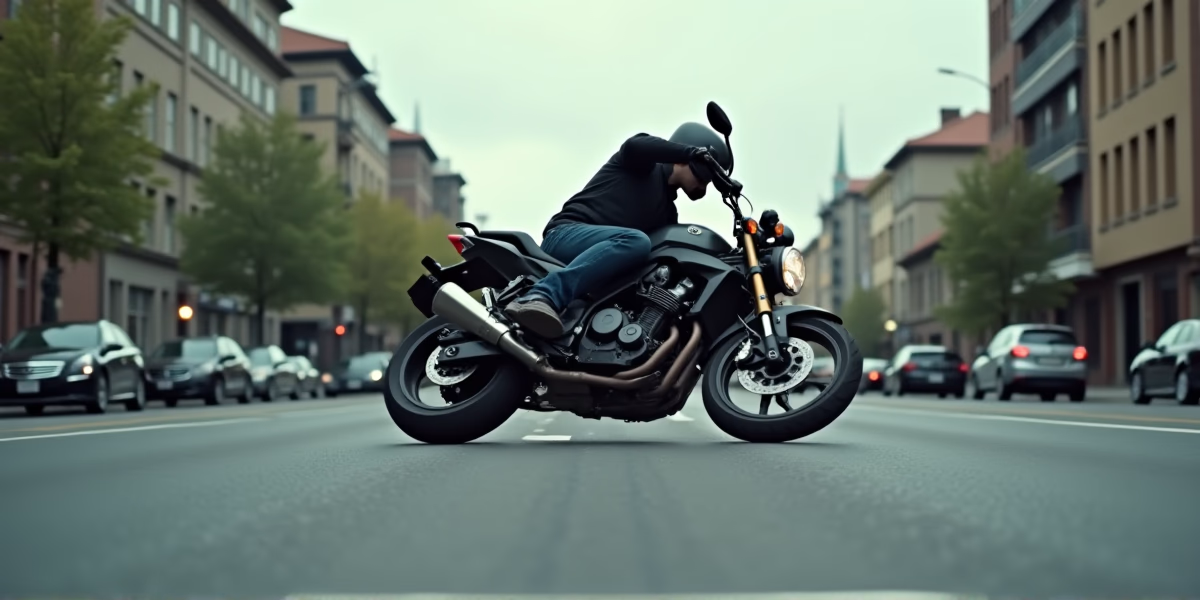
How Is Fault Determined At A Busy San Diego Intersection?

Determining fault in a motorcycle accident at a busy intersection can be incredibly complex. Unlike a simple rear-end collision, these accidents often involve multiple vehicles, conflicting witness statements, and the challenge of establishing who had the right-of-way. As a personal injury attorney practicing in San Diego for over 13 years, I’ve seen firsthand how insurance companies attempt to minimize their payouts by shifting blame onto the motorcyclist, even when the driver is clearly at fault. I was trained by a former insurance defense attorney, giving me intimate knowledge of how insurance companies evaluate, devalue, and deny claims.
The initial police report is a crucial starting point, but it’s rarely the final word. Officers often prioritize clearing traffic and may not have the time or resources to conduct a thorough investigation. They may rely on limited witness accounts or make assumptions based on superficial observations. It’s essential to understand that the police report is simply a record of what was reported at the scene, not a definitive finding of fault. We often conduct our own independent investigation, gathering evidence like traffic camera footage, interviewing witnesses, and reconstructing the accident to build a strong case.
What evidence is most helpful in proving fault at an intersection?
Several types of evidence can be critical in establishing fault. First, any available video footage – from traffic cameras, dashcams, or nearby businesses – is invaluable. This provides an objective record of the events leading up to the crash. Second, witness statements, if obtained promptly, can corroborate your version of events. Third, the physical evidence at the scene, such as skid marks, vehicle damage, and the position of the motorcycles and cars, can help reconstruct the accident and determine the point of impact. Finally, the police report, while not conclusive, can provide important details about the accident and the drivers involved.
Dashcam footage is particularly powerful, as it provides a neutral perspective of the accident. However, even without dashcam footage, we can often reconstruct the accident using the principles of physics and accident reconstruction experts. These experts analyze the damage to the vehicles, the road conditions, and other factors to determine the speed, direction, and impact forces involved in the collision.
What if the other driver claims I was speeding or lane splitting improperly?
Insurance companies frequently attempt to allege rider negligence, claiming you were speeding, lane splitting unsafely, or otherwise contributing to the accident. California law formally recognizes lane splitting as legal, defined as driving a motorcycle between rows of stopped or moving vehicles in the same lane. In accident litigation, proving that the maneuver was performed ‘in a safe and prudent manner’ is essential to rebutting claims of rider negligence. We’ll thoroughly investigate the accident to determine if your speed was reasonable and if your lane splitting was within legal parameters.
It’s important to remember that even if you were partially at fault, you may still be entitled to recover damages. California is a ‘pure’ comparative fault state, meaning you can recover compensation even if you shared some responsibility for the accident. However, your total recovery will be reduced by your percentage of fault.
How long do I have to file a claim after a motorcycle accident in San Diego?
Time is of the essence after a motorcycle accident. California law provides a **two-year** window from the date of the motorcycle accident to file a lawsuit for personal injury. Because evidence at a crash scene—such as skid marks or GoPro footage—can disappear quickly, immediate filing is critical to preserve the integrity of the claim. Delaying can also make it more difficult to locate and interview witnesses, and it may raise questions about the credibility of your claim.
Furthermore, if the accident involved a government-owned vehicle or a dangerous road condition, the deadlines are even shorter. If a motorcycle accident involves a government-owned vehicle or a dangerous road condition like loose gravel, potholes, or poorly marked construction zones, a formal administrative claim **MUST** be presented within **6 months** (180 days). Failure to meet this strict deadline under the Government Tort Claims Act can result in the permanent loss of your right to recover.
What if the at-fault driver has minimal insurance coverage?
Unfortunately, many drivers in California carry only the minimum required insurance coverage, which may not be sufficient to cover your medical bills, lost income, and other damages. In these cases, you may be able to pursue a claim under your own Uninsured Motorist (UM) coverage. California law requires insurers to offer Uninsured Motorist (UM) and Underinsured Motorist (UIM) coverage. For motorcyclists hit by a driver with minimum or no insurance, this coverage allows you to recover damages directly from your own policy up to your selected limits.
We’ll carefully review your insurance policy to determine the extent of your UM/UIM coverage and pursue a claim on your behalf. It’s important to act quickly, as there are strict deadlines for filing a UM/UIM claim.
What should I do if the insurance company asks me to give a recorded statement?
Insurance companies often request recorded statements from claimants shortly after an accident. While you may feel obligated to cooperate, it’s generally best to decline. These statements are often used to minimize their payouts or deny your claim altogether. They are skilled at asking leading questions and twisting your words to create inconsistencies or undermine your credibility.
It’s always advisable to consult with an attorney before giving any statement to the insurance company. We can advise you on your rights and protect your interests during the claims process.
What if I have medical liens from various providers?
Following a motorcycle accident, you may receive medical bills from various providers, and each provider may place a lien on your settlement. California law limits the amount a health insurance company or medical provider can claim from your settlement via a lien. These ‘anti-subrogation’ protections ensure that the injured rider retains a fair portion of their recovery after medical bills are addressed. We will negotiate with the medical providers to reduce the liens to a reasonable amount, ensuring you receive the maximum possible compensation.
What if the other driver was operating a borrowed vehicle?
If the at-fault driver was operating a vehicle borrowed from a friend or family member, you may be able to pursue a claim against the vehicle owner as well. A vehicle owner is liable if they permit an unfit or incompetent driver to operate their car, leading to a collision with a motorcyclist. This is a vital tool for recovery when the at-fault driver was operating a vehicle borrowed from a friend or family member.
What if the accident involved a left turn?
Accidents involving left turns are particularly dangerous for motorcyclists. Drivers intending to turn left must yield the right-of-way to all vehicles approaching from the opposite direction which are close enough to constitute a hazard. This statute is the primary basis for liability in ‘left-turn’ accidents, which are among the most common and deadly types of motorcycle crashes. We will investigate the accident to determine if the driver failed to yield the right-of-way, contributing to the collision.
What if the other driver was under the influence of alcohol?
If the other driver was driving under the influence of alcohol, it is unlawful for any person who is under the influence of alcohol to drive a vehicle. Proving intoxication or ‘malice’ allows for the pursuit of exemplary (punitive) damages, designed to punish the defendant and increase the total recovery beyond standard medical and wage losses. We will work with law enforcement to obtain any evidence of the driver’s intoxication, including breathalyzer results and witness statements.