How Do Expert Witnesses Help Truck Accident Cases?

That initial lowball offer is tragically common. Insurance companies are businesses, and their goal is to minimize payouts. They rely on a complex system of evaluation, often devaluing claims before a family even understands the full scope of their losses. That’s where expert witnesses become absolutely critical. They aren’t just helpful; they’re often the difference between a fair recovery and financial ruin.
Expert witnesses bring specialized knowledge to the table, knowledge that levels the playing field. They can analyze accident reconstruction data, medical records, and industry regulations to build a compelling case. But understanding *how* they do this, and what types of experts are most effective, is crucial for anyone facing a serious truck accident claim.
What types of expert witnesses are typically needed in a truck accident case?
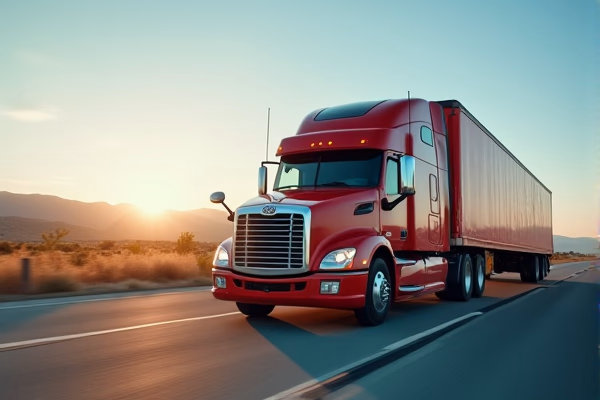
Several types of experts can be invaluable in truck accident litigation. Accident reconstructionists are often the first called upon. They examine the physical evidence – skid marks, vehicle damage, road conditions – to determine how the accident occurred and who was at fault. Their analysis can refute the insurance company’s narrative and establish the truck driver’s negligence. Beyond reconstruction, medical experts are essential. They assess the extent of the injuries, project future medical expenses, and testify to the long-term impact on the victim’s quality of life.
Furthermore, experts in trucking regulations and safety standards can be crucial. These individuals understand the complex federal and state rules governing commercial drivers, including hours of service, vehicle maintenance, and driver qualifications. They can identify violations that contributed to the accident, strengthening the claim against the trucking company. Finally, vocational rehabilitation experts can assess the victim’s ability to return to work and calculate lost earnings capacity.
The specific experts needed will vary depending on the facts of the case. A complex case involving a fatigued driver and a mechanical failure will require a more extensive team than a simple rear-end collision.
How do accident reconstructionists determine fault in a truck accident?
Accident reconstructionists employ a variety of techniques to analyze the cause of a truck accident. They start by gathering all available evidence, including police reports, witness statements, vehicle data recorders (often called “black boxes”), and photographs of the scene. They then use specialized software and engineering principles to recreate the accident, taking into account factors like speed, braking distance, and road conditions.
Crucially, they can analyze the truck’s Electronic Logging Device (ELD) data to verify the driver’s hours of service. Violations of federal **Hours of Service (HOS)** regulations dictate exactly how long a driver can be behind the wheel. Violations of these federal safety standards, often proven through Electronic Logging Device (ELD) data, are used to demonstrate driver fatigue. This data can be incredibly powerful in proving negligence, especially in cases where the driver was operating while fatigued. They also examine the vehicle’s maintenance records to identify any pre-existing mechanical issues that may have contributed to the crash.
Their final report is a detailed analysis of the accident, often presented with compelling visual aids like diagrams and simulations. This report can be used to refute the insurance company’s claims and establish the truck driver’s liability.
I’ve been practicing personal injury law in San Diego for over 13 years, and I’ve seen firsthand how insurance companies attempt to minimize their exposure. I was trained by a former insurance defense attorney, giving me intimate knowledge of how they evaluate, devalue, and deny claims. That experience is invaluable when selecting and preparing expert witnesses to effectively counter their tactics.
What role do medical experts play in quantifying damages?
Medical experts are critical in establishing the full extent of the victim’s injuries and the associated damages. They review the medical records, conduct independent medical examinations, and provide opinions on the nature and severity of the injuries. This includes not only the immediate medical expenses but also the future costs of treatment, rehabilitation, and ongoing care.
They can also testify to the long-term impact of the injuries on the victim’s quality of life, including pain and suffering, emotional distress, and loss of enjoyment of life. In cases of catastrophic injuries, they can assess the need for long-term care, assistive devices, and home modifications. Their testimony is essential in securing fair compensation for all of the victim’s losses.
Furthermore, they can provide a clear and concise explanation of the medical issues to the jury, making it easier for them to understand the severity of the injuries and the need for compensation. A well-qualified medical expert can be the difference between a modest settlement and a substantial verdict.
How do trucking regulation experts help prove negligence?
Trucking is a heavily regulated industry, and violations of these regulations can be strong evidence of negligence. Experts in trucking regulations can review the trucking company’s safety records, driver logs, and maintenance schedules to identify any violations that may have contributed to the accident. This includes violations of federal hours of service rules, vehicle maintenance requirements, and driver qualification standards.
They can also testify to the industry standards of care and whether the trucking company met those standards. For example, they can explain the importance of pre-trip inspections and the consequences of failing to properly maintain the vehicle. Their testimony can demonstrate that the trucking company was negligent in its oversight of its drivers and vehicles, increasing the likelihood of a successful claim.
In San Diego, we often see cases where trucking companies cut corners on safety to save money. An expert in trucking regulations can expose these violations and hold the company accountable for their negligence.
What is the process for finding and retaining qualified expert witnesses?
Finding and retaining qualified expert witnesses requires careful consideration. It’s not enough to simply hire the first expert you find online. You need to find someone with the right credentials, experience, and expertise. I typically start by researching experts in the relevant field and reviewing their qualifications and publications.
I then conduct interviews to assess their knowledge, communication skills, and ability to explain complex concepts in a clear and concise manner. It’s also important to ensure that they are unbiased and willing to testify truthfully in court. Once I’ve identified a qualified expert, I work with them to develop a comprehensive report and prepare them for deposition and trial.
The cost of hiring expert witnesses can be significant, but it’s a necessary investment in a successful truck accident claim. The potential recovery far outweighs the expense of retaining qualified experts.
What happens if the insurance company disputes the expert’s testimony?
Insurance companies often attempt to discredit expert testimony by challenging their qualifications, methodology, or conclusions. They may hire their own experts to offer a conflicting opinion. This is where effective preparation and cross-examination become critical. I work closely with my experts to anticipate the insurance company’s challenges and prepare them to defend their opinions.
I also conduct thorough cross-examination of the insurance company’s experts, exposing any weaknesses in their methodology or biases. The judge ultimately decides whether to admit the expert’s testimony, and a skilled attorney can significantly influence that decision. It’s important to remember that the jury will weigh the credibility of all witnesses, including the experts, when determining the outcome of the case.
Furthermore, I often use the discovery process to obtain information about the insurance company’s experts, including their qualifications, prior testimony, and any potential conflicts of interest.
How can a recorded statement to the insurance company impact my claim?
Recorded statements to insurance companies are often traps. While they may seem harmless, they are designed to gather information that can be used to devalue or deny your claim. Insurance adjusters are trained to ask leading questions and elicit statements that can be used against you later. It’s crucial to avoid giving a recorded statement without first consulting with an attorney.
They will often focus on minimizing the severity of the accident or suggesting that you were at fault. They may also ask about pre-existing conditions or prior injuries, attempting to attribute your current injuries to something other than the truck accident. Even seemingly innocent statements can be twisted and used against you.
If you are contacted by an insurance company requesting a recorded statement, politely decline and refer them to your attorney. I will handle all communication with the insurance company on your behalf, protecting your rights and ensuring that your statement is not used to harm your claim.
What is a medical lien and how does it affect my truck accident settlement?
A medical lien is a legal claim against your settlement proceeds to cover the costs of medical treatment you received as a result of the truck accident. Healthcare providers often place liens on your settlement to ensure that they are compensated for their services. These liens can significantly reduce the amount of money you ultimately receive.
The amount of the lien is typically based on the total cost of treatment, including bills, co-pays, and other expenses. However, liens can be negotiated, especially if the healthcare provider was at fault for the accident or if the treatment was excessive or unnecessary. I have extensive experience negotiating medical liens with healthcare providers, often reducing the amount owed by a substantial margin.
It’s important to understand your rights and obligations regarding medical liens. I will carefully review all liens placed on your settlement and work to protect your interests.
What are the government claim deadlines if the accident involved a public entity?
If a truck accident involves a government-owned vehicle or a dangerous road condition maintained by a public entity, a formal administrative claim **MUST** be presented within **6 months** (180 days). Failure to meet this strict deadline under the Government Tort Claims Act can result in the permanent loss of your right to recover. This is a critical deadline that must be strictly adhered to.
The claim must be submitted to the appropriate government agency and include detailed information about the accident, including the date, time, location, and the names of all parties involved. It’s also important to include a detailed description of your injuries and damages. The government agency will then investigate the claim and either accept or deny it.
If the claim is denied, you may have the right to file a lawsuit in court. However, you must do so within a specific timeframe, typically six months from the date of the denial. I have extensive experience handling government claims and ensuring that all deadlines are met.
What is a policy limits tender and how should I respond?
A policy limits tender is an offer from the insurance company to settle your claim for the maximum amount of their policy. While it may seem like a generous offer, it’s important to carefully consider whether it adequately compensates you for all of your losses. Insurance companies often make policy limits tenders early in the claim process to avoid going to trial.
Before accepting a policy limits tender, I will thoroughly evaluate your damages, including medical expenses, lost wages, pain and suffering, and future care costs. I will also consider the potential for additional recovery from other sources, such as the truck driver or the trucking company. If the policy limits are insufficient to cover your losses, I will advise you to reject the tender and pursue litigation.
It’s important to remember that accepting a policy limits tender releases the insurance company from any further liability. Therefore, it’s crucial to make an informed decision based on a complete understanding of your rights and options.
How do dashcam and digital evidence sources impact my truck accident case?
Dashcam footage, Electronic Control Module (ECM) data, and Electronic Logging Device (ELD) data are invaluable sources of evidence in truck accident cases. Dashcam footage can provide a clear and objective record of the accident, often revealing the truck driver’s negligence. ECM data can reveal the truck’s speed, braking distance, and other critical information. ELD data can verify the driver’s hours of service and identify any violations of federal regulations.
However, it’s important to obtain this evidence quickly, as it can be lost or overwritten. I will immediately send a spoliation letter to the trucking company, demanding that they preserve all relevant evidence. I will also work with forensic experts to analyze the data and ensure that it is properly presented in court.
In San Diego, we often see cases where trucking companies attempt to hide or destroy evidence. I am skilled at uncovering this evidence and holding them accountable for their actions.