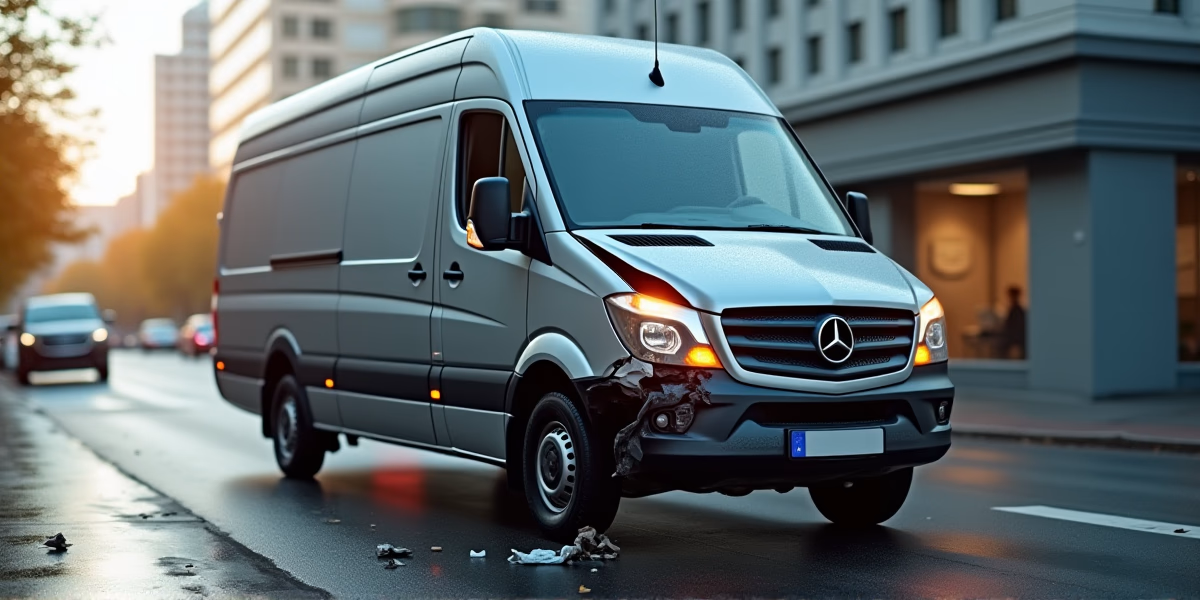
How Do Safety Ratings Affect Truck Accident Cases?

Truck accident litigation is complex. It’s not simply about proving the driver was at fault. It’s about uncovering the systemic issues that contributed to the crash, and holding all responsible parties accountable. This often includes the trucking company, the truck manufacturer, and even maintenance providers. A crucial piece of this puzzle is the truck’s safety rating, and how it impacts the legal arguments we can make on your behalf.
Federal and state agencies assign safety ratings to trucking companies based on a variety of factors, including crash history, driver qualifications, vehicle maintenance, and compliance with safety regulations. These ratings are publicly available and can provide valuable insight into a company’s commitment to safety. A poor safety rating is a red flag, suggesting a pattern of negligence that could significantly increase the potential recovery in your case.
I’ve been practicing personal injury law in San Diego for over 13 years, and I’ve seen firsthand how insurance companies attempt to downplay the importance of safety ratings. They often argue that a single accident doesn’t necessarily indicate a systemic problem. However, my experience—and I was trained by a former insurance defense attorney, giving me intimate knowledge of how insurance companies evaluate, devalue, and deny claims—tells me otherwise. A history of safety violations is powerful evidence of negligence and can be used to demonstrate the trucking company’s reckless disregard for public safety.
What do the different truck safety ratings mean?
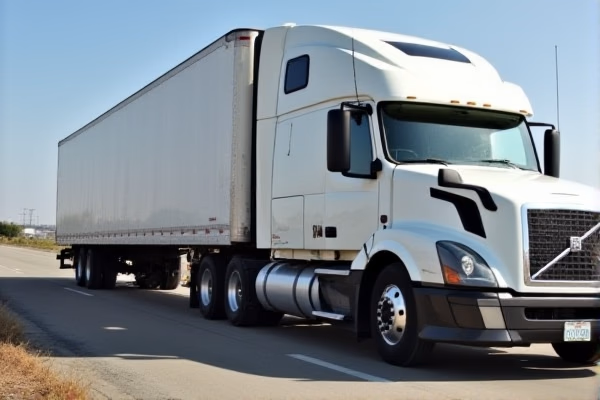
The Federal Motor Carrier Safety Administration (FMCSA) uses a system of safety ratings to assess the performance of trucking companies. These ratings range from “Satisfactory” to “Unsatisfactory.” A “Satisfactory” rating indicates that the company meets minimum safety standards, while an “Unsatisfactory” rating suggests significant safety deficiencies. It’s important to understand that even a “Satisfactory” rating doesn’t guarantee a company is completely safe. It simply means they haven’t been flagged for major violations recently.
Beyond the basic ratings, the FMCSA also assigns companies a Safety Measurement System (SMS) score. This score is based on a variety of factors, including crash rates, inspection violations, and driver behavior. A higher SMS score indicates a greater risk of future accidents. We use these scores to build a stronger case against negligent trucking companies.
How can a poor safety rating help my truck accident claim?
A poor safety rating can be used in several ways to strengthen your claim. First, it demonstrates a pattern of negligence on the part of the trucking company. This can be used to argue that the company was aware of the risks associated with its operations and failed to take adequate steps to prevent accidents. Second, it can be used to show that the company prioritized profits over safety. This is particularly damaging in a jury trial, as it suggests the company knowingly put drivers and the public at risk.
Furthermore, a poor safety rating can be used to establish punitive damages. Punitive damages are awarded to punish the defendant for egregious misconduct and deter similar behavior in the future. If we can prove that the trucking company acted with reckless disregard for safety, we may be able to recover additional compensation on top of your economic damages.
Does the truck’s safety technology matter in a crash?
Absolutely. Modern trucks are equipped with a variety of safety features designed to prevent accidents, such as automatic emergency braking (AEB), lane departure warning systems, and blind spot monitoring. If a truck was equipped with these features but they were not properly maintained or functioning at the time of the crash, it could be considered negligence. Similarly, if the truck lacked essential safety features that are commonly available, it could be a sign of the company’s disregard for safety.
We work with accident reconstruction experts to analyze the truck’s event data recorder (EDR) and determine whether these safety features were functioning properly. This data can be crucial in establishing liability and maximizing your recovery.
What if the truck passed inspection before the accident?
Passing a DOT inspection doesn’t automatically absolve the trucking company of responsibility. Inspections are often cursory and may not uncover all safety defects. Moreover, a truck can pass inspection one day and develop a mechanical problem the next. We investigate the truck’s maintenance records to determine whether the company was following proper maintenance procedures and addressing known safety issues.
It’s also important to remember that inspections are only as good as the inspector. If the inspector was negligent in performing the inspection, it could be considered a contributing factor to the accident. We’ll explore all possible avenues to hold the responsible parties accountable.
How long do I have to file a claim after a truck accident in California?
In California, you generally have **two years** from the date of the truck accident to file a lawsuit. Because trucking companies often begin evidence destruction (like purging ELD data) as soon as the law allows, immediate filing is critical to preserve the integrity of the claim. CCP § 335.1
What should I do if the accident involved a government vehicle or roadway?
If a truck accident involves a government-owned vehicle or a dangerous road condition maintained by a public entity, a formal administrative claim **MUST** be presented within **6 months** (180 days). Failure to meet this strict deadline under the Government Tort Claims Act can result in the permanent loss of your right to recover. Gov. Code § 911.2
What if the driver was classified as an independent contractor?
California’s ‘ABC test’ determines if a delivery driver (Amazon/FedEx) is an employee or contractor. Even if labeled a ‘contractor,’ a company may be liable if they exercise control over the driver’s work, a key factor in San Diego delivery truck litigation. Labor Code § 2775
Can the trucking company be held liable for the driver’s negligence?
Under the doctrine of **vicarious liability** (respondeat superior), a principal is responsible to third persons for the negligence of their agent in the transaction of business. This holds the trucking company legally liable for the wrongful acts of its drivers committed within the scope of their employment. Civ. Code § 2338
What are the speed limits for commercial trucks in California?
In California, commercial trucks (including semi-tractors with three or more axles) are strictly prohibited from exceeding **55 miles per hour** on any highway. In San Diego freeway crashes, proving a violation of this speed limit is a primary tool for establishing statutory negligence. CVC § 22406