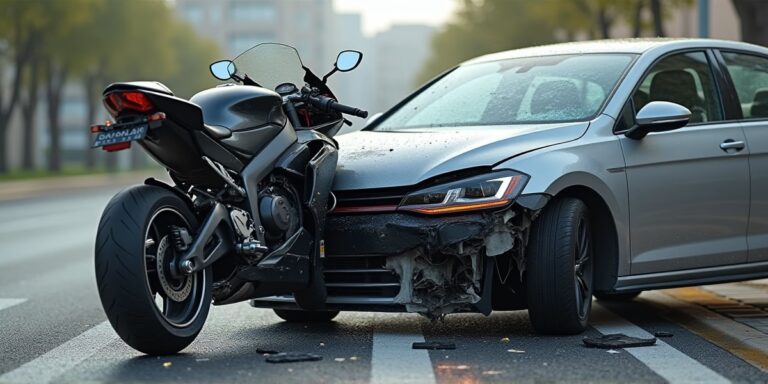
Can Heavy Traffic Conditions Increase A Drivers Duty Of Care?

This scenario highlights a common issue in motorcycle accident claims: the interplay between heavy traffic and a driver’s duty of care. While congested conditions don’t *excuse* negligent driving, they absolutely *increase* the level of caution required. California drivers are legally obligated to operate their vehicles safely under all circumstances, and that obligation becomes heightened when visibility is reduced, reaction times are compressed, and the risk of collisions increases due to the sheer volume of vehicles. It’s a misconception that simply being in traffic absolves a driver of responsibility for causing an accident.
The concept hinges on the legal principle of “reasonable care.” What constitutes reasonable care in open highway conditions differs drastically from what’s expected during a standstill commute. In heavy traffic, drivers must increase their following distance, reduce their speed, signal lane changes well in advance, and be hyper-aware of their surroundings. Failure to do so can be considered negligence, even if no specific traffic law was violated. The insurance company will attempt to portray the situation as a shared responsibility, but a skilled attorney can demonstrate how the other driver’s failure to exercise increased care was the primary cause of the collision.
I’ve spent over 13 years representing motorcyclists injured in San Diego, and I’ve seen firsthand how insurance companies leverage traffic conditions to minimize payouts. Trained by a former insurance defense attorney, I understand their tactics intimately – how they evaluate claims, devalue injuries, and deny legitimate compensation. They’ll often focus on the difficulty of navigating traffic as a justification for the accident, rather than the at-fault driver’s actions.
What evidence can prove the other driver was negligent in heavy traffic?
Establishing negligence in heavy traffic requires a multi-faceted approach to evidence gathering. Police reports are a starting point, but often lack the detail needed to fully reconstruct the event. Witness statements are invaluable, particularly if they corroborate your account of the other driver’s actions – speeding, aggressive lane changes, distracted driving, or failure to yield. Dashcam footage, if available, is compelling evidence. Increasingly, vehicles are equipped with Event Data Recorders (EDR) that capture critical data like speed, braking patterns, and steering angles immediately before the collision. We routinely subpoena this data to build a strong case.
Furthermore, expert reconstruction analysis can demonstrate how the other driver’s actions deviated from the standard of care expected in those specific traffic conditions. This may involve analyzing traffic flow patterns, sight lines, and the other driver’s reaction time. It’s crucial to document the traffic density at the time of the accident, as this directly supports the argument that a higher degree of caution was required.
How does California’s comparative fault law apply when traffic is a factor?
California operates under a “pure” comparative fault system, meaning you can recover damages even if you were partially at fault for the accident. However, your recovery will be reduced by your percentage of fault. The insurance company will aggressively attempt to assign you a portion of the blame, often citing factors like speed or positioning in relation to other vehicles. It’s essential to counter these arguments with evidence demonstrating that the other driver’s negligence was the primary cause of the collision, despite the challenging traffic conditions. Civ. Code § 1714 outlines the principles of comparative negligence in California.
What if the other driver claims they couldn’t see me due to traffic?
The argument that the other driver “didn’t see you” is a common defense tactic, particularly in heavy traffic. However, this doesn’t automatically absolve them of responsibility. Drivers have a duty to maintain a proper lookout and exercise reasonable care to avoid collisions, regardless of visibility. If they were speeding, distracted, or otherwise operating their vehicle negligently, they are liable for the accident, even if they claim they didn’t see you. We can demonstrate this by analyzing the other driver’s speed, braking distance, and the availability of alternative evasive maneuvers.
What is the statute of limitations for filing a motorcycle accident claim in California?
In California, you have a **two-year** window from the date of the motorcycle accident to file a lawsuit for personal injury. Because evidence at a crash scene—such as skid marks or GoPro footage—can disappear quickly, immediate filing is critical to preserve the integrity of the claim. CCP § 335.1 governs the statute of limitations for personal injury claims in California. Delaying action can jeopardize your ability to recover full compensation.
What should I do if the accident involved a government vehicle or roadway hazard?
If a motorcycle accident involves a government-owned vehicle or a dangerous road condition like loose gravel, potholes, or poorly marked construction zones, a formal administrative claim **MUST** be presented within **6 months** (180 days). Failure to meet this strict deadline under the Government Tort Claims Act can result in the permanent loss of your right to recover. Gov. Code § 911.2 details the requirements for filing a claim against a government entity in California.
How can a recorded statement to the insurance company impact my claim?
Insurance companies routinely request recorded statements from claimants shortly after an accident. While you are not legally obligated to provide one, they often use these statements to identify inconsistencies or potential weaknesses in your case. It’s crucial to consult with an attorney *before* agreeing to a recorded statement. They can advise you on the potential risks and prepare you for the questions you may be asked. Insurance adjusters are trained to elicit information that minimizes their liability, and a poorly worded statement can significantly damage your claim.
What if I have medical liens that need to be resolved after my settlement?
Medical liens arise when healthcare providers seek reimbursement for treatment rendered after an accident. California law limits the amount a health insurance company or medical provider can claim from your settlement via a lien. These ‘anti-subrogation’ protections ensure that the injured rider retains a fair portion of their recovery after medical bills are addressed. Civ. Code § 3040 provides the legal framework for medical lien resolution in California.
What if the at-fault driver was operating a borrowed vehicle?
A vehicle owner is liable if they permit an unfit or incompetent driver to operate their car, leading to a collision with a motorcyclist. This is a vital tool for recovery when the at-fault driver was operating a vehicle borrowed from a friend or family member. CACI No. 724 outlines the legal standards for negligent entrustment claims in California.
What if the other driver made an unsafe lane change or left turn?
Drivers intending to turn left must yield the right-of-way to all vehicles approaching from the opposite direction which are close enough to constitute a hazard. This statute is the primary basis for liability in ‘left-turn’ accidents, which are among the most common and deadly types of motorcycle crashes. CVC § 21801 is the key statute governing these types of accidents in California.