
Can I File A Claim Against My Own Motorcycle Insurance?

Many motorcyclists in California mistakenly believe their own insurance only covers damage they *cause* to others. This is a common misconception. While your policy certainly protects you from third-party lawsuits, it also includes provisions for your own injuries and damages, particularly through Uninsured Motorist (UM) and Underinsured Motorist (UIM) coverage. Understanding these options is critical, especially in a state like California where a significant percentage of drivers are either uninsured or carry minimal liability limits.
The key is to understand the different types of coverage available. Collision coverage will pay for damage to your motorcycle, regardless of fault, subject to your deductible. Medical Payments (MedPay) coverage can help cover immediate medical expenses, regardless of who caused the accident. However, the most valuable coverage for many riders is UM/UIM. If you’re hit by an uninsured driver, UM coverage steps in to pay your medical bills, lost wages, and pain and suffering, up to your policy limits. If the at-fault driver has insurance, but their limits are insufficient to cover your damages, UIM coverage kicks in to bridge the gap.
I’ve been practicing personal injury law in San Diego for over 13 years, and I’ve seen firsthand how insurance companies attempt to minimize payouts, even to their own policyholders. Trained by a former insurance defense attorney, I have intimate knowledge of how these companies evaluate, devalue, and deny claims. They often look for ways to dispute liability, question the extent of your injuries, or argue that you were partially at fault, even if the accident wasn’t your responsibility.
What should I do immediately after an accident if I want to file a claim with my own insurance?
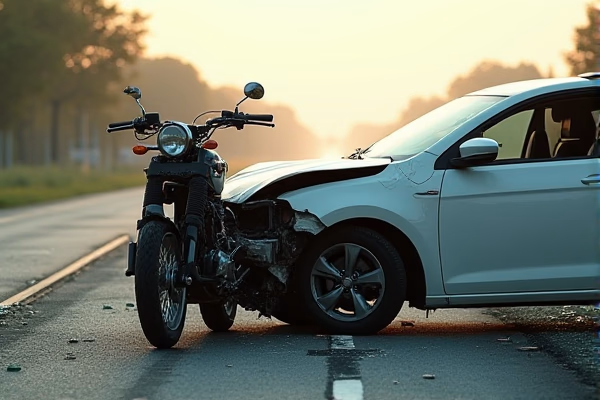
The first step is to document everything. Take photos of the damage to your motorcycle, the other vehicle, and the accident scene. Obtain the other driver’s insurance information, and if possible, get contact information from any witnesses. Most importantly, seek medical attention immediately, even if you don’t feel seriously injured. Many injuries, like internal bleeding or concussions, may not be immediately apparent.
Next, report the accident to your insurance company as soon as possible. Be careful about what you say during this initial report. Stick to the facts and avoid speculating about fault. You are not required to provide a recorded statement at this stage, and in fact, it’s often best to consult with an attorney before doing so. Insurance companies are skilled at using recorded statements to find loopholes and deny claims.
What if the accident was partially my fault? Can I still file a claim?
California is a ‘pure’ comparative fault state, meaning you can still recover damages even if you were partially at fault for the accident. However, your total compensation will be reduced by your percentage of fault. For example, if you sustained $100,000 in damages and were found to be 20% at fault, you would only be able to recover $80,000. Civ. Code § 1714 governs this process. The insurance company will likely attempt to maximize your percentage of fault to reduce their payout, so it’s crucial to have an experienced attorney on your side to challenge their assessment.
How long do I have to file a claim with my own insurance company?
The timeframe for filing a claim with your own insurance company is generally dictated by the terms of your policy, but it’s essential to act quickly. While there isn’t a strict statutory deadline like there is for filing a lawsuit against the at-fault driver, delays can jeopardize your claim. Evidence at a crash scene—such as skid marks or GoPro footage—can disappear quickly, immediate filing is critical to preserve the integrity of the claim.
What if my insurance company denies my claim?
If your insurance company denies your claim, don’t give up. There are several reasons why a claim might be denied, including disputes over liability, insufficient evidence, or pre-existing conditions. You have the right to appeal the denial, and an attorney can help you gather additional evidence, negotiate with the insurance company, and potentially file a lawsuit to enforce your rights. It’s important to remember that insurance companies are businesses, and they are often motivated by profit. They may deny claims in an attempt to save money, even if you have a legitimate case.
What is Uninsured/Underinsured Motorist (UM/UIM) coverage, and why is it so important for motorcyclists?
UM/UIM coverage is a critical protection for motorcyclists in California. As mentioned earlier, it covers your damages if you’re hit by an uninsured driver or a driver whose insurance limits are insufficient to cover your losses. Ins. Code § 11580.2 outlines the requirements for offering this coverage. Given the high rate of uninsured drivers in some parts of San Diego, having adequate UM/UIM coverage can be the difference between recovering your full damages and being left to pay for medical bills and lost wages out of pocket.
What role does a dashcam or other digital evidence play in my claim?
Dashcam footage, ECM/EDR (Event Data Recorder) data, and even GPS information can be invaluable in proving liability and supporting your claim. These types of evidence provide objective documentation of the accident, which can be particularly helpful in disputes over fault. It’s important to preserve this evidence as soon as possible, as it can be overwritten or lost. An attorney can help you obtain and analyze this data to strengthen your case.
What if I was a delivery driver at the time of the accident?
If you were working as a delivery driver at the time of the accident, you may be entitled to workers’ compensation benefits. However, workers’ compensation is generally the exclusive remedy against your employer, though separate claims may exist against negligent third-party drivers. Labor Code § 3600 details these rights. An attorney can help you navigate the complexities of both workers’ compensation and third-party claims.
Can I pursue a lawsuit against a negligent third party even if I’m receiving workers’ compensation benefits?
Yes, California law preserves your right to pursue a separate civil claim against a negligent third party (such as another driver) whose actions contributed to the motorcycle accident, even if you are currently receiving workers’ compensation benefits. Labor Code § 3852 protects this right. This allows you to recover damages beyond what is available through workers’ compensation, such as pain and suffering and loss of enjoyment of life.
What if the motorcycle part that failed was defective?
Manufacturers and distributors are strictly liable for injuries caused by a product that has a manufacturing, design, or warning defect. This applies to failed motorcycle brakes, defective tires, or helmets that did not perform as advertised during a crash. CACI No. 1200 provides the legal framework for these product liability claims. An attorney can help you investigate the defect and pursue a claim against the responsible parties.
What are medical liens, and how do they affect my settlement?
Medical liens are claims that healthcare providers have against your settlement to recover the costs of medical treatment they provided. California law limits the amount a health insurance company or medical provider can claim from your settlement via a lien. Civ. Code § 3040 outlines these ‘anti-subrogation’ protections. An attorney can help you negotiate with medical providers to reduce the amount of the lien and ensure that you retain a fair portion of your recovery.